 English
  日本語
日本語  Deutsch


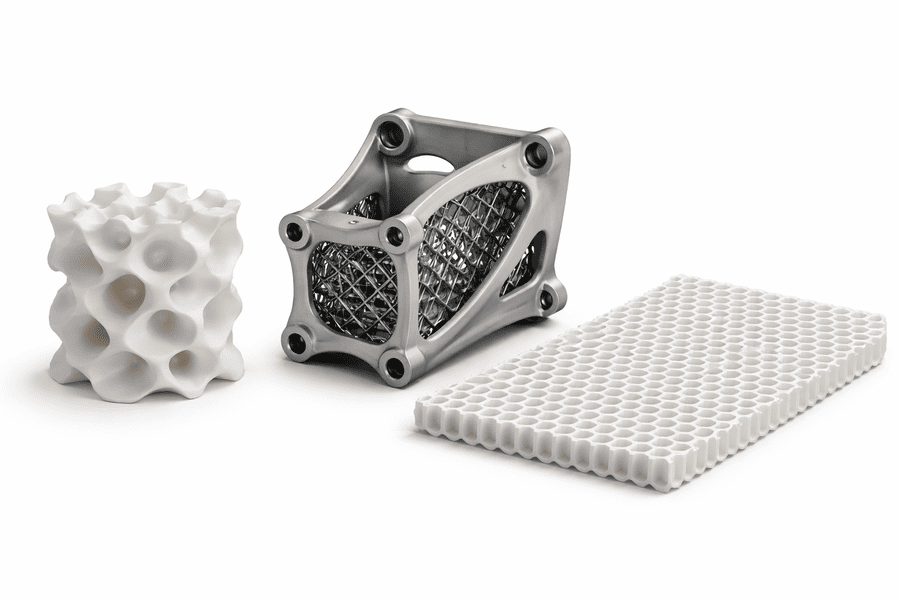
Lightweighting is one of the fastest-growing priorities in product design. Less mass can mean lower material costs, better fuel efficiency, faster movement, and new performance opportunities. Two of the most powerful ways to remove weight while keeping useful stiffness and strength are lattice and honeycomb structures. Both are cellular geometries with networks of beams, walls, or continuous surfaces that replace solid volume with an engineered pattern.
Benefits of Lattice and Honeycomb Structures
Lattices and honeycombs are widely used because they give designers a favorable trade-off between mass and mechanical function:
• High strength-to-weight ratio. By placing material where it carries load and removing it elsewhere, cellular structures maintain stiffness and strength using much less material than a solid block.
• Energy absorption and impact resistance. Well-designed cellular geometries deform progressively under load, which helps dissipate energy in crash or impact scenarios.
• Tailored stiffness and anisotropy. Designers can orient cells or vary densities to create parts that are stiff in a required direction and compliant elsewhere.
• Thermal and acoustic properties. Open lattices can promote cooling or airflow; certain honeycomb arrangements provide sound damping.
• Part consolidation. Complex assemblies often can be redesigned as a single printed part with internal lattices replacing multiple bonded or machined components.
• Material savings and sustainability. Less raw material per part, especially in high-value metals, reduces cost and embodied energy.
Basic Concepts and Terminology
• Unit cell: The smallest repeating building block of a lattice or honeycomb (e.g., a single octet cell or a hexagon).
• Relative density (or porosity): The ratio of the cellular structure’s solid volume to the volume of the same bounding envelope. Lower relative density = lighter part.
• Wall thickness: The thickness of beams (struts) or faces (walls) that make up the cell.
• Open-cell vs. closed-cell: Open cells allow fluid or powder to pass through; closed cells trap material or fluids inside.
• Isotropy vs. anisotropy: Isotropic lattices behave similarly in all directions; anisotropic patterns have directionally dependent stiffness.
• Graded (or functionally graded): Changing the unit cell size or relative density across the part to match local loads or functional needs.
Types of Lattices
Beam Lattices (Periodic)
These are networks of rods connected at nodes. Examples include body-centred cubic (BCC), face-centered cubic (FCC), and octet truss. They’re easy to parameterize, good for directional loads, and common in metal AM.
Use when: You need high compressive or bending strength and can control strut thickness precisely.
Triply Periodic Minimal Surfaces (TPMS)
Continuous, smooth surfaces like the gyroid, Schwarz, and diamond patterns. TPMS have no discrete struts; instead, they form continuous walls that distribute stress smoothly and often avoid stress concentrations. They are good for fatigue resistance and fluid flow.
Use when: You want isotropic behavior, better surface continuity, or improved washout of trapped powder in metal prints.
Graded Lattices
Unit cell size, orientation, or density varies through the part. This is powerful for matching load paths, improving comfort in wearables, or making lightweight stiff cores near high stress.
Use when: Loads are nonuniform, and you want local reinforcement without adding global mass.
Stochastic/Foam-Like Lattices
Randomized cellular structures mimic natural foams. They can be excellent for vibration damping and impact energy absorption, but are less predictable for structural design.
Use when: You need damping or biomimetic porosity (e.g., for implants).
Each lattice type has tradeoffs in predictability, manufacturability, and computational cost. Explicitly modeling a dense lattice in a finite element analysis is expensive; designers often use homogenized material models (effective properties) when doing early optimization.
Honeycomb Patterns Explained
Honeycombs are typically 2D or prismatic cellular patterns inspired by the hexagonal cells of natural bees’ combs. They’re widely used in sandwich panels and thin-walled structures.
2D (Hexagonal) Honeycomb
A planar array of hexagonal voids bounded by thin walls. Excellent in-plane stiffness-to-weight for panels and shells, often used in aerospace and transportation skins. They’re efficient for loads distributed across a surface and provide good bending stiffness when used as a core between face sheets.
3D/Prismatic Honeycomb
Extends honeycomb along a third dimension with prismatic cells or corrugated walls. These can provide directional stiffness, very stiff along one axis while lighter in others.
When to Prefer Honeycombs vs. Lattices
Honeycombs excel for panel and shell applications where loads are mostly in the plane of the faces. Lattices are better for volumetric parts needing isotropic performance or internal load paths.
Honeycombs are easy to design and often generate smaller file sizes than fully explicit lattices, which can help with CAD handling and slicing.
Do Lattice and Honeycomb Structures Reduce Mechanical Performance
Short answer: not necessarily, and often they improve performance relative to mass. But the outcome depends entirely on how they’re designed and manufactured.
Strength Per Unit Mass
Properly designed cellular structures often have equal or higher strength for the same mass compared to a solid section that’s simply scaled down. Designers exploit geometry: placing material in load paths and making the rest void.
Directionality and Load Type
If a lattice is anisotropic and loads come from an unexpected direction, performance can be worse. That’s why matching lattice orientation and grading to anticipated loads is crucial.
Buckling and Fatigue
Thin struts can buckle or fail under cyclic loading. TPMS or slightly thicker struts with fillets can improve buckling resistance and fatigue life. For high-cycle applications, you should validate with fatigue testing.
Manufacturing Defects
In metal AM, trapped powder, surface roughness, or residual stress from printing can reduce mechanical performance. Proper process planning (supporting, heat treatment, post-machining, or infiltration) is often required.
Scale and Minimum Feature Size
If the chosen cell size is too small for the process’s minimum feature capability, the printed lattice will not perform as intended, and walls may fuse or break, reducing strength.
Design Conservatism
Using homogenized properties or conservative safety factors until testing validates the design reduces the risk of unexpected failures.
In practice, many successful applications demonstrate clear advantages: aerospace brackets with internal lattices that save weight while meeting stiffness targets; orthopedic implants using porous lattices to allow bone in-growth without compromising load capacity; and automotive crash-absorbing components that use graded cellular cores. The consistent theme is informed design + validation: simulate, prototype, test, iterate.
 0
0