 English
  日本語
日本語  Deutsch


What MIT Developed
MIT CSAIL researchers recently brought a long-forgotten idea back to life: a three-sided zipper concept that can transform flexible strips into rigid, load-bearing forms. The project began with an old patent idea from MIT Professor Bill Freeman, who first imagined the concept in the 1980s as a way to switch objects such as chairs, tents, and purses between soft and rigid states. His original proposal was rejected, but decades later, MIT researchers revisited it with modern digital tools and 3D printing, turning the idea into a practical system they call the Y-zipper.
The new system is more than a novelty. MIT describes it as an automated design tool plus an adaptable fastener that users can customize in software and then 3D print in plastics. Instead of requiring manual fabrication and awkward assembly, the system generates a three-sided zipper structure that can be zipped together into a compact, stronger shape and then reversed again when needed. In other words, the Y-zipper is designed for rapid and reversible assembly, not just for fastening.
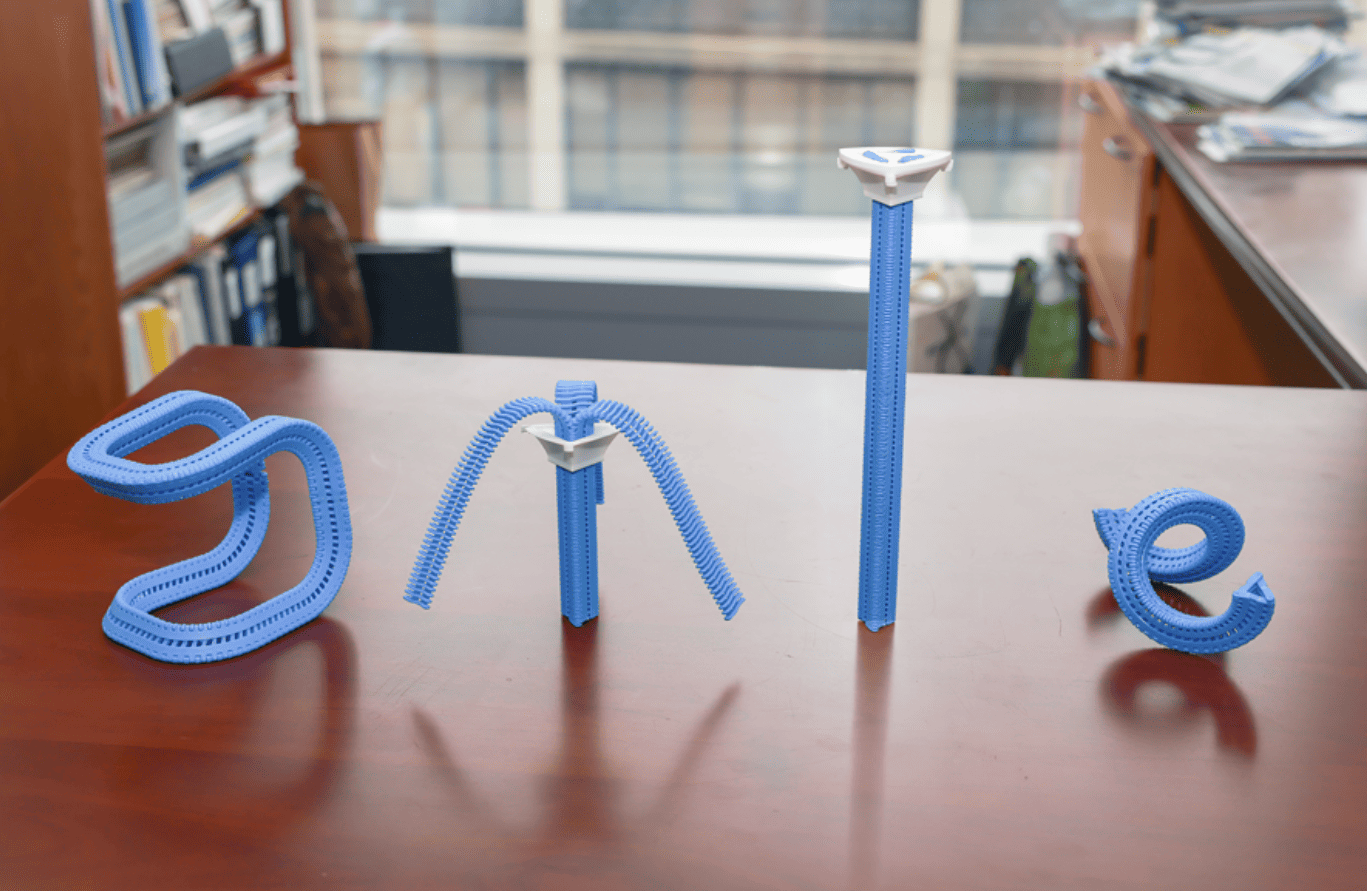
Image Source: MIT News
Why This Matters for 3D Printing
For 3D printing, the most interesting part of the Y-zipper is not simply the shape itself, but the design logic behind it. MIT’s software lets users define how the zipper will behave when closed, including the length of each strip and the direction and angle of the bend. The system also offers four “motion primitives”: straight, bent, coiled, and twisted. That means the final object is not just printed as a static part; it is designed as a structure with movement built into its geometry from the start.
That matters because many 3D printed objects are still treated as fixed forms. Designers print a part, and then assembly, rigidity, or motion usually comes from extra fasteners, hinges, or labor-intensive post-processing. The Y-zipper points toward a different model: one where geometry itself becomes a functional mechanism. It is a compelling direction for additive manufacturing because 3D printing is especially strong at producing complex shapes that would be difficult or expensive to make with traditional methods. The Y-zipper shows how that advantage can be used not only for appearance, but also for transformation and structural control.
Another reason the project matters is that it demonstrates an approach to tunable stiffness. MIT’s researchers specifically framed the project as a way to create items whose stiffness can be changed in a reversible way. That is a meaningful shift for additive manufacturing, especially in products that need to be compact for storage, then quickly deployed in the field. Instead of designing one object for one state, the Y-zipper suggests that a printed object can be designed for multiple states and multiple uses.
Potential Applications
MIT’s article shows several practical demonstrations that help explain the promise of the Y-zipper. One example is camping gear: the team showed a tent that could be assembled more quickly with the zipper system, reducing the setup process from as much as six minutes to about one minute and 20 seconds. That kind of improvement may sound small on paper, but for emergency shelters, field equipment, or travel gear, faster and simpler deployment can make a real difference.
A second area is wearables and medical support. The MIT team wrapped the Y-zipper around a wrist cast so it could be loosened during the day and zipped up at night. That is a strong example of how 3D printed mechanisms can support comfort and function at the same time. In future applications, the same principle could be useful for braces, temporary supports, or adjustable medical gear that needs to balance stability with ease of use.
The project also has clear potential in robotics. MIT demonstrated an adaptive quadruped robot that could adjust the size of its legs, making them taller or lower depending on the terrain. This is important because many robots need to adapt to uneven or unpredictable environments. A reversible structure that can shift form on demand could help robots move through forests, canyons, or other difficult spaces more effectively.
Finally, MIT also showed an art installation in which a long, winding flower “bloomed” as the device zipped together. That example matters because it highlights a broader design truth: innovations in 3D printing do not always begin with industrial parts or medical devices. Sometimes they begin with expressive, dynamic objects that reveal what a system can do. In this case, the art demonstration helps make the engineering idea visible and memorable.
3DSPRO’s View
From a 3DSPRO perspective, the Y-zipper is exciting because it moves additive manufacturing closer to functional design, not just form-making. It is the kind of innovation that can inspire new product categories. It suggests that 3D printing may become even more valuable when the goal is not only to produce a part, but to create a part that can change state, help with assembly, or reduce the number of separate components needed in a final product.
It is also a reminder that 3D printing works best when it solves an actual design problem. The Y-zipper is interesting because it tackles a very practical challenge: how to make a structure easy to transport, easy to deploy, and still strong enough to be useful. That is a smart direction for the industry, and it fits especially well with applications where speed, flexibility, and packaging efficiency all matter.
Limitations and What Comes Next
Even with all its promise, the Y-zipper is still an early-stage prototype. MIT tested the design with two common 3D printing plastics, PLA and TPU. The tests showed that PLA could handle heavier loads, while TPU was more flexible. The researchers also stress-tested the mechanism by continuously opening and closing it, and it eventually failed after about 18,000 cycles. That is a strong sign of durability for a prototype, but it is still not the same as a fully mature commercial product.
MIT also notes that larger-scale versions are not yet possible with the current platform, and the team is considering stronger materials such as metal for future versions. That suggests the concept is promising, but not finished. In practice, the next phase will likely involve improving material performance, scaling the mechanism, and testing more real-world use cases.
There is also room for new applications that have not yet been explored. MIT mentions space exploration as one possibility, where the zipper’s three arms could help a spacecraft reach around and grasp nearby rock samples. They also point to rapid-deployment shelters and medical tents for disaster response. Those are ambitious ideas, but they show why the project has drawn attention: the Y-zipper is not just a clever mechanism, but a platform for thinking differently about how structures are assembled and how they change form.
 0
0