 English
  日本語
日本語  Deutsch


Pet mobility problems are often deeply personal. When an animal loses a limb, is born with a deformity, or struggles to move comfortably because of injury or disease, families are usually looking for one thing: a solution that fits that specific pet, not a generic device made for a broad category of cases. That is where 3DPets stands out. The company designs and builds custom mobility devices for pets, using 3D scanning, custom software, and 3D printing to create prosthetics and carts that are tailored to each animal’s anatomy and needs. Its product line also includes cranial helmets, stifle braces, and device accessories, which shows that the company is working across several types of pet mobility support!
What 3DPets Does
At its core, 3DPets is a pet mobility company. It is a builder of “prosthetics and mobility devices for pets. Each device is custom-fit to the animal and designed to be flexible, breathable, lightweight, and adjustable. The company’s product menu includes full-limb pet prosthetics, custom pet wheelchairs, cranial helmets, and custom stifle braces. That combination matters because it shows 3DPets is not only making replacement limbs, but also designing support devices for pets with different mobility needs and different stages of recovery.
As pet orthotics, prosthetics, and mobility carts had not kept pace with newer technologies, 3DPets stepped in to bring those tools into the industry. The company is using Industry 4.0 methods to help pets achieve better outcomes while reducing stress and strain for both animals and families. In other words, 3DPets is a technology-driven solution provider in an area that has traditionally relied on more limited options.
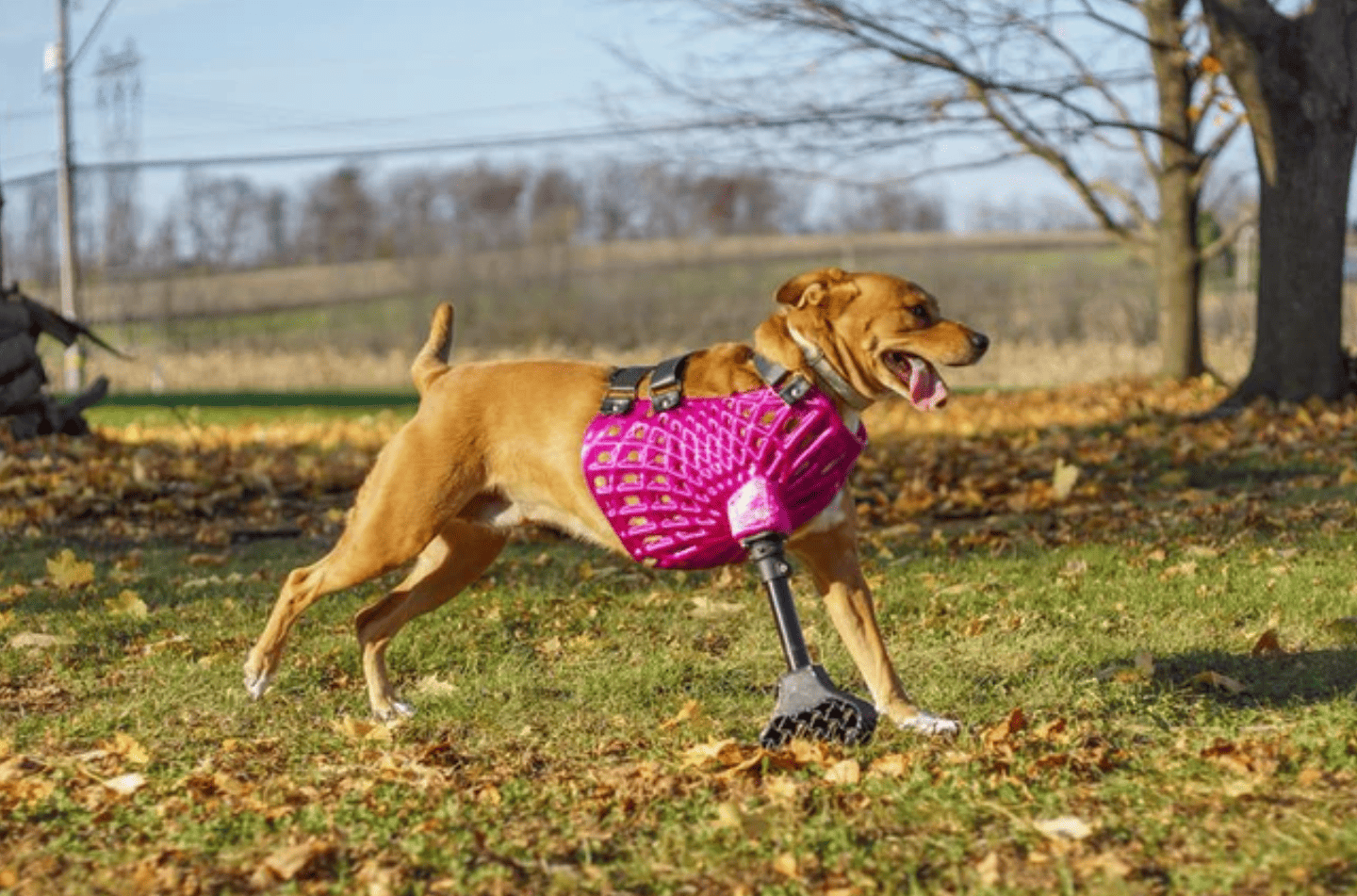
Image Source: 3DPets
How 3DPets Uses 3D Printing
The most important part of the 3DPets model is its workflow. For full-limb prosthetics, the process starts with either an in-office 3D scan or a mold made at home using a DIY kit. Once the scan or mold is ready, 3DPets uses custom software to design a perfectly fitted harness, then 3D prints the harness and foot, attaches the components, and finishes with an in-person fitting or shipping.
That workflow is a strong example of what makes 3D printing useful in health-related applications. Instead of forcing the animal to adapt to a prefabricated shape, the device is built from the pet’s own measurements. The final result is meant to be lightweight, durable, and individualized from the very beginning.
3DPets also emphasizes practical benefits that matter to owners and veterinarians: fit guarantee, device warranty, payment plans, modular attachments, shock-absorbing feet and wheels, and adjustability over time. The devices are exact replicas of the pet’s anatomy, and the goal is to reduce strain and fatigue while helping prevent hyperextension and chronic arthritis in the remaining limb. That is important because pet prosthetics are meant to support long-term comfort, movement, and quality of life.
3DPets’ Contribution to the Industry
3DPets’ contribution is bigger than any single prosthetic or wheelchair. The company is helping push veterinary mobility care toward a more modern, digital, and patient-specific model. Combining 3D scanning, custom software, and 3D printing allows the company to create “the next generation of devices for pets in need.” It helps demonstrate that pet prosthetics can be designed with the same kind of digital precision that has already transformed other manufacturing fields.
The company also appears to be contributing through education. The company includes videos, testimonials, links, articles, social media, and FAQ material, along with specific how-to resources such as casting for a prosthetic or cart, full-limb training, installing a prosthetic elbow joint, and shortening device straps on its website. That kind of support is valuable because successful prosthetics often require training, adjustment, and follow-up, not just a one-time purchase. In a field where many pet owners are unfamiliar with the process, educational resources can make the technology feel more approachable and workable.
Pet Prosthetics and Veterinary 3D Printing
The broader veterinary field helps explain why 3DPets is relevant. The American Veterinary Medical Association has noted that 3D printing has found uses in veterinary medicine, including prosthetics and orthotics. Research also shows that 3D scanning and 3D printing can be used to design and manufacture orthoses and socket prostheses for animals. In one study, devices were made for ten patients, including nine dogs and one calf, and the printed devices were fitted and generally tolerated, which suggests that the technology is not just theoretical; it is already being tested in practical animal-care settings.
At the same time, the industry still has real limitations. The same study notes that orthoses and socket prostheses are still rarely used in veterinary medicine, and that cost and limited evidence on outcomes remain major barriers. That helps explain why companies like 3DPets matter: they are working in a space where demand is real, but the market is still developing, and the available solutions are still evolving. The need for custom design, careful fitting, and realistic expectations remains central to the success of any pet prosthetic program.
There is also a larger healthcare lesson here. A review on 3D printing in healthcare says the technology can provide low-cost individualized prostheses, implants, and models, while helping surgeons work more effectively with customized equipment. That same logic applies in veterinary care. The more a device can be tailored to a body, the more useful it can be. 3DPets is one of the companies showing how that principle can move from human medicine into animal mobility support.
Technology Should Be Used Where It Matters Most
One of the clearest takeaways from 3DPets is that technology is most valuable when it solves a real, specific problem. 3D printing is impressive on its own, but its true strength appears when it is used in situations where precision, customization, and comfort matter more than mass production. Pet prosthetics are a perfect example of that.
A pet with a missing limb, a mobility issue, or a structural problem does not need a generic device that only works “well enough.” It needs something that fits properly, supports movement safely, and matches the animal’s unique body shape. That is where 3D printing makes a meaningful difference. Instead of forcing a pet to adapt to a standard product, 3DPets uses technology to build around the pet’s actual needs.
3DPets also reminds us that technology should support care, not replace it. The goal is not just to make something high-tech. The goal is to improve comfort, mobility, and quality of life for the animal and peace of mind for the owner. When technology is used with that kind of purpose, it becomes more than a manufacturing method; it becomes part of a better care solution.
3D printing can be practical, compassionate, and effective when applied to a problem that truly benefits from customization. In the future, the most successful technologies will probably be the ones that work this way, quietly, carefully, and exactly where they are needed most.
 0
0


COMMENTS
- Be the first to share your thoughts!