 English
  日本語
日本語  Deutsch


Outsourcing 3D printing can save time, reduce equipment costs, and make production more flexible. It is a practical choice for startups, product teams, designers, and manufacturers who need prototypes or end-use parts without building their own print farm. But the moment you send your files to a third party, you also create risk. Your CAD data, product geometry, brand elements, and process know-how may all become visible to someone outside your company.
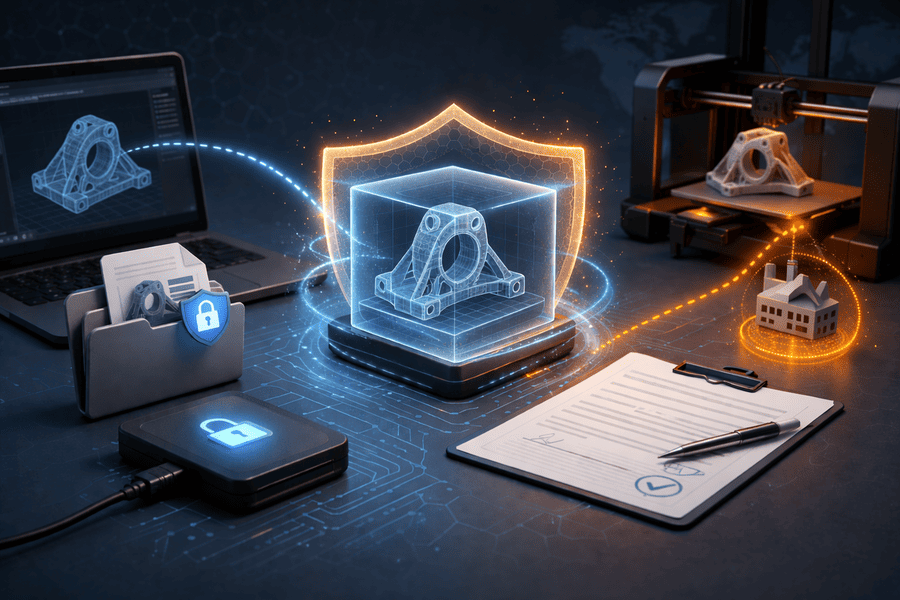
That is why intellectual property protection should be part of every outsourcing decision. Good IP protection is not just about legal documents. It is also about careful file sharing, smart workflow design, and internal security discipline. When these pieces work together, you can outsource with more confidence and less exposure.
What IP You Need to Protect
Before you send anything out, identify exactly what kind of IP is inside your design. Many teams think only about the model, but a 3D print file can contain several forms of valuable information at once.
First, there is the design itself. Your CAD model may include the shape of the part, its dimensions, internal structure, and any features that make it work. If the part is new, that geometry may be one of your most important competitive assets.
Second, there may be functional innovation. A printed part can include hidden mechanisms, special assemblies, lightweight structures, or performance-focused features. These details may not be visible at a glance, but they can still be central to your product advantage.
Third, there may be brand-related IP. Logos, product names, packaging elements, and distinctive design features can all be protected in different ways. If a vendor sees these assets, they may learn more about your product launch plans than you intended.
Fourth, there may be trade secrets and confidential business information. This can include tolerances, material choices, post-processing methods, production targets, and test results. Even if the design is not patentable, the surrounding manufacturing knowledge may still be highly valuable.
The key point is that not every file is just a file. In many cases, it is a container for multiple kinds of protected information.
The Main IP Risks in Outsourcing
Once you share your files with a service provider, several things can go wrong. Some risks come from bad intent, while others come from weak systems or careless handling.
One of the biggest risks is file leakage. A CAD file may be stored on shared drives, forwarded through email, or accessed by people who do not need it. If the provider has poor internal controls, your file could move far beyond the original project team.
Another risk is unauthorized reuse. A vendor might keep your file and later use it for another customer, a private experiment, or even their own production. Even if they do not copy the exact part, they may reuse your concepts, methods, or design approach.
Subcontracting creates another layer of risk. Some printing providers outsource work to other companies for finishing, post-processing, or logistics. If that happens without your knowledge, your IP may be exposed to additional parties you never approved.
Reverse engineering is also a concern. Once a part is printed, someone may inspect it, measure it, and recreate the design. It is especially important for visible consumer products, functional parts, and components with a unique fit or internal structure.
Finally, there is the risk of weak security on the provider’s side. Even a trustworthy company can have poor file controls, inadequate access restrictions, or employees who are not trained to handle sensitive designs. In other words, IP loss is not always dramatic or obvious. Sometimes it happens quietly through poor process management.
Put Legal Protections in Place
Legal protection should come before file transfer, not after something goes wrong. A strong contract will not eliminate risk, but it can create clear boundaries and give you a better position if there is a dispute.
Start with a non-disclosure agreement. An NDA should be signed before any sensitive files are shared. It should define what counts as confidential information, who can access it, how it can be used, and when it must be returned or destroyed.
Next, make sure the contract clearly states ownership. Your agreement should say that you retain ownership of your designs, files, and related IP unless there is a separate written transfer. It should also clarify that any modifications made for the purpose of printing do not give the vendor rights to your original design.
You should also restrict the vendor’s use of your materials. The contract should say that your files can only be used for the specific project you approved. This prevents a provider from treating your design as a reusable asset.
If the project is especially sensitive, consider adding stronger terms. These may include limits on subcontracting, requirements to notify you before sharing files internally, audit rights, destruction requirements, and penalties for unauthorized disclosure. For high-value designs, it is worth having an IP lawyer review the agreement before work begins.
Legal terms are only effective when they are specific. Generic language is better than nothing, but clear project-based terms are much stronger.
Limit the Information You Share
One of the simplest ways to reduce risk is to share less. Many teams send more information than the printer actually needs. That creates avoidable exposure.
Only provide the files and instructions necessary for the print job. If the vendor only needs one component, do not send the full assembly. If they only need geometry, do not include branding files, technical notes, or internal test results unless they are required.
You can also separate sensitive files from less sensitive ones. For example, keep your functional geometry in one file and your branding or packaging in another. That way, no single upload reveals the entire product concept.
When possible, use a print-ready version rather than your master design file. Export the file in the format needed for production and avoid sharing editable native files unless absolutely necessary. A print-ready file still carries risk, but it can reduce what the recipient can easily modify or repurpose.
Be careful with annotations and naming, too. File names, layer labels, comments, and project notes can reveal much more than the geometry itself. A clean, neutral file package helps reduce unnecessary disclosure.
The goal is not secrecy for its own sake. The goal is to give the provider what they need to do the job well, while keeping everything else private.
Break the Workflow Into Smaller Pieces
If a design is especially sensitive, do not give one vendor the entire picture. A modular workflow can lower risk significantly.
One approach is to split the product into separate parts or print stages. A vendor may print one component, while another vendor handles finishing or assembly. This limits how much any single party can learn about the full product.
You can also keep your most sensitive elements in-house. For example, a supplier might print a shell or support component, while your team handles proprietary inserts, final assembly, or critical finishing steps. This keeps the core design knowledge closer to your own organization.
Another useful tactic is to divide responsibility by function. One company may handle prototyping, another may handle surface finishing, and a third may handle packaging or logistics. By breaking the workflow into smaller tasks, you reduce the chance that one external party can reconstruct the whole product from start to finish.
The approach does require more coordination, but it often pays off when the design is valuable or the market opportunity is large. The more sensitive the IP, the more useful it becomes to control who sees which part of the process.
Manage Internal Security on Your Side
IP protection is not only the vendor’s responsibility. Your own internal process matters just as much. In many companies, leaks happen because files are shared too freely inside the organization before they ever leave the building.
Start by limiting who can approve outside sharing. Not everyone on the team should be able to send files to a printer. A simple approval process can prevent accidental exposure.
You should also keep a record of what was shared, when it was shared, and with whom. That record is useful for accountability and for tracing issues later if something goes wrong.
Train your team to treat design files as sensitive assets. Employees should understand that CAD models, print settings, and prototype images may all be confidential. They should also know not to forward files casually, save them on personal devices, or upload them to unauthorized platforms.
Access control is another important step. Store files in secure folders, use permission settings, and review who still needs access after a project ends. Old permissions are a common weak point.
Finally, build an IP review into your workflow. Before any outsourced print job is released, someone should check whether the files are complete, whether the contract is in place, and whether any unnecessary information has been included. This simple checkpoint can stop many problems before they begin.
3DSPRO Guarantees Your IP Safety
When outsourcing 3D printing, the partner you choose plays a critical role in protecting your intellectual property. At 3DSPRO, IP safety is built into every stage of the workflow, ensuring that your designs are handled with care from upload to delivery.
A professional service provider should treat every file as sensitive. At 3DSPRO, access to your files is controlled and limited to only those directly involved in your project, which minimizes unnecessary exposure and reduces the risk of internal leakage.
We also support a privacy-first approach by encouraging clients to share only the essential data required for production, which aligns perfectly with best practices for IP protection, helping you maintain control over your most valuable information.
In addition, we work under strict confidentiality standards and support NDAs and project-based agreements. Our processes are designed to respect ownership rights and prevent unauthorized use of your files.
To reinforce this commitment, you can review the 3DSPRO Guarantee, which outlines how your data, designs, and orders are handled securely throughout the process. The added transparency gives businesses greater confidence when outsourcing critical projects.
By combining secure file handling, controlled access, and clear communication, we enable companies to outsource 3D printing without compromising their IP. Instead of worrying about data exposure, you can focus on innovation and product development.
 0
0


COMMENTS
- Be the first to share your thoughts!