 English
  日本語
日本語  Deutsch


Injection molding is the backbone of modern high-volume plastics manufacturing. From smartphone housings to automotive dashboards and countless consumer goods, injection molding delivers parts that are affordable, consistent, and production-ready at scale.
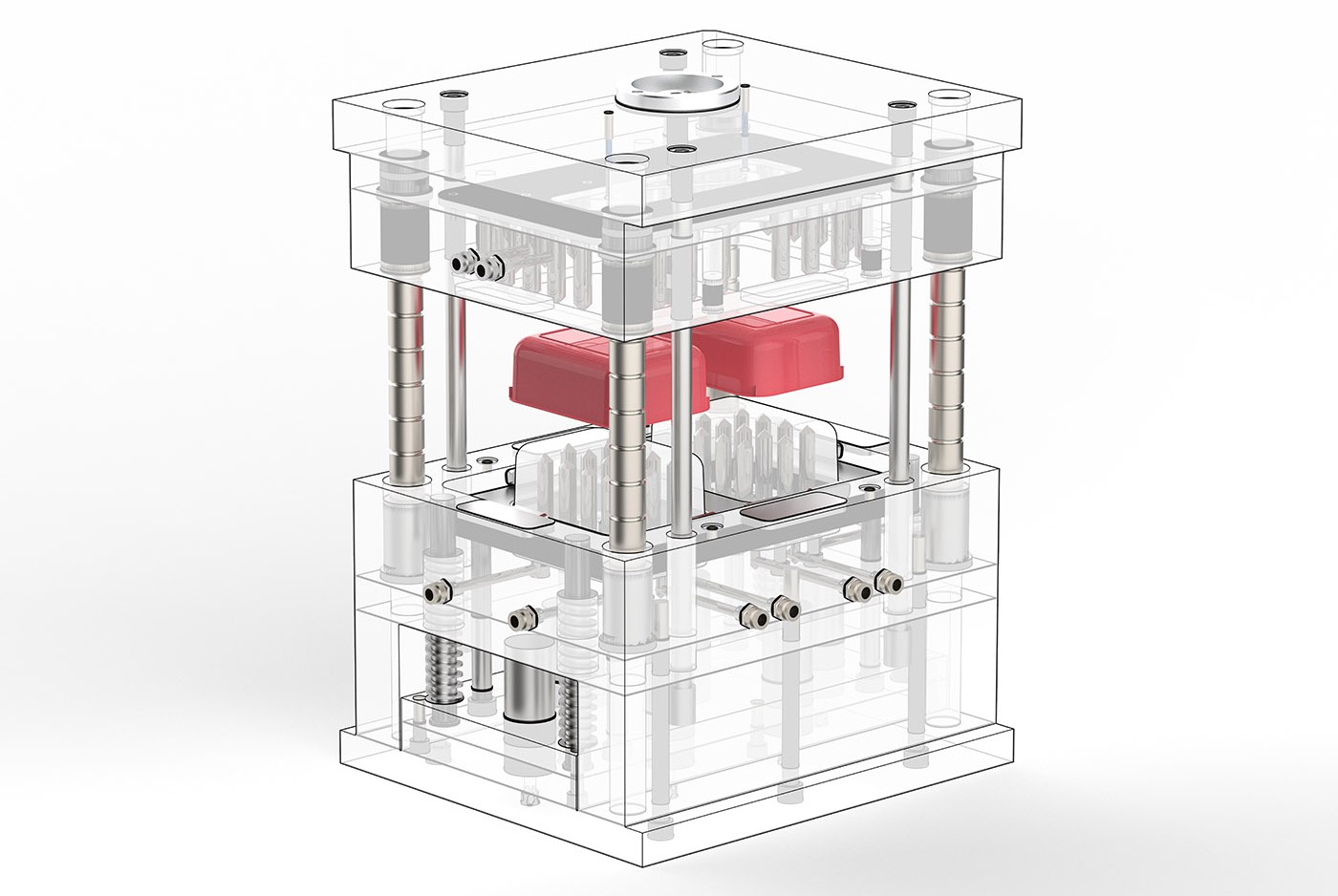
Image Source: Plastics Engineering
Low Per-Part Cost at Scale
One of the strongest arguments for injection molding is economics. While the upfront cost of tooling (the mold) can be significant, that cost is amortized over every part produced. As production volumes rise, the per-part cost drops dramatically, often to a fraction of what equivalent parts would cost from machining or high-end additive processes.
A mold might cost from a few thousand dollars for a prototype tool to tens or hundreds of thousands for a hardened multi-cavity production tool. If you produce thousands or millions of parts, the tooling cost divided across the run becomes negligible compared to material and cycle costs per piece. That makes injection molding uniquely attractive for consumer products, medical disposables, packaging, and any application where unit economics matter.
Very Fast Production Cycles
Injection molding is designed for throughput. Typical cycle times can be anywhere from a few seconds to a minute or two, depending on part size and material. Multiplied by automated robots and multi-cavity molds, which leads to thousands or tens of thousands of parts per day from a single press.
Fast cycle times translate to shorter lead times for large orders and predictable production schedules. For businesses that need large volumes quickly, injection molding is almost always faster than batch machining or additive methods run serially.
Exceptional Repeatability and Precision
When accuracy and consistency are required across thousands or millions of parts, injection molding shines. A well-made mold combined with controlled process parameters produces parts within narrow tolerances, with extremely low variation from part to part.
The repeatability is critical for assemblies where parts must fit together reliably, or in regulated industries like medical or automotive, where dimensional consistency impacts safety and function. Compared with many other mass-production methods, injection molding provides both the dimensional control and stable production processes needed for dependable large-scale manufacturing.
Wide Material Selection
Injection molding supports a broad spectrum of thermoplastics and some thermosets, such as commodity resins like polypropylene (PP) and polyethylene (PE); engineering plastics such as ABS, polycarbonate (PC), and nylon (PA); and high-performance polymers like PEEK and PPS for demanding applications. Manufacturers can also use filled compounds (glass, mineral, carbon) to adjust stiffness, heat resistance, or dimensional stability.
The versatility means designers can pick materials for strength, flexibility, chemical resistance, heat deflection, or appearance while still leveraging high-volume production economics. Color, flame retardance, and other additive packages are widely available, letting designers meet both functional and regulatory needs.
Excellent Surface Finish and Cosmetic Options
Injection-molded parts can come out of the tool with a near-finished surface. Mold cavities can be polished or texturized to produce smooth, glossy, matte, or patterned finishes. In-mold decorating techniques, foil inserts, overmolding, and multi-shot molding allow integrated color, soft-touch areas, or decorative elements without extra assembly steps.
For products where looks matter, such as consumer electronics, branded packaging, or automotive interiors, injection molding delivers high cosmetic quality at scale that would otherwise require additional finishing operations.
Material Efficiency and Low Scrap
When properly designed and optimized, injection molding can be very material efficient. Sprues, runners, and rejected parts can often be reground and reused (depending on polymer and application), and process improvements reduce rejects and cycle variability. Compared to CNC machining, which often starts from a larger block and removes material, injection molding typically generates less net waste.
Design choices further reduce sink, warp, and scrap. For companies focused on cost and sustainability, regrind practices and careful process control make injection molding an efficient choice.
Injection Molding vs Alternative Processes
|
Methods |
Injection Molding |
3D Printing |
CNC Machining |
|
Best for |
High volumes, low per-part cost at scale |
Prototyping, low-volume custom parts, complex one-offs |
Mid-to-High volumes where material properties or tight tolerances needed |
|
Typical cost drivers |
Tooling, material, cycle time |
Part time, machine time, support removal |
Material stock, machining time, tool wear |
|
Per-part cost |
Low at scale; high upfront tooling |
High for large volumes; low for prototypes |
Higher than molding for large volumes due to material removal |
|
Production speed |
Very fast per cycle; high throughput |
Slower serial build times |
Moderate; can be fast with multiple machines |
|
Repeatability |
Excellent across long runs |
Variable by machine/process |
Very good; depends on fixturing and tooling |
|
Surface finish |
Excellent (molded finish) |
Often requires post-processing |
Good; may need finishing for cosmetics |
|
Material waste |
Low (regrind possible) |
Low to moderate (support waste) |
High (subtractive removal) |
|
Ideal use case |
Mass production, cosmetic parts |
Rapid prototyping, complex geometries, customization |
Functional prototypes, metal parts, tight tolerances |
 0
0


COMMENTS
- Be the first to share your thoughts!