 English
  日本語
日本語  Deutsch


Key Definitions and Fundamentals
Strength
Strength is how much load a part can take before it fails. Think of strength as the part’s ability to resist breaking or permanently changing shape. A strong clip will snap back or keep holding something instead of breaking when you pull on it.
Stiffness
Stiffness is how much a part bends or deforms when you put a load on it. A “stiff” bookshelf bracket hardly bends when you put weight on the shelf; a flexible one bends noticeably. Stiffness answers: Will it keep its shape under normal use?
Toughness and Ductility
These are cousins of strength. Toughness is how much energy a part can absorb before it breaks. Ductility is how much permanent shaping a material can tolerate before snapping. A tough material might not be very stiff, but it can take a hit without shattering.
Why Geometry Matters
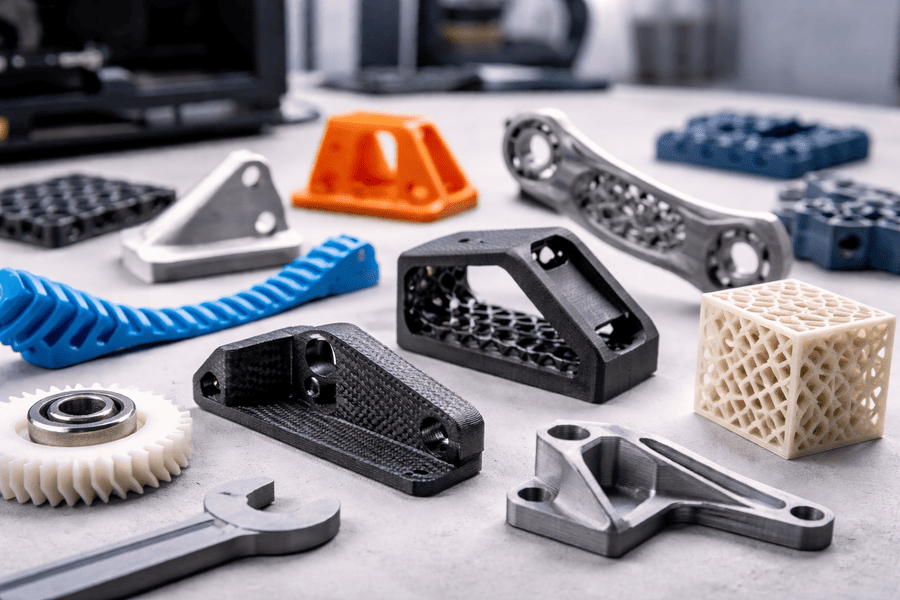
Stiffness depends heavily on the shape of the part. A thin flat strip will bend easily, but the same material arranged as a thicker beam or with ribs will be much harder to bend. That means you can often make a part stiffer by changing its shape instead of switching materials.
Strength = “How much force until failure?”
Stiffness = “How much it bends under that force?”
How Stiffness and Strength Are Related
Stiffness and strength are connected, but they don’t always go up or down together.
• A hard, brittle material can be very stiff (doesn’t bend much) and also strong up to a point, but it can break suddenly without warning.
• A soft, rubbery material might be very flexible (low stiffness) yet tough; it stretches a lot before breaking and so can survive impacts that would snap a brittle piece.
Because of shape effects, you can make a part much stiffer without changing the material. For example, adding a thick rib or moving material farther from the part’s center can dramatically reduce bending. Sometimes much more effectively than switching to a stiffer material.
Common Real-World Situations:
• A part that meets stiffness needs but fails: it hardly bends under load, but a small stress concentration (a sharp corner or thin wall) causes a crack and break.
• A part that is strong but too flexible: it won’t break under load, but bends so much that it stops doing its job.
Material Effects
Common Thermoplastics (FDM / FFF)
• Examples you’ve probably heard of behave differently: some are fairly stiff but brittle, others are tougher and more flexible.
• Materials that are stiff tend to resist bending but can snap under sudden shock. Tougher plastics bend more before breaking.
• Many filament materials depend strongly on how they’re printed: orientation, temperature, and layer settings change real-world performance a lot.
Resins (SLA / DLP)
• Resin parts can be very detailed and often feel stiff and precise.
• Post-print curing (the process used to finish resin parts) makes them harder and stiffer, but over-curing can make them fragile. There are also tougher resin formulas designed to avoid brittleness.
Powder-Based Plastics (SLS/MJF)
• These parts often read as more uniform and less layered than FDM parts. They can offer a nice mix of strength and flexibility, and usually beat the cheap filament parts for consistent mechanical behavior.
Metals (SLM)
• Metal-printed parts are typically both stiff and strong — similar to conventionally made metal parts — but only if printed and heat-treated correctly. Tiny internal flaws or leftover powder can reduce strength, so post-processing matters.
Composites and Fiber-Reinforced Prints
• Adding fibers or continuous strands of reinforcement can drastically increase stiffness and strength in the fiber direction. This is a powerful tool when you need one direction to be very stiff without adding a lot of material everywhere.
Post-processing and Treatments that Change Stiffness or Strength
Heat Treatment
Heating printed parts under controlled conditions can improve internal bonding and relieve internal stresses. For some plastics, heat treatment can increase stiffness and dimensional stability.
Metal printed parts often undergo heat treatment to achieve their intended strength and durability.
UV Post-Curing
Resin prints are usually exposed to additional ultraviolet light after printing. This extra curing step completes the chemical reaction in the material, making the part harder and stiffer.
However, excessive curing may also make some resins more brittle.
Some printed parts, especially those made from porous materials, can be soaked with resins or other chemicals that fill tiny gaps in the structure. Chemical smoothing can improve strength and make the part more resistant to cracking.
Surface Coatings
Applying coatings such as epoxy or protective layers can slightly increase stiffness and improve durability. Coatings may also protect parts from moisture or environmental damage.
Hot Isostatic Pressing for Metal Parts
In metal additive manufacturing, special pressure and heat treatments can remove internal pores and improve overall structural strength. The HIP process helps printed metal parts perform more like traditionally manufactured components.
 0
0


COMMENTS
- Be the first to share your thoughts!