 English
  日本語
日本語  Deutsch


At-A-Glance Comparison Table
|
Factor |
Buy a 3D Printer (In-house) |
Use 3D Printing Service Bureaus |
|
Upfront cost |
High (capex: printer + setup) |
Low (pay per job) |
|
Ongoing cost |
Materials, maintenance, operator time |
Per-part price + shipping |
|
Speed / turnaround |
Instant for in-house jobs; ideal for fast iterations |
Variable; depends on queue & shipping |
|
Material & tech range |
Limited to purchased machine(s) |
Wide — many technologies & specialty materials |
|
Quality & finishing |
Depends on in-house skill & post-processing |
Professional finishing and QC available |
|
Volume economics |
Better at consistent mid-to-high volumes |
Better for sporadic or low-volume work |
|
IP & confidentiality |
Highest control (on-prem) |
Requires contracts/NDA for protection |
|
Staffing & space |
Requires trained operator and space |
No staffing or shop floor footprint |
|
Best for |
Fast iteration, IP-sensitive work, recurring parts |
One-off parts, specialty materials, certified parts |
Key Factors to Decide
Volume and Cadence
If you consistently print many parts every month, buying can pay off. If your needs are irregular or one-off, services avoid idle assets.
Upfront Budget vs Operating Budget
Buying converts expenses into capital expenditure (machines, fixtures); services are operational expenses (per order). Which fits your accounting and risk tolerance?
Iteration Speed
In-house gives near-instant iterations for design-test cycles. Service bureaus can add days to weeks depending on the process and shipping.
Required Materials and Processes
Do you need engineering-grade thermoplastics, high-temperature resins, or metal? Many specialty materials are easiest via a service bureau.
Part Quality and finishing
Surface finish, tolerance, and post-processing (polishing, painting, heat treatment) matter. Service bureaus often offer higher-end finishing than most small shops.
IP, Security and Regulatory Needs
For regulated industries or highly sensitive IP, on-site printing reduces exposure and simplifies traceability. If you use a provider, insist on NDAs, secure file transfer, and a documented chain of custody.
Staffing, Expertise and Maintenance
Buying requires someone to run, tune, and maintain equipment. If you lack technical capacity, services save time and headaches.
Long-Term Roadmap
If 3D printing will become a core capability for your product lifecycle, buying and building expertise can be strategic.
When to Buy A 3D Printer
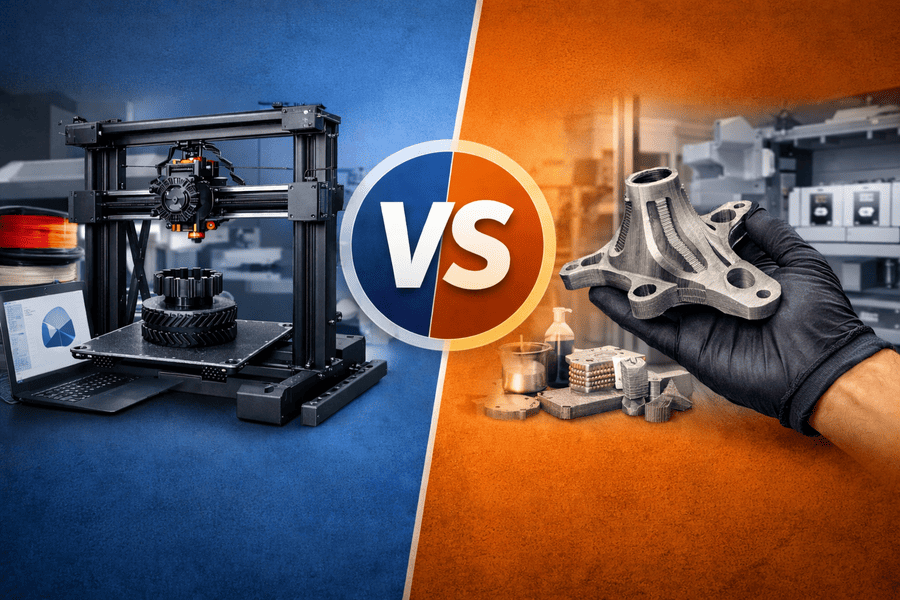
Buying a printer can be appropriate when control, iteration speed, and recurring demand are prioritized over cost and maintenance.
Benefits
• Instant iterations: Designers can print, test, and revise in hours instead of days.
• Lower per-part cost at scale: For steady monthly volumes, amortized machine cost + materials often beat per-part service pricing.
• IP & confidentiality: Sensitive designs stay on-prem without needing file transfers to third parties.
• Customization & on-demand manufacturing: Short-run customizations, late-stage design changes, and batch variation are easy.
• Learning & capability building: In-house know-how can become a competitive advantage.
Drawbacks
• High initial investment: Industrial or professional machines (and proper post-processing) cost thousands to hundreds of thousands.
• Maintenance & consumables: Repairs, recalibration, replacement parts, and print materials add ongoing costs.
• Staffing needs: You’ll need operators and possibly a technician for reliability and quality control.
• Limited material/technology breadth: A single machine rarely covers everything.
Good Fit Examples
• An R&D team running daily design iterations.
• A manufacturer producing consistent batches of jigs, fixtures, or production parts.
• IP-sensitive components for medical or defence markets where on-site control is required.
When to Use 3D Printing Service Bureaus
Service bureaus excel when flexibility, materials choice, and professional finishing matter more than owning hardware.
Benefits
• No capital outlay: Pay per job without buying expensive machines.
• Access to many technologies: SLA, SLS, MJF, DMLS/SLM (metal), binder jetting — often available from the same provider.
• Professional post-processing & certification: Surface finishing, painting, machining, or aerospace/medical traceability are usually available.
• Scalability on demand: Short lead times for bursts of volume without purchasing more machines.
• Lower operational overhead: No need to train staff or maintain machines.
Drawbacks
• Per-part cost can be higher, especially if you have continual, high-volume demand.
• Lead times & logistics: Turnaround is subject to provider capacity, inspections, and shipping times.
• Potential IP exposure: Mitigate by using NDAs, vetted vendors, and secure file transfer.
• Less immediate control: You depend on the provider’s process and scheduling.
Good fit examples
• Prototyping one-offs or small batches where a wide material set is desirable.
• Startups with limited capital that need occasional metal or certified parts.
• Projects requiring high-end finishing (polish, anodize-like appearances, machining).
Check out 3DSPRO’s 3D Printing Capabilities and Guarantee >>
How to Evaluate Printers vs Service Providers
When Evaluating A Printer to Buy
• Consider build volume and dimensional requirements (ensure it accommodates your largest part).
• Verify supported materials (require ABS-like, engineering nylons, resins, or metal-readiness).
• Check resolution, repeatability, and tolerance specifications.
• Assess vendor support, warranty, and spare-part availability.
• Calculate total cost of ownership: machine price, consumables, maintenance, + expected lifetime amortization.
• Determine post-processing needs and required equipment (wash, cure, sintering, ovens).
• Review safety and facility requirements (venting, power, inert gas for metal).
• Consider the community, the software ecosystem, and the upgrade path.
When Evaluating A Service Bureau
• Check the material and process portfolio to ensure they offer the needed technology.
• Confirm typical turnaround times and rush job procedures.
• Request quality control details: inspection reports, dimensional verification, and sample availability.
• Review post-processing capabilities: surface finish, painting, machining, heat treatment.
• Check certifications and traceability for regulated industries (ISO, NADCAP, medical device standards).
• Evaluate pricing transparency: sample quotes, volume discounts, shipping, and tooling costs.
• Review IP/security policies: NDAs, secure upload portals, data retention rules.
• Request references and examples of similar past projects.
 0
0


COMMENTS
- Be the first to share your thoughts!