 English
  日本語
日本語  Deutsch


What Is ABS-Like Resin?
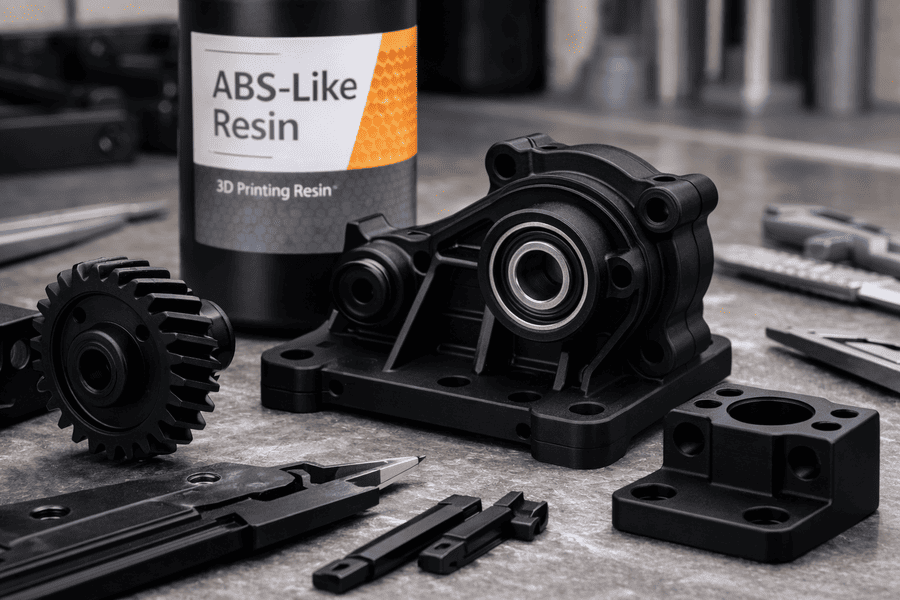
ABS-like resin is a family of SLA/MSLA/DLP photopolymer formulations engineered to mimic the feel, toughness, and impact resistance of injection-molded ABS (Acrylonitrile-Butadiene-Styrene), while retaining the surface quality and fine detail advantages of resin printing. Manufacturers achieve that balance by adding flexibilizers or impact-modifying components to the base photopolymer so cured parts show higher elongation and better impact performance than standard “brittle” model resins. Formlabs.
In practical terms, ABS-like resin is aimed at functional prototypes, housings, jigs/fixtures, and small end-use components where printed detail and a more ABS-like mechanical behavior are both important.
Key Properties of 3D Printed ABS-Like Resin
Tensile Strength and Elongation
Typical values often sit below engineered thermoplastics, but above generic model resins. Some vendor datasheets report tensile strengths in the tens of MPa with elongation at break in the tens of percent, a balance that gives parts both stiffness and some ductility. eSUN.
Impact Resistance
ABS-like formulations are tuned to resist crack propagation better than standard brittle resins; reported Izod/Charpy values are often far higher than a generic SLA model resin.
Heat Resistance (HDT)
Expect a lower heat deflection temperature than injection-molded ABS. Typical HDT for ABS-like resins is often in the 55–70 °C range (brand dependent), whereas molded ABS grades commonly reach ~90–100 °C. That means ABS-like resin is fine for many functional uses, but not for sustained high-temperature service.
Surface Finish and Dimensional Stability
One of the big advantages is that SLA/DLP prints keep an excellent surface finish and fine features, plus good dimensional stability for mating parts if you follow the manufacturer’s shrinkage/tolerance guidance.
Pros and Cons
Pros
• Great surface finish and feature fidelity (resin printing advantage).
• Noticeably tougher and less brittle than many general-purpose resins.
• Good for functional prototypes, snap-fits, housings, and small mechanical parts.
• Paints, sands, and machines reasonably well after proper post-processing.
Cons
• Lower continuous operating temperature than true ABS or high-temperature engineering resins.
• Still photopolymer: parts can be sensitive to prolonged UV exposure (yellowing/embrittlement) if not protected.
• Requires solvent washing (IPA or alternatives) and UV post-curing, more chemical handling than FDM.
• Mechanical performance can be more variable between suppliers than for commodity thermoplastic filaments.
ABS-Like Resin vs FDM Printed ABS vs Engineering Resins
|
Feature / Property |
ABS-Like Resin (SLA/DLP/MSLA) |
FDM ABS (filament) |
Engineering Resins (high-temp / nylon-like) |
|
Surface finish & detail |
Excellent — very smooth, fine features, minimal visible layer lines. |
Visible layer lines; post-processing required for smooth finish. |
Very good (resin detail) — can be formulated for specific finishes. |
|
Mechanical strength & toughness |
Good for many functional uses; tougher than standard model resins but usually below the best engineering thermoplastics. |
Strong and tough in bulk; good impact resistance for structural parts. |
Often superior — engineered for high strength, toughness, or specialized properties. |
|
Heat resistance (HDT / continuous use) |
Moderate (commonly ~55–70 °C, brand dependent) — not ideal for sustained high-heat use. |
Higher HDT than ABS-like resins; better for elevated-temperature service. |
High (many formulations exceed FDM ABS); choose high-temp grades for >100 °C. |
|
Anisotropy / dimensional behavior |
Generally more isotropic for small features (resin cures uniformly), good dimensional accuracy. |
Can show anisotropy and weaker Z-axis; warping possible for large parts. |
Depends on resin—many are isotropic with excellent dimensional stability. |
|
Part size & per-part cost |
Best for small to medium parts; per-part cost increases with volume (resin + post-process). |
More cost-effective for large parts and bulk production. |
Usually pricier; chosen for performance, not low cost. |
|
Printer & process requirements |
SLA/MSLA/DLP printer, washing (IPA/alternatives), UV curing—more chemical handling. |
FDM printer with heated bed/chamber preferred; simpler post-process (sanding/acetone smoothing for ABS). |
May require specialized printers, controlled cure, or specific safety measures. |
|
Post-processing |
Wash + UV cure, sanding, priming/painting. Pigmented/dark parts need longer cure. |
Sanding, vapor smoothing (acetone) possible, priming/painting. |
Varies — some need thermal post-cure or special coatings. |
|
UV / weather resistance |
Photopolymer can yellow/embrittle with prolonged UV — coatings recommended for outdoor use. |
Better long-term UV performance than most resins (additives available). |
Many engineering resins are formulated for improved UV/chemical resistance. |
|
Best use cases |
Detail-rich functional prototypes, enclosures, small mechanical parts, snap-fits, visual + functional prototypes. |
Larger structural parts, functional prototypes needing higher heat or impact resistance, low-cost production. |
End-use parts requiring high temp, chemical resistance, or certified properties (medical, aerospace, industrial). |
|
When to pick |
When surface finish and fine detail matter and moderate toughness is sufficient. |
When heat resistance, toughness, or low cost for larger parts is a priority. |
When you need top-tier mechanical or thermal performance and are willing to pay more. |
FAQs
Q: Can I sand, paint, or glue ABS-like resin parts?
A: Sure.
Q: Is ABS-like resin as strong as FDM ABS?
A: It depends. ABS-like resin often offers better fine-feature strength and more isotropic small-part behavior, while FDM ABS usually provides higher heat resistance and sometimes better bulk impact/toughness for larger structural parts.
Q: Is ABS-like resin safe for outdoor use and how should I store/dispose it?
A: Photopolymer parts can yellow and embrittle with prolonged UV exposure, so use UV-blocking coatings for outdoor use.
 1
1


COMMENTS
- Be the first to share your thoughts!