 English
  日本語
日本語  Deutsch


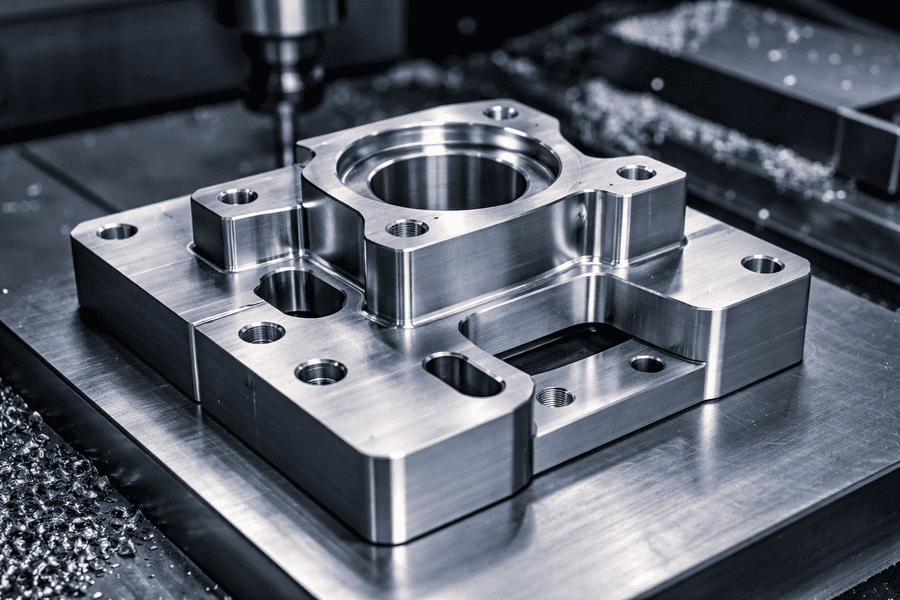
High Precision and Tight Tolerances
One of CNC machining’s most important strengths is precision. Because numerical coordinates govern tool motion and closed-loop feedback systems, advanced CNC mills and lathes can consistently position cutting tools with extremely small incremental steps.
Precision matters when components must mate together, when bearings need exact bores, or when functional surfaces determine part performance. Industries such as medical devices, aerospace, and optics routinely demand tolerances measured in microns or thousandths of an inch. CNC machines can be tuned and fixtured to reach those specifications. Equally important is geometric accuracy; flatness, perpendicularity, concentricity, all of which are controllable through careful CNC programming, appropriate fixturing, and properly maintained tooling.
Because CNC machining is a subtractive, deterministic process, it preserves critical material properties of metals and engineering plastics better than processes that involve high heat or chemical changes. When a component’s mechanical performance depends on the integrity of the base material, CNC’s ability to deliver tight dimensional control while retaining material strength is a major advantage.
Excellent Repeatability and Consistency
Precision is valuable, but it becomes truly powerful when it is repeatable. CNC machining delivers consistent results across dozens, hundreds, or thousands of parts because the same digital program that produced the first good part can be reused repeatedly. Once a toolpath is validated, the machine follows that path precisely every run, eliminating much of the operator-dependent variability common in manual processes.
Repeatability reduces inspection burden and scrap. Statistical process control (SPC) is easier to implement when the underlying process is consistent, and quality assurance workflows are in place. From first-article inspection to in-line metrology checks, can be automated and tied back to machine logs. For production runs where interchangeable parts are required, CNC’s repeatability ensures that every component will meet the same design intent with minimal rework.
Speed and Production Efficiency
CNC machining can be fast. For prototypes, CNC shortens the time from concept to physical part because CAD-to-CAM workflows are well established, and many shops support rapid setup options. For production, modern multi-axis machines, automatic tool changers, pallet systems, and turn-mill centers dramatically increase throughput. Complex parts that would require multiple setups on manual equipment can often be completed in a single automated program on a multi-axis center.
Cycle times are influenced by machine capability, tooling choices, feed/speed optimization, and part geometry, but the capacity for continuous, unattended operation is a major productivity advantage. When coupled with efficient CAM strategies, such as trochoidal milling, high-speed machining, and adaptive toolpaths, CNC machining can produce parts faster while extending tool life and reducing thermal distortion.
Wide Material Compatibility
CNC machining is compatible with a very broad range of materials. From soft plastics to hardened steels and exotic alloys like titanium and Inconel, CNC machines can cut materials that are challenging for other manufacturing methods. The versatility makes CNC a natural choice where material properties are critical, for example, when high strength-to-weight ratios, temperature resistance, or specific mechanical properties are required.
Moreover, CNC machining preserves the native microstructure of metals, which can be important for fatigue life, corrosion resistance, and predictable mechanical behavior. The ability to machine high-hardness materials, heat-treated components, and specialized engineering plastics gives designers flexibility to choose the best material for function rather than being constrained by manufacturing limitations.
Superior Surface Finish and Reduced Post-Processing
Surface finish delivered directly from CNC machining is often superior to that from many other manufacturing processes. Proper selection of tooling, feeds, speeds, and finishing passes yields smooth surfaces with minimal tool marks. For many parts, this eliminates or reduces the need for time-consuming secondary operations such as grinding, sanding, or polishing.
When a tighter surface finish is required, CNC machines can perform dedicated finishing operations that achieve optical or near-optical surfaces. Additionally, CNC machining supports precision features such as threads, bores, splines, and chamfers that are ready for assembly without additional finishing.
Reducing post-processing not only shortens production time but also lowers costs and limits opportunities for error during handling. For manufacturers who must meet cosmetic and functional expectations, CNC’s ability to produce high-quality surfaces directly is a notable advantage.
Cost-Effectiveness and Scalability
Although initial setup costs for CNC (programming, tooling, and fixturing) can be higher than some manual or low-tech options, CNC becomes increasingly cost-effective as production volume or part complexity grows. The per-part cost drops with batch size because the validated program and tooling amortize across more units, and automated runs reduce labor costs.
CNC machining scales well for small to medium production runs and remains competitive for larger volumes when precision and material choices make alternative processes (like injection molding or casting) less suitable. For mid-volume manufacturing, where tooling costs for molding are hard to justify but demand exceeds simple prototyping, CNC often hits the sweet spot.
Other cost-saving levers include reduced scrap rates thanks to process control, fewer secondary operations due to improved surface finishes, and shorter lead times that decrease inventory holding costs. Additionally, modern CAM software optimizes toolpaths for material removal and tool life, further improving economics.
 0
0


COMMENTS
- Be the first to share your thoughts!