 English
  日本語
日本語  Deutsch


Choosing a 3D printing service for jewelry is not the same as choosing a general prototyping vendor. Jewelry pieces demand extreme detail, clean surfaces, accurate dimensions, and reliable finishing. A tiny flaw in a ring, pendant, or bracelet can affect both appearance and wearability. The best partner will understand jewelry workflows, work with suitable materials, and help you move from concept to finished piece with fewer mistakes and less wasted time.
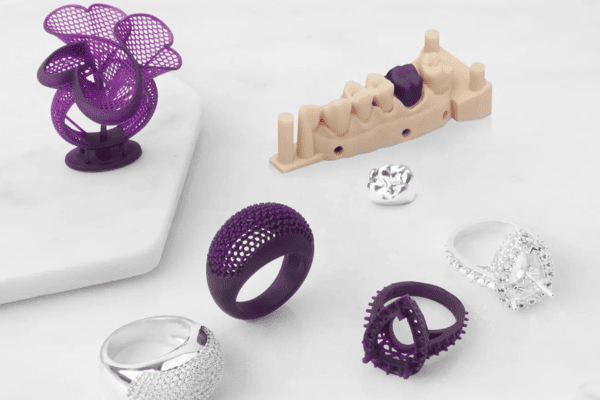
Image Source: Formlabs
Understand Your Jewelry Project Requirements
Before comparing services, define what your project actually needs. A custom engagement ring, a collection of fashion jewelry, and a wax pattern for casting all require different printing approaches. Some projects are meant for visual prototypes only, while others must be strong enough for casting or direct use.
Start by identifying the purpose of the print. Are you making a single sample for client approval, or do you need multiple identical pieces for production? Do you need microscopic detail, smooth curves, or structural strength? Will the printed part be used as a master model, a mold, or the final jewelry item? Clear answers will help you choose a service with the right technology and workflow.
It also helps to think about your design complexity. Intricate filigree, stone settings, engraved surfaces, and thin prongs need a service that can handle delicate geometry without distortion. A good match begins with a clear understanding of the project itself.
Check the Service’s Jewelry Printing Experience
Not every 3D printing company understands jewelry work. Experience matters because jewelry has unique requirements that are very different from industrial parts or consumer products. A service that has printed rings, pendants, earrings, or wax models for casting is more likely to understand the details that matter.
Look for a provider with a portfolio that includes jewelry projects. This can tell you whether they have dealt with fine features, polished surfaces, and small-scale precision. A service with experience in jewelry is also more likely to anticipate common problems, such as fragile supports, over-polished edges, or design features that become too thin after printing and finishing.
Specialized experience often shows up in the quality of communication as well. A provider familiar with jewelry will usually ask better questions about stone settings, wall thickness, casting shrinkage, and finishing requirements. That kind of knowledge can save time and reduce costly rework.
Evaluate Print Resolution and Surface Detail
Jewelry lives or dies by detail. A ring may look simple at a distance, but close up, every curve, edge, and engraved line matters. That is why print resolution should be one of your top evaluation criteria.
Ask about the printer’s layer height, dimensional accuracy, and ability to reproduce fine features. Smaller layer heights usually help create smoother surfaces and sharper detail, which is important for delicate jewelry designs. For pieces with textures, patterns, or lettering, high resolution can make the difference between a professional result and an unusable part.
Surface finish is equally important. Even if a print comes out dimensionally correct, it may still require too much sanding or polishing if the surface quality is poor. Jewelry projects usually benefit from services that can deliver a clean output with minimal visible stepping. The better the print quality, the less time you will spend correcting it afterward.
Review Material Options
The material used for jewelry printing can affect every stage of your project. Different materials are suited to different goals, so the service should offer options that match your workflow.
If you are preparing for investment casting, castable resin or wax-like materials are often a strong choice. These materials are designed to burn out cleanly and support detailed geometry. If you are testing shape, size, or proportions, standard resin may be enough for a concept model. Some services may also offer specialty materials for stronger prototypes or heat-resistant patterns.
Material choice affects more than just printability. It also influences surface quality, flexibility, brittleness, and how well the part responds to post-processing. For example, a brittle resin may capture fine detail beautifully but could be too fragile for handling. A slightly tougher material might survive more use but lose a bit of detail. The best service should help you match the material to the exact purpose of your jewelry project.
Look at Post-Processing Capabilities
Post-processing is a major part of jewelry production. A printed model rarely goes straight from the printer to the customer. It usually needs cleaning, support removal, curing, and sometimes polishing or inspection before it can be used.
This step matters because post-processing can either enhance or damage the final piece. A service with careful support removal and finishing can preserve delicate prongs, sharp engraving, and clean edges. Poor handling during post-processing can leave marks, distort thin areas, or reduce the quality of the surface.
Ask what finishing steps are included in the service. Do they offer support removal? Do they clean and cure the part properly? Can they smooth the surface or prepare it for casting? If your jewelry project requires a polished presentation model, you should also ask whether they can achieve a high-end visual finish. Strong post-processing support often separates a basic vendor from a truly useful jewelry partner.
Compare Lead Time and Production Capacity
Jewelry projects often work on tight deadlines. A client may need a sample quickly, or a seasonal collection may have a fixed launch date. For that reason, lead time is not just a convenience issue; it can affect your entire schedule.
Compare how fast different services can complete prototypes and production runs. Some providers may be excellent at detailed work but slow when orders increase. Others may offer faster turnaround but less consistency. You need to balance speed with reliability.
Production capacity matters too. A small project may only need one printed sample, but a collection launch may require multiple pieces or repeat orders. A service that can handle both short runs and larger batches gives you more flexibility as your business grows. The ideal partner can keep up with your deadlines without sacrificing quality.
Consider Quality Control and Consistency
Jewelry customers notice inconsistency quickly. Even tiny differences between pieces in a set can become a problem. That is why quality control is essential when choosing a printing service.
Ask how the service checks accuracy before shipping. Do they inspect dimensions, surface quality, and part integrity? Do they catch defects before the pieces leave the facility? A reliable provider should have a clear quality control process in place.
Consistency is especially important for collections, matching pairs, or repeat production. If you plan to reorder a design later, you want the new parts to match the original as closely as possible. A service with strong quality standards can help you avoid variations that affect fit, appearance, or castability. In jewelry, consistency builds trust.
Check Communication and Customer Support
Good communication can save a project. Even the best design may need adjustments, and a responsive service can help you avoid expensive mistakes. When evaluating a provider, pay attention not only to what they can print, but also how they support you during the process.
A helpful service should be able to explain file requirements, point out weak spots in a design, and suggest practical improvements. This is especially valuable if you are working with thin walls, small settings, or highly detailed models. Clear feedback can prevent failed prints and reduce delays.
Customer support also matters when deadlines are tight. Fast responses, clear updates, and direct technical guidance can make the entire process smoother. For jewelry projects, strong support often means fewer surprises and better final results.
Compare Pricing Without Sacrificing Quality
Price always matters, but the cheapest option is not always the best choice for jewelry. A low quote may look attractive at first, yet it can become expensive if the print needs rework, finishing, or replacement. Instead of focusing only on cost, look at value.
Compare what is included in each quote. Does the price cover file review, printing, cleaning, curing, or support removal? Are there extra charges for rush orders, revisions, or finishing? A transparent quote is often more reliable than a low price with hidden fees.
The right balance is important. For jewelry projects, quality, precision, and finish usually matter more than saving a small amount upfront. A dependable service may cost more, but it can protect your design, save time, and help you deliver a better product to your customers.
 0
0


COMMENTS
- Be the first to share your thoughts!