 English
  日本語
日本語  Deutsch


Metal 3D Printing Service Tolerances at 3DSPRO
|
Metal 3D Printing Technology |
Tolerance |
Maximum Printing Size |
Material Options |
|
± 300μm or 0.3%mm |
427*527*460mm |
What Influences Tolerance in Metal 3D Printing
Printing Process
Different metal 3D printing technologies behave differently. Laser powder bed fusion processes, binder jetting, and electron beam melting each have their own strengths and limitations. Some are better for great detail, while others are stronger in throughput or part size. The process directly affects dimensional stability, surface finish, and how much post-processing is needed.
Material Behavior
Metal expands, contracts, and responds to heat during printing and cooling. Different alloys behave differently under thermal stress. Some materials are more prone to distortion, while others hold geometry more reliably. The choice of alloy can therefore have a direct effect on tolerance.
Part Size and Geometry
A small, compact part is usually easier to control than a large, thin-walled one. Long spans, broad flat faces, and tall vertical structures are more likely to warp or shift slightly during the build. Complex geometry can also trap heat unevenly, which increases the chance of dimensional drift.
Build Orientation
How the part is positioned in the build chamber matters a lot. Orientation affects support placement, heat flow, surface quality, and the direction in which the machine builds layers. A dimension that looks simple in CAD may become more difficult to control if it is aligned in an unfavorable direction.
Support Strategy
Supports are necessary in many metal builds, but they can influence the final dimensions of the part. They help anchor the part and reduce movement, yet they can also leave marks or affect nearby geometry. If supports are removed aggressively, that removal process can change edges or fine features.
Post-processing
Heat treatment, stress relief, removal from the build plate, surface finishing, and machining all influence final dimensions. In many cases, a part is not finished when it leaves the printer. Post-processing can improve dimensional accuracy, but it can also slightly alter it. That is why tolerance planning must include the full manufacturing workflow, not just the print stage.
Machine Calibration and Process Control
A well-maintained machine with consistent process settings is more likely to produce repeatable results. That does not mean every part is identical, but it does mean the service can better predict outcomes and maintain consistency across batches.
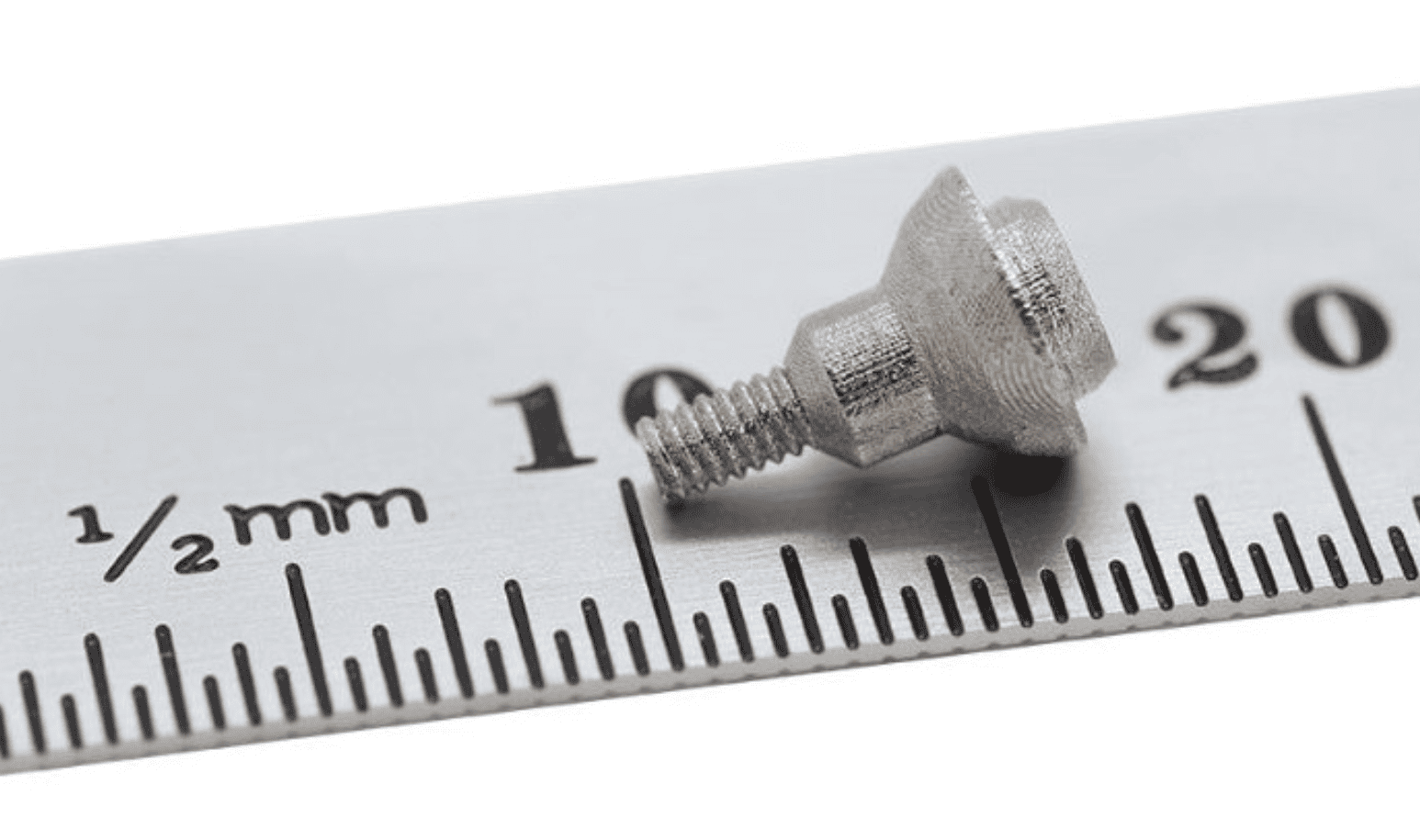
Image Source: Titanium Supplier
Typical Tolerance Ranges You Can Expect
The tolerance range for metal 3D printing is not fixed across all services or processes, but there are general expectations customers can use as a starting point. In many cases, metal 3D printed parts are accurate enough for functional prototypes, industrial components, and complex assemblies, especially when the design is optimized for additive manufacturing.
For straightforward features on a well-controlled build, many metal 3D printing services can hold tolerances that are suitable for general engineering use. However, truly tight tolerances usually require machining or finishing on critical surfaces. The printed part may be close enough to serve as a near-final component, but not every feature will match the precision of CNC machining.
A useful way to think about it is this:
• General external geometry can often be produced with practical functional accuracy.
• Critical interfaces may need extra allowance or secondary processing.
• Precision holes, bores, and mating surfaces often need machining if fit is important.
• Very small details may print, but may not be reliable for exact dimensional control.
At 3DSPRO, we offer a hybrid strategy: print the main body of the part and machine the critical areas afterward, which gives you the design freedom of additive manufacturing and the precision of subtractive finishing where it counts.
Which Features Are Most Likely to Drift
Not every feature on a metal 3D printed part behaves the same way. Some are naturally more stable, while others are more sensitive to heat, support, and post-processing.
Thin Walls
Thin walls are among the most challenging features in metal printing. They can cool unevenly, deform slightly, or become sensitive to support removal. If the wall is very thin relative to its height or length, it may not stay perfectly straight.
Small Holes
Printed holes often come out undersized or slightly out of round. This is common because of thermal effects, powder behavior, and layer-by-layer building. Small holes are usually better designed with machining allowance if they must accept pins, screws, or bearings.
Long Flat Surfaces
Large flat surfaces can warp or show subtle curvature. Even a small amount of distortion may matter when the surface is used for sealing or mounting. Such surfaces often benefit from machining after printing.
Sharp Internal Corners
Internal corners can accumulate stress and may not reproduce exactly as drawn. Rounded transitions are often more print-friendly and more dimensionally reliable than perfectly sharp edges.
Tall Unsupported Structures
The taller and thinner a feature is, the greater the risk that it will shift, vibrate, or drift slightly during the build. This is especially true if the geometry creates uneven heat distribution.
Fine Text and Small Embossed Details
Decorative or identification features can print successfully, but very small text or fine raised details may lose clarity or change size. If the detail is functionally important, it should be reviewed carefully before production.
Threads
Printed threads are possible in some cases, but they are not usually the best choice for precision or repeatable fit. Tapped or machined threads often perform better when reliability matters.
How to Design Parts for Better Tolerance Results
Design has a huge effect on the quality of the final part. If you want better tolerance results from a metal 3D printing service, the best time to improve them is before the part is printed.
Identify Critical Dimensions Early
Not every dimension needs a tight tolerance. Mark the dimensions that truly matter for fit, sealing, alignment, or load transfer. When the service knows what is critical, it can plan the build and post-processing more intelligently.
Add Machining Allowance Where Needed
If a bore, face, or mounting surface must be precise, leave extra material for machining. It is one of the most reliable ways to combine additive manufacturing with accurate finishing.
Avoid Relying on Printed Holes for Exact Fits
Printed holes are often good for clearance, but not always ideal for precision fastening. When an exact diameter matters, it is better to print undersized and finish it later.
Simplify Tolerance-Sensitive Geometry
The more complex the geometry, the more opportunities there are for variation. Keep critical interfaces as simple and direct as possible. Avoid placing multiple precision features in a region that may distort during cooling.
Choose Orientations Strategically
Build orientation should not be treated as an afterthought. A different orientation can improve surface quality, reduce support marks, and make the most important dimensions more stable.
Use Realistic Design Tolerances
Not every feature should be specified like a machined aerospace component. When the application allows more flexibility, design for that flexibility, which reduces cost and improves manufacturability.
Think about Assembly Clearance
If the part must mate with another component, make sure the clearance is realistic for the chosen process. Add enough room for the expected variation, especially if the part will go through heat treatment or finishing.
Consult the Service before Finalizing the Model
A strong metal 3D printing service can review your CAD file and point out where dimensions may shift. That feedback can save time, reduce rework, and improve the chance of a successful first build.
 0
0


COMMENTS
- Be the first to share your thoughts!