 English
  日本語
日本語  Deutsch


Vacuum casting and 3D printing are often used together because they solve two different problems in product development. 3D printing is fast and flexible for creating a master pattern, while vacuum casting is better for producing multiple high-quality copies that look and feel close to an injection-molded part. In practice, the pair is especially useful for prototypes, market-testing samples, bridge production, and low-volume end-use parts.
For many projects, vacuum casting and 3D printing create a practical middle step between a digital concept and full-scale manufacturing. A designer can print a master model, refine it quickly, use it to make a silicone mold, and then cast several parts in resin without the cost and lead time of steel tooling. That is why this workflow is common in product development, consumer electronics, automotive components, and other applications where appearance, fit, and turnaround time matter.
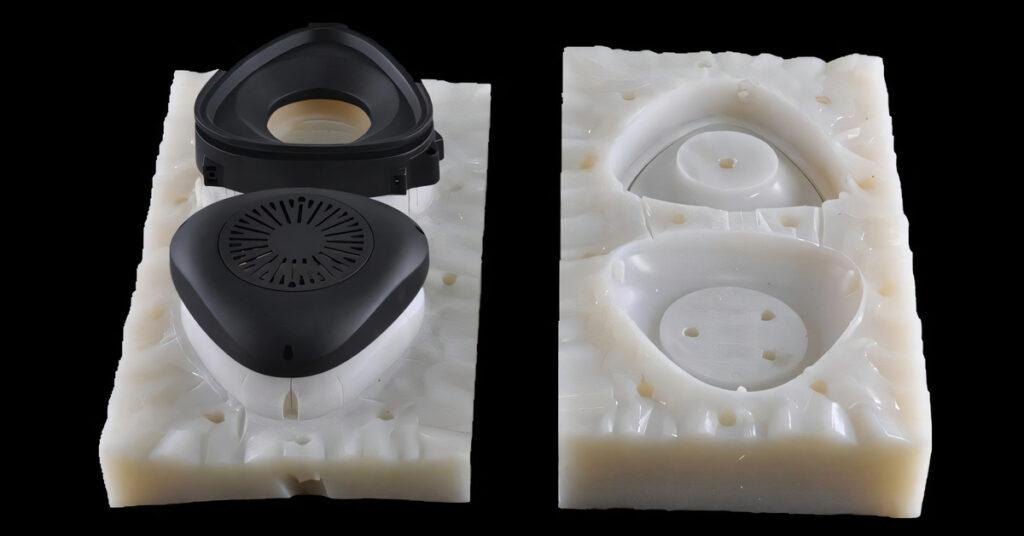
Image Source: PROTO&GO
What Is Vacuum Casting?
Vacuum casting is a manufacturing process that uses a silicone mold and a liquid casting resin, usually polyurethane-based, to reproduce a master model. The mold is made around the master, cut into halves, and then the master is removed. After that, resin is poured into the cavity under vacuum, which helps reduce air bubbles and improve surface quality and detail reproduction.
The process is often called urethane casting or polyurethane casting in the United States, because polyurethane is the most common family of casting material used in this workflow. Although the terminology varies, the idea is the same: vacuum is used to support a clean cast, and the silicone mold is used to duplicate the shape of the master part.
Vacuum casting is especially valuable when a project needs low-volume parts with a production-like appearance. It is a strong option for small-batch production runs, market-testing prototypes, personalized products, and made-to-fit medical devices. Vacuum casting is also used for investor presentations, trade shows, photography samples, and early series production, because the parts can be highly detailed and visually close to the final product.
What Is 3D Printing’s Role in Vacuum Casting?
3D printing is usually the starting point of the vacuum casting workflow because it creates the master pattern. That master is the positive model around which the silicone mold is formed, so its shape, dimensions, and surface finish directly influence the quality of every cast part that comes later. In other words, the 3D print is not the final product in this workflow; it is the tool used to make the mold.
This is where 3D printing brings the biggest advantage: speed and design freedom. Compared with hand-built masters or machined patterns, a printed master can be produced quickly, revised easily, and reprinted if needed. That makes it much simpler to iterate on geometry before committing to silicone tooling.
The choice of printing technology also matters. SLA prints are often preferred for masters because they can produce a smoother surface, while SLS can be useful for strong, temperature-resistant masters and complex geometries such as snap fits, thin walls, or interlocking features. Any non-porous 3D print can be used as a master model for silicone rubber mold making, but visible layer lines can show up in the final cast, so resin prints are often better when surface quality is important.
How Vacuum Casting and 3D Printing Work Together
The workflow starts with a CAD model. After the design is finalized for the project stage, the part is 3D printed as a master pattern. At this point, accuracy and surface finish matter more than speed alone, because any blemishes, support marks, fingerprints, or rough layer lines can be transferred into the silicone mold and then into every cast part.
Next, the master is post-processed. Sanding, polishing, priming, or other finishing steps may be needed depending on the printing method and the required appearance. This step is important because the silicone mold captures the master very faithfully. A smoother master generally leads to a smoother cast part, which is one reason SLA masters are frequently chosen for appearance-critical work.
After the master is ready, silicone is poured around it to form the mold. Once cured, the mold is cut open, and the master is removed. The silicone mold then becomes the reusable tool for casting parts. During the casting step, mixed resin is poured into the cavity, the trapped air is reduced under vacuum, and the part is cured before demolding. It is the stage where vacuum casting most closely resembles injection molding in appearance, even though the tooling and materials are very different.
The final step is finishing and inspection. Cast parts may need trimming, painting, coating, or assembly, depending on the project. Because silicone molds wear out over time, consistency should be checked as more parts are produced. Some sources describe standard silicone molds as lasting around 15–20 parts before quality starts to decline, while others report roughly 50 casts per mold and up to 300–500 casts with more durable HTV silicone or rubber systems. The actual life depends on part geometry, mold material, and production conditions.
Advantages of Combining Vacuum Casting with 3D Printing
The biggest advantage of this combined workflow is speed. 3D printing eliminates the need to machine a master pattern, and vacuum casting then lets the team produce multiple copies from one mold without waiting for hard tooling. Formlabs notes that this approach is useful when companies want to move quickly from a printed concept to low-volume parts for testing or early launch activities.
Cost efficiency for small batches. Compared with injection molding, vacuum casting requires much lower upfront investment because it uses silicone molds instead of steel tooling. Formlabs describes vacuum casting as a cost-effective bridge from prototyping to production, especially when the project does not yet justify an expensive injection mold.
Good appearance. Vacuum casting can reproduce fine details and deliver a smooth surface finish that is often close to the final product. That makes it useful for presentation models, cosmetic samples, and parts that need to look production-ready before mass manufacturing begins. It is one of the reasons this workflow is often chosen for consumer products, automotive trim, and electronics housings.
The workflow is also flexible when designs still need refinement. Because the master is digital and 3D printed, changes can be made quickly without reworking expensive hard tooling. That makes the combination ideal for design validation, fit testing, and pre-production trials. It is especially useful when a product team expects one or more revision cycles before locking the design.
Limitations
The main limitation is that vacuum casting is not meant for mass production. Silicone molds are much less durable than metal tools, so they are best suited to prototypes, bridge production, and low-volume runs rather than thousands or millions of parts. Once the mold wears out, a new one has to be made, which keeps the process efficient only within a certain volume range.
Another limitation is material performance. Vacuum casting mainly uses polyurethane and related resin systems, which can imitate ABS, PP, rubber-like, or transparent materials, but they are still not the same as full production thermoplastics or metals. That means the cast part may be perfect for appearance, fit, and short-run function, yet still not match the final engineering performance of injection-molded or machined parts in every case.
The quality of the master also matters a great deal. If the 3D printed pattern has rough surfaces, support marks, or dimensional errors, those flaws are copied into the silicone mold and then into the finished cast parts. This makes master preparation one of the most important steps in the whole workflow.
Finally, the process has geometry and size limits. Very large parts, very thick parts, or designs that are difficult to demold may require segmentation or special planning. Vacuum casting is excellent for many prototype and low-volume applications, but it is not the universal answer for every production need.
 0
0


COMMENTS
- Be the first to share your thoughts!