 English
  日本語
日本語  Deutsch


FibreSeeker 3 brings continuous-fiber 3D printing into a compact desktop format, with claims such as up to 900 MPa tensile strength, print speeds up to 500 mm/s, and a build volume of 300 × 300 × 245 mm. It is also presented as a dual-head system with three printing modes, designed to combine thermoplastic printing with continuous fiber reinforcement
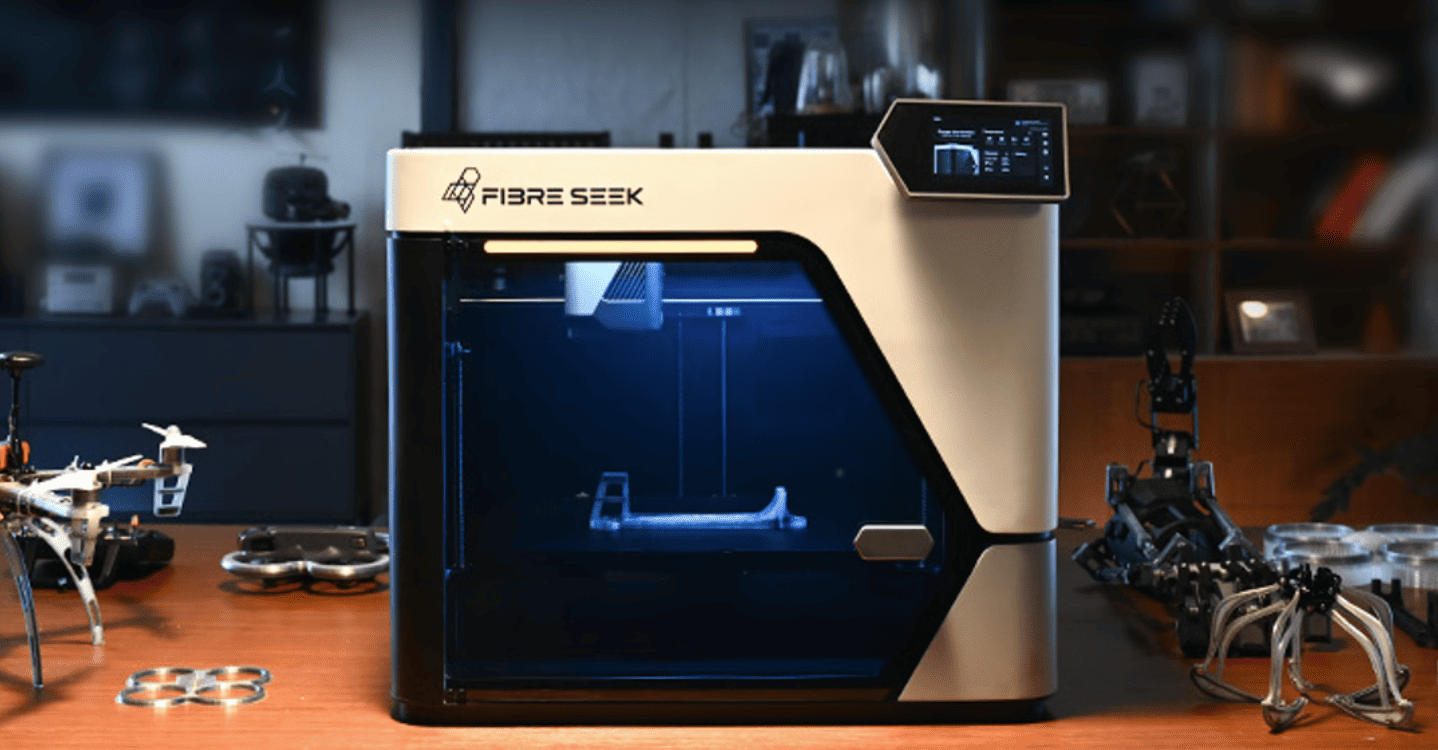
Image Source: FibreSeeker 3
For 3D printing users, FibreSeeker 3 is not only a machine to admire, but also a sign of where the industry is heading. It suggests that high-strength composite printing is becoming more accessible, more compact, and more practical for everyday users, not only industrial labs.
Why FibreSeeker 3 Caught Our Attention
FibreSeeker 3 stands out because it bridges two worlds that have often felt separate: desktop convenience and serious functional performance. Traditional desktop printers are usually associated with prototypes, visual models, or low-load parts. FibreSeeker 3 changes that conversation by bringing continuous-fiber reinforcement into a machine size that looks suitable for workshops, design studios, and advanced makerspaces.
That shift matters because it changes expectations. Instead of asking only, “Can this printer make a part?” users begin asking, “Can this printer make a part that actually works under stress?” That is a meaningful design inspiration on its own: tools should not only make production easier, but also expand the type of ideas that feel possible. FibreSeeker 3 is compelling because it points toward that possibility.
Inspiration One: Continuous Fiber Technology
The most obvious inspiration comes from the continuous fiber technology itself. In simple terms, it is what allows the printer to go beyond standard plastic parts and create reinforced composite parts with much higher strength potential. FibreSeeker 3 is described as using continuous fibers in a co-extrusion process, where the thermoplastic acts as the matrix and the fiber adds structural reinforcement.
That idea is important because it redefines what a “printed part” can be. With ordinary FDM printing, strength is often the main limitation. With continuous fiber reinforcement, strength becomes part of the design strategy. For product developers, that means the printer is not just a fabrication tool; it is a materials platform. It encourages thinking about load paths, stiffness, failure points, and reinforcement zones much earlier in the design process.
It is also a useful inspiration for 3D printing service providers. It shows that customers may increasingly expect more than shape and surface quality. They may want functional parts that are lighter, stiffer, and better suited to real use. Continuous-fiber printing broadens the kinds of requests a service provider can confidently handle, especially for jigs, fixtures, robotic components, brackets, and other application-driven parts.
Inspiration Two: Stronger Parts in a Smaller Space
Another strong message from FibreSeeker 3 is that advanced capability no longer has to live inside a huge industrial system. The machine is presented with a desktop-friendly footprint, yet it still offers a large 300 × 300 × 245 mm build volume and performance claims that would once have sounded like industrial-only territory. That contrast is one of its most inspiring features.
Space is not only a hardware issue; it is also a business issue. Smaller systems are easier to place in a studio, a design office, a lab, or a small production environment. When a machine offers strong output without demanding a large footprint, it lowers the barrier to entry for teams that want to test ideas quickly and produce functional parts in-house.
The deeper inspiration here is efficiency. FibreSeeker 3 suggests that “smaller” does not have to mean “less capable.” Instead of scaling up size first, manufacturers are now finding ways to scale up performance, workflow, and material behavior in a more compact form.
Inspiration Three: 3 Printing Modes
FibreSeeker 3 is also interesting because it offers three printing modes, which are presented as different ways to balance speed, practicality, and strength. Even without focusing on the exact menu of settings, the concept itself is valuable: a single machine can support different priorities depending on the project.
It is a smart design idea because real production work rarely has only one goal. Sometimes the priority is rapid iteration. Sometimes the priority is balanced output. Sometimes the priority is maximum structural performance. A machine that acknowledges those differences helps users work more intentionally. It does not force every job into the same mold.
For designers, FibreSeeker 3 is inspiring because it mirrors how good engineering decisions are made in practice. The best solution is not always the strongest or the fastest; it is the one that fits the use case. FibreSeeker 3’s three-mode concept is a reminder that good manufacturing tools should support decision-making, not just execution. That is a lesson worth carrying into 3D printing service workflows as well.
Inspiration Four: The Balance of Speed and Strength
A particularly compelling part of FibreSeeker 3 is the attempt to combine speed with strength. The project is marketed with up to 500 mm/s FDM nozzle speed alongside very high-strength composite output, which is not an easy balance to achieve in the same machine category. That mix is part of what makes it feel like a serious step forward for desktop additive manufacturing.
Users often have to choose between fast prototypes and strong parts. FibreSeeker 3 suggests that those two goals do not always have to be separated so sharply. For many applications, the ability to move quickly while still producing mechanically useful parts can reshape development cycles and shorten the path from concept to testable hardware.
It also changes how people think about iteration. When speed and strength can coexist more effectively, teams may be more willing to test real-world use cases earlier. That means less guesswork, faster learning, and more confidence in the final part. In other words, FibreSeeker 3 is inspiring not just because of what it prints, but because of how it may change the way people design and refine products.
Inspirations for 3DSPRO
For 3DSPRO, FibreSeeker 3 offers a useful creative signal. It shows that users are increasingly interested in functional performance, not only geometry and appearance. That means service providers should continue emphasizing part strength, application fit, material selection, and production guidance, especially for customers who need end-use components rather than display models.
It also reinforces the value of helping customers choose the right manufacturing path. Not every part needs continuous fiber reinforcement, but some parts absolutely benefit from stronger materials, better design decisions, or a more suitable production method. Whether the part is for prototyping, testing, tooling, or end use, the real value comes from matching the technology to the job. FibreSeeker 3 is a good reminder of that principle.
 0
0


COMMENTS
- Be the first to share your thoughts!