 English
  日本語
日本語  Deutsch


In today’s manufacturing and design industries, precision, speed, and durability are non-negotiable. Whether it’s marking serial numbers on automotive parts, engraving logos on jewelry, or coding medical instruments for traceability, businesses need a solution that delivers permanent, high-quality results. Fiber laser marking has rapidly become the gold standard for industrial marking because it combines cutting-edge laser technology with versatility across materials. Fiber lasers create marks that are resistant to wear, chemicals, and environmental exposure.
What is Fiber Laser Marking?
A fiber laser is a type of solid-state laser that uses optical fibers doped with rare-earth elements (commonly ytterbium) as the gain medium. It typically operates around a wavelength of 1064 nm, which is ideal for interacting with metals and certain plastics.
Fiber laser marking refers to the process of using this laser beam to create permanent marks on a material’s surface. These marks can include:
• Text (serial numbers, barcodes, QR codes)
• Logos and branding
• Decorative patterns
• Identification marks for compliance and traceability
Compared to other laser systems like CO₂ or UV lasers, fiber lasers are particularly effective on metals, alloys, and hard plastics, making them the preferred choice for industrial applications.
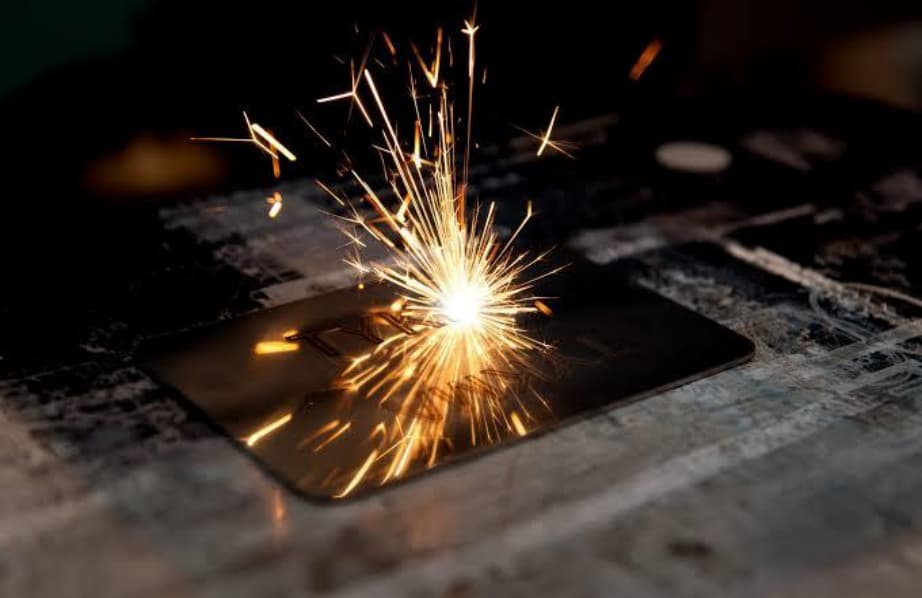
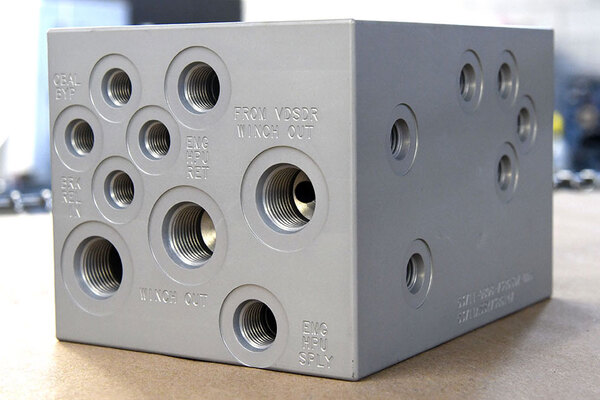
Image Source: Rapid Direct
How Fiber Laser Marking Works
The process is based on focused light energy interacting with the material surface:
1. Laser Generation: The fiber laser source produces a high-powered beam of light.
2. Beam Delivery: The beam is transmitted through a fiber-optic cable to the marking head.
3. Focusing: Lenses focus the beam onto the material surface with extreme precision.
4. Material Interaction: The surface absorbs the laser energy, causing localized heating, melting, or discoloration.
5. Permanent Mark Creation: Depending on the technique, the mark may be a change in color, texture, or depth.
Because the process is non-contact, there’s no mechanical wear, and the marks are consistent even on complex geometries.
Pros and Cons
Pros
• High Precision: Capable of marking fine details, down to microns.
• Durability: Marks are resistant to abrasion, chemicals, and heat.
• Speed: Fast processing reduces cycle times.
• Eco-Friendly: No inks, solvents, or consumables required.
• Low Maintenance: Fiber lasers have long lifespans.
• Versatility: Works on metals, plastics, ceramics, and more.
Cons
• High Initial Cost: Investment can be significant compared to traditional methods.
• Material Limitations: Less effective on organic materials like wood or leather.
• Technical Expertise Needed: Operators must understand laser parameters and safety.
• Limited Color Options: Color marking is possible but restricted to certain metals like stainless steel and titanium.
Types of Fiber Laser Marking Techniques
Fiber lasers can produce different effects depending on how the beam interacts with the material:
• Annealing Marking: Creates oxide layers on metals, producing dark or colored marks without removing material. Ideal for medical tools.
• Engraving/Deep Marking: Removes material to create deep, tactile marks. Common in automotive and aerospace.
• Etching: Shallow removal of material for fine text or logos.
• Black Marking: Produces high-contrast black marks, often used for barcodes and QR codes.
• Color Marking: Achieved on stainless steel or titanium by controlling laser parameters to produce interference colors.
Applications
Fiber laser marking is used across a wide range of industries:
• Electronics: Marking circuit boards, chips, and connectors for identification.
• Automotive: VIN codes, part numbers, and safety labels.
• Medical Devices: Surgical instruments, implants, and compliance markings (e.g., UDI codes).
• Jewelry & Fashion: Engraving logos, personalization, and decorative patterns.
• Industrial Tools: Traceability of machinery parts and tools.
• Aerospace: Permanent identification on critical components.
FAQs
Q: What materials can fiber lasers mark?
A: Fiber lasers excel at marking metals (steel, aluminum, brass, copper, titanium) and some plastics. They are less effective on organic materials like wood or paper.
Q: How long does a fiber laser last?
A: Most fiber lasers have lifespans exceeding 100,000 hours, making them highly reliable.
Q: Is fiber laser marking safe?
A: Yes, but operators must follow laser safety protocols, including protective eyewear and enclosures.
Q: Can fiber lasers create colored marks?
A: Yes, but only on certain metals like stainless steel and titanium, using precise parameter control.
Q: How does fiber laser compare to CO₂ laser?
A: CO₂ lasers are better for organic materials (wood, leather, glass), while fiber lasers dominate in metal marking.
 0
0


COMMENTS
- Be the first to share your thoughts!