 English
  日本語
日本語  Deutsch


Choosing the right polymer for use in a chemical environment is a practical exercise in matching chemistry to conditions. The wrong plastic can swell, soften, craze, or fail catastrophically. The right one will survive years with predictable performance.
How Solvents Interact with Polymers
Solvent attack on polymers is not a single reaction but a set of related physical and chemical processes:
1. Swelling and plasticization. Solvent molecules penetrate the polymer matrix, increasing free volume and reducing intermolecular forces. The part softens, loses stiffness (lower modulus), or changes dimensions. It is common with amorphous, low-crosslinked polymers when exposed to compatible solvents.
2. Dissolution and chemical solvation. If solvent-polymer interactions are strong enough, polymer chains can be solvated, and the material can partially or completely dissolve. It is most extreme and obvious, for example, some resins dissolve in chlorinated solvents.
3. Chemical degradation (hydrolysis, oxidation). Some solvents chemically cleave polymer backbones or side groups. Ester-containing polymers are vulnerable to hydrolysis under hot, acidic conditions.
4. Crazing and embrittlement. Solvent stress cracking occurs when solvents cause local plasticization combined with mechanical stress; fine microcracks form and propagate, reducing toughness.
5. Permeation and permeation-related failure. Small solvent molecules can permeate, even when they don't cause bulk damage, leading to slow mass transfer, loss of barrier properties, or contamination of fluids on the other side of a thin wall.
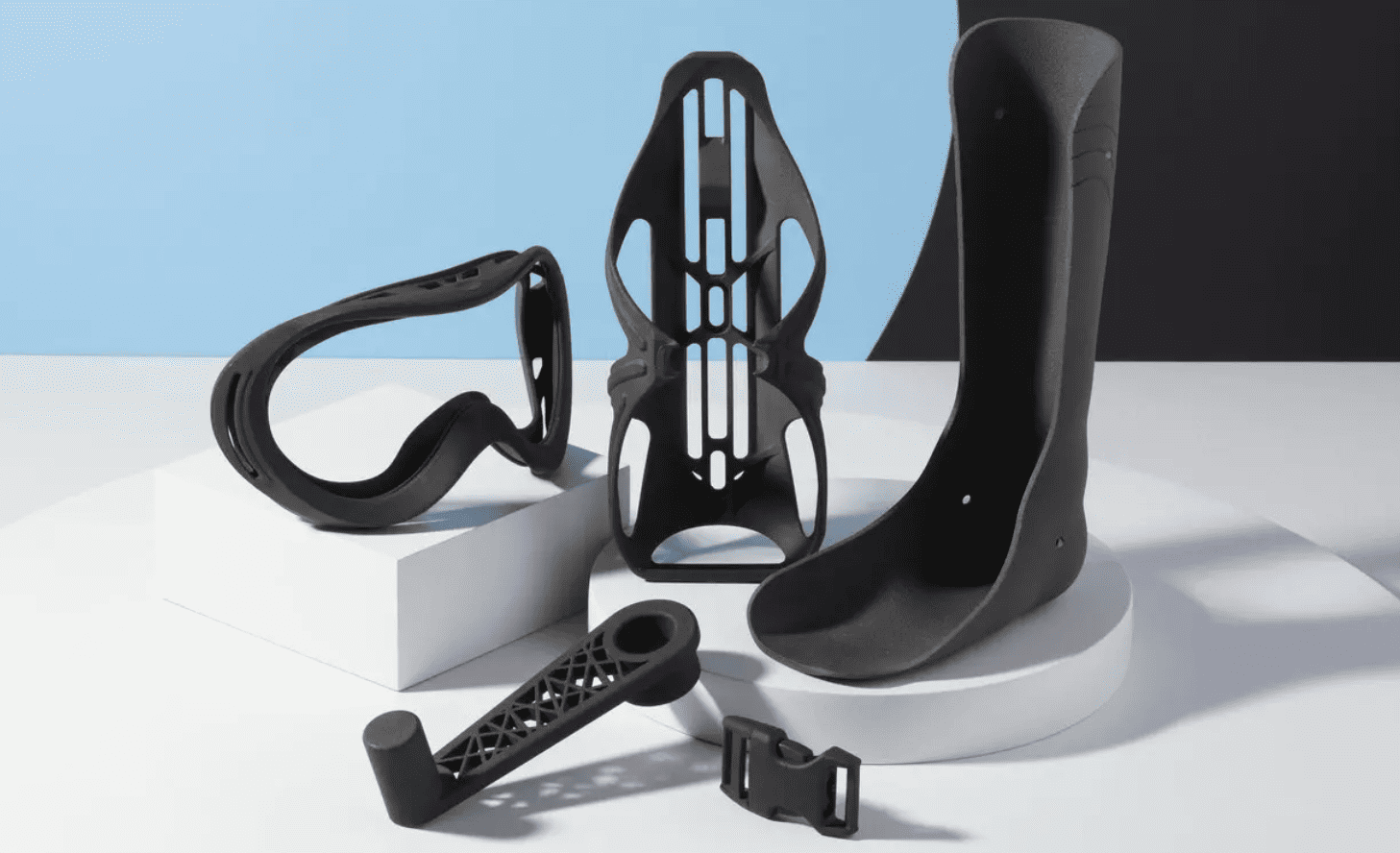
Image Source: Formlabs
Selection Parameters and Constraints
Solvent Identity and Chemistry
• Classify solvents, such as nonpolar hydrocarbons, polar aprotic, polar protic, chlorinated solvents, strong acids/bases, and oxidizers.
• Note mixtures, additives, and real-world formulations, commercial fluids are rarely pure.
Exposure Profile
• Continuous immersion vs splash vs vapor exposure.
• Concentration, 100% solvent vs diluted solutions.
• Temperature and pressure during exposure.
• Cyclic exposure, wet or dry cycles, thermal cycling.
Mechanical Requirements
Static load vs dynamic cycling, tensile/compressive load, impact resistance, and sealing function.
Service Lifetime and Safety
Expected lifetime, failure consequences, regulatory needs, such as food, medical, and UL flammability.
Manufacturing and Cost
• Compatibility with molding, extrusion, 3D printing, bonding, and coatings.
• Budget constraints and availability of grades.
Testing and Verification Capability
Ability to run immersion tests, accelerated aging, or perform field trials.
Step-by-Step Material Selection Process
1. Define the exposure matrix. Record every solvent and real operational condition (temp, time, stress). Be conservative, include possible upset conditions.
2. Prioritize requirements. Rank what matters most: chemical resistance, mechanical performance, temperature tolerance, cost, and regulatory constraints.
3. Screen broad polymer families. Use compatibility charts and chemistry rules to eliminate clearly unsuitable families. Consider polarity matches and temperature limits.
4. Shortlist candidate grades. Within families, select engineering grades rather than generic commodity resins when performance is critical.
5. Consult the vendor and published compatibility charts. Use them as a starting filter, treat them as informative but not definitive.
6. Perform lab screening tests, such as immersion tests, mechanical testing after exposure, visual inspection for crazing, clouding, or discoloration, and permeation tests for thin walls.
7. Accelerated aging and prototype trials. Use elevated temperatures or cyclic conditions to accelerate effects, but interpret acceleration conservatively.
8. Field verification. If practical, install prototypes and monitor under actual operating conditions.
9. Document acceptance criteria. Define allowable mass change, dimensional change, and retained mechanical properties.
Common Polymer Families and Typical Solvent Resistance
PTFE (Polytetrafluoroethylene, Teflon)
Outstanding chemical inertness; resists virtually all solvents and oxidizers at typical temperatures. Low friction, high temp capability, but poor mechanical strength and difficult to bond. Ideal for seals, linings, and bearings when cost is acceptable.
PE (LDPE, HDPE)
Excellent resistance to many hydrocarbons, acids, and bases; limited high-temperature performance (~80–120°C depending on grade). Permeable to some organic solvents and aromatic compounds. Good for tanks and piping at moderate temps.
Similar to PE with slightly higher temperature capability and better chemical resistance to bases. Not suited for strong oxidizers, some aromatics at high temp.
PEEK (Polyetheretherketone)
One of the highest performing thermoplastics — excellent chemical resistance, very high temperature capability, and superb mechanical properties. Expensive but often the correct choice for harsh environments.
POM (Acetal, Delrin)
Good for hydrocarbons and alcohols, but can be attacked by strong acids and oxidizers. Moderate temperature limits.
PVC (Rigid)
Good resistance to acids, alkalis, and many alcohols. Organic solvents and high temperatures soften PVC. Widely used in piping for lower temp service.
Methods to Enhance Resistance
1. Barrier coatings and linings. Apply fluoropolymer coatings, epoxy linings, or Parylene films to create a chemically inert barrier. Coatings protect but can delaminate under mechanical stress—surface prep and adhesion testing are crucial.
2. Use liners or composite constructions. Combine a chemically resistant inner liner (PTFE, PVDF) bonded to a structural outer polymer to get the best of both worlds.
3. Filled or modified compounds. Glass or carbon fillers reduce free volume and solvent uptake; chemical stabilizers and additives can improve resistance. Note trade-offs in toughness and processability.
4. Crosslinking or thermosets. Crosslinked systems and thermoset polymers (epoxies, phenolics) are often far more solvent resistant than thermoplastics, though processing and repair become more complex.
5. Design for swelling and stress relief. Provide tolerances for dimensional change, avoid tight interference fits in solvent-exposed areas, and eliminate sharp stress concentrators that promote crazing.
6. Surface treatments. Plasma or chemical surface treatments can improve coating adhesion or reduce initial solvent uptake.
7. Operational controls. Lower operating temperature, dilution, or reduced exposure time can extend life dramatically.
8. Redundancy and monitoring. For critical systems, design with fail-safe features and monitor key indicators, including leakage, pressure drops, and visual checks.
 1
1


COMMENTS
- Be the first to share your thoughts!