 English
  日本語
日本語  Deutsch


Threaded parts are common in everyday products, from enclosures and machine covers to brackets, fasteners, and custom assemblies. In 3D printing, however, threads are not always as simple as they look on screen. A thread may appear correct in CAD, but once printed, the real part can be too tight, too weak, or too rough to assemble properly.
That is why thread design for 3D printing requires more than copying a standard thread profile into your model. You need to think about the printing process, material behavior, layer resolution, and how the part will be used after printing. In some cases, direct printing works well. In others, the better choice is to redesign the thread, increase clearance, or use a post-processing method instead.
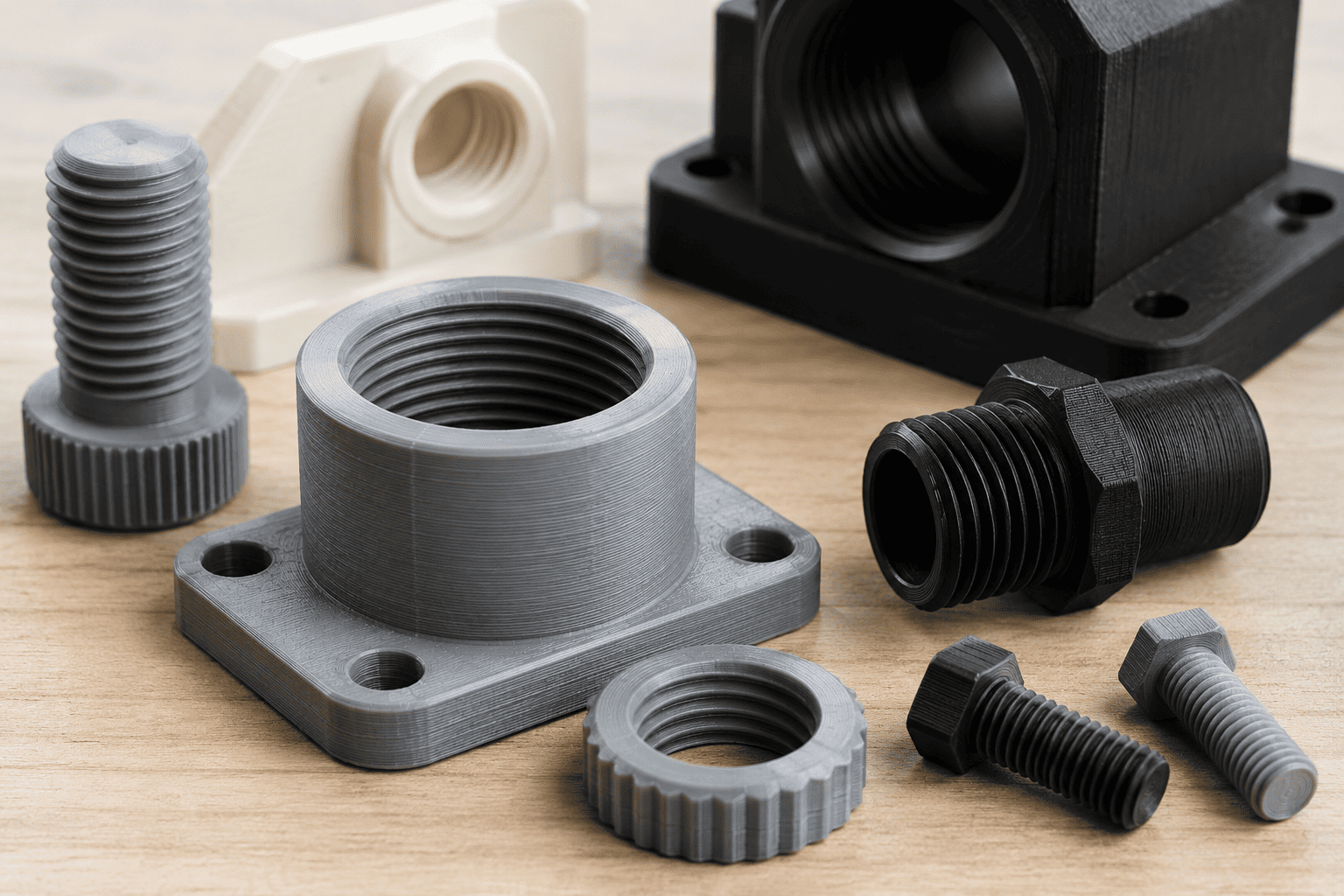
AI Generated Image
What Makes Threads Difficult to 3D Print
Threads are small geometric features with repeated slopes, valleys, and peaks. That makes them sensitive to the limits of 3D printing.
One major challenge is surface quality. Most 3D printing technologies build parts layer by layer, so the thread surface is never perfectly smooth. Layer lines can interfere with the fit of male and female threads, especially on fine pitches. A thread that looks fine in a digital model may bind during assembly because the real surface has small ridges and step marks.
Another issue is tolerance. 3D printers do not produce exact dimensions in the same way every time. Heat, shrinkage, material type, orientation, and machine calibration all affect the final size. For threaded parts, even a small dimensional error can make the thread unusable. If the printed hole is slightly too small, the screw may not start. If the external thread is slightly oversized, it may damage the mating part.
Thread strength is also a concern. Thin thread tips can be fragile, especially in brittle materials or in parts printed with poor layer bonding. A thread can strip easily if the profile is too small or if the load is applied repeatedly.
Orientation matters as well. Threads printed parallel to the build direction may show different strength than threads printed across layers. The layer orientation can influence not only strength but also the smoothness of the thread surface. This is why a thread that works in one print orientation may fail in another.
Choose the Right Thread Type
Not every thread is equally suitable for 3D printing. The best choice depends on the part’s purpose and the type of printer you use.
Internal threads are often easier to manage in printed parts, especially for large housings or covers. External threads can also work, but they are more exposed and can be damaged more easily during handling or support removal. If the part will be assembled many times, durability should be considered early in the design.
Coarse threads are usually better than fine threads. A coarse thread has larger features, which makes it easier for the printer to reproduce accurately. It is also less sensitive to small surface defects. Fine threads may look neat in CAD, but they often perform worse after printing because the details are too small for reliable use.
Standard metric and imperial threads can be printed, but standard dimensions do not always translate well to additive manufacturing. In many cases, it is better to slightly adjust the design rather than expect a perfectly printed standard thread to perform like a machined one. For functional applications, it is often smarter to use a thread size that gives more room for tolerance and assembly.
It is also important to consider whether the thread needs to be load-bearing or only lightly used. A decorative thread or a light-duty closure may be fine with direct printing. A structural fastening point, on the other hand, may need a stronger solution, such as an insert or tapping after printing.
Design Guidelines for Better Printed Threads
Good thread design starts with geometry. The more you adapt the thread for printing, the better the final result will be.
Add Clearance
Printed threads usually need more space than machined threads. Internal threads should be slightly larger, while external threads should be slightly smaller than nominal dimensions, depending on the printer and material. The exact adjustment should be tested, because the best tolerance varies by technology and machine.
Keep the Thread Size Practical
Very small threads are difficult to print accurately, especially on desktop FDM machines. If the thread is too fine, the printer may not form clean peaks and valleys. Larger thread diameters and deeper profiles are easier to produce and more likely to assemble successfully.
Use Chamfers or Lead-Ins
A small chamfer at the entrance of an internal thread helps the screw or bolt start more easily. It also reduces the chance of cross-threading. This simple change can make assembly much smoother.
Avoid Making the Thread too Deep Unless Necessary
Deep threads can increase print time and may trap support material or debris. In some cases, a shallower thread with better clearance performs better than a fully detailed standard thread.
Think about Orientation before You Finalize the CAD Model
If possible, orient the part so the thread forms in the direction that gives the best finish and strength. Sometimes a slight change in orientation improves print quality more than any design adjustment.
Always Test before Production
A thread that works on one printer or with one material may not work on another. Printing a small sample first can save time, reduce waste, and prevent assembly problems later.
When to Use Alternatives to Printed Threads
Directly printed threads are not always the best answer. In many applications, an alternative method is more reliable and professional.
Threaded inserts are one of the most common solutions. These are metal inserts placed into the printed part to create a stronger and more durable fastening point. They are especially useful when a screw will be removed and reinstalled many times. Heat-set inserts work well in some thermoplastics, while press-fit inserts can be used in other cases.
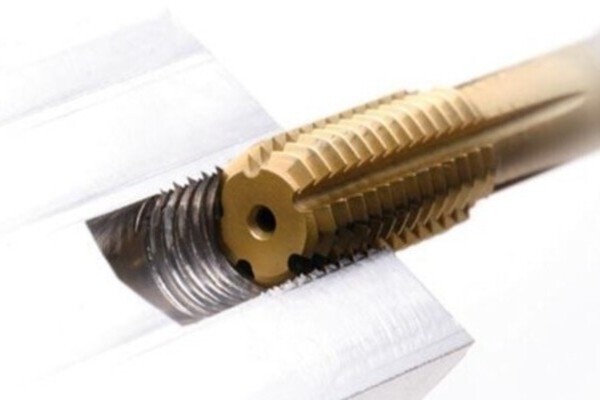
Post-processing is another option. If a printed hole is close to the needed size, tapping can improve the thread after printing. This approach is often better than depending on the printer to form the full thread profile by itself. Tapping is especially useful for parts that need a more precise or usable connection.
Machining after printing is the most reliable choice for high-precision applications. A 3D printed part can be used as a near-net-shape blank, then drilled, tapped, or threaded on a machine. This combines the design freedom of additive manufacturing with the accuracy of subtractive manufacturing.
The right alternative depends on the use case. If the thread is mainly for appearance or light assembly, direct printing may be enough. If the part must hold torque, repeat use, or tight tolerances, inserts, tapping, or machining are usually better options.
 0
0


COMMENTS
- Be the first to share your thoughts!