 English
  日本語
日本語  Deutsch


Electrostatic discharge (ESD) is an invisible but significant threat in electronics manufacturing. A small static spark that goes unnoticed by a person can permanently damage integrated circuits, sensors, and other sensitive components. As manufacturers increasingly adopt 3D printing for production tooling and functional parts, ESD-safe materials have become an important category of engineering plastics.
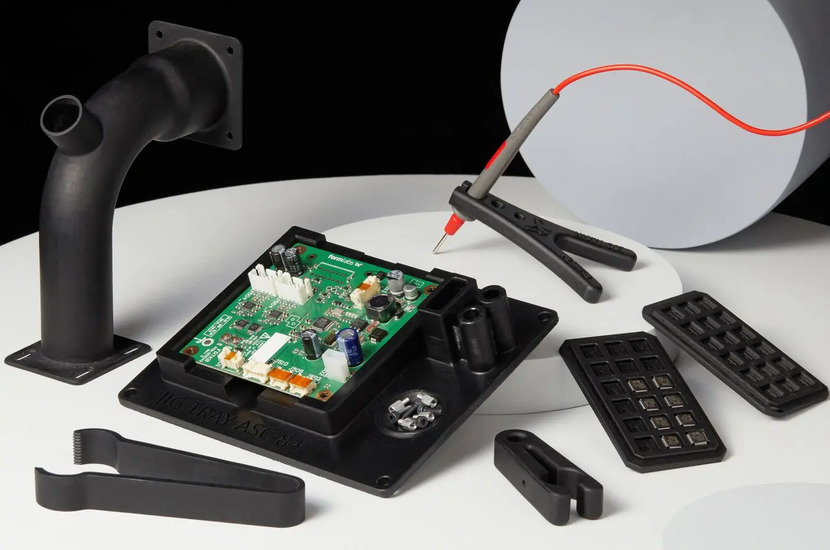
Image Source: Formlabs
What Are ESD Materials?
ESD stands for Electrostatic Discharge, the sudden flow of electricity between two objects with different electrical charges. Static electricity can accumulate through simple activities such as handling plastic parts, moving packaging materials, or even walking across certain flooring.
Standard plastics are typically electrical insulators, allowing static charges to build up on their surfaces. When the accumulated charge is released, it may damage delicate electronic components or reduce manufacturing yield.
ESD-safe materials are formulated with conductive or static-dissipative additives that allow electrical charges to dissipate gradually rather than discharging suddenly. Their electrical resistance is carefully controlled so they reduce static buildup without behaving like highly conductive metals.
Many ESD materials fall within the static-dissipative range, making them suitable for handling electronic assemblies while minimizing the risk of accidental discharge.
Key Properties of 3D Printed ESD Materials
Static Dissipation
The primary purpose of an ESD material is to safely dissipate accumulated electrical charges. This helps prevent sudden electrostatic discharge that could damage electronic devices during assembly, testing, or transportation.
Mechanical Strength
Most ESD materials maintain good mechanical properties, allowing them to be used for production tooling, fixtures, protective housings, and functional end-use parts. Depending on the base polymer, they can offer high stiffness, impact resistance, or durability.
Dimensional Accuracy
Many ESD applications require precise positioning of electronic components. 3D printed ESD materials can provide the dimensional stability needed for assembly fixtures, inspection gauges, and alignment tools where consistent accuracy is important.
Wear Resistance
Manufacturing tools are often used repeatedly throughout production. Many engineering-grade ESD materials provide good wear resistance, allowing trays, jigs, and fixtures to withstand frequent handling without significant degradation.
Industrial Compatibility
Some ESD materials also offer enhanced resistance to chemicals, oils, cleaning agents, or elevated temperatures, making them suitable for demanding industrial and electronics manufacturing environments.
Common Types of ESD Materials
ESD Nylon (PA12)
ESD PA12 is widely used in Selective Laser Sintering (SLS) and Multi Jet Fusion (MJF). It combines excellent strength, toughness, and dimensional stability with reliable static-dissipative properties. It is commonly used for production fixtures, robotic tooling, custom trays, and inspection tools.
ESD ABS
ESD ABS is frequently used with FDM 3D printing. It offers a relatively affordable solution for manufacturing aids, electronic enclosures, and functional prototypes where moderate mechanical strength is sufficient.
ESD PC
Polycarbonate-based ESD materials provide higher impact resistance and improved heat resistance compared to ABS. They are often selected for industrial equipment and protective covers that experience more demanding operating conditions.
High-Performance ESD Polymers
For aerospace, semiconductor, and advanced manufacturing applications, high-performance polymers such as ESD PEKK or ESD PEEK provide exceptional chemical resistance, temperature stability, and mechanical performance. Although significantly more expensive, they are suitable for highly demanding production environments.
Advances in resin technology have introduced ESD-capable photopolymer materials for LCD and other resin-based 3D printing processes. These materials combine high printing accuracy with static-dissipative performance, making them suitable for precision electronic applications.
Applications of 3D Printed ESD Parts
Electronics Assembly Fixtures
Assembly fixtures, positioning jigs, and testing tools made from ESD materials help protect printed circuit boards (PCBs) and sensitive electronic assemblies during production.
Semiconductor Manufacturing
Semiconductor production requires strict control of electrostatic discharge. Custom wafer carriers, handling tools, transport trays, and inspection fixtures can all benefit from ESD-safe materials.
Electronic Packaging
Custom packaging inserts, storage trays, and transport containers made with ESD materials provide both mechanical protection and static control during shipping and internal logistics.
Robotic End-of-Arm Tooling
Robotic grippers and end-of-arm tooling frequently come into direct contact with sensitive components. Lightweight 3D printed ESD parts help reduce robot payload while maintaining safe handling.
Custom Electronic Enclosures
Small-batch electronic housings and protective covers can be produced using ESD materials, providing both functional protection and static control without investing in injection molding.
Pros and Cons
|
Pros |
Cons |
|
Protect sensitive electronic components from electrostatic discharge. |
Higher material costs than standard engineering plastics. |
|
Enable customized tooling with rapid design iterations. |
More limited material selection compared to conventional resins or nylons. |
|
Reduce tooling costs for prototypes and low-volume production. |
Electrical performance varies between material formulations. |
|
Lightweight compared to many traditional metal fixtures. |
Some ESD materials may have reduced cosmetic appearance due to conductive additives. |
|
Available across multiple 3D printing technologies, and suitable for functional industrial applications. |
Proper ESD workplace procedures are still required, as ESD-safe materials alone cannot eliminate all electrostatic risks. |
LCD 3D Printing ESD Resin at 3DSPRO
For customers who require both excellent detail resolution and static protection, 3DSPRO offers LCD ESD Resin as part of its professional resin 3D printing services.
LCD 3D printed ESD resin is designed for applications where dimensional accuracy and smooth surface quality. LCD printing enables the production of complex geometries, fine features, and precise components that would be difficult or costly to manufacture using traditional methods.
Typical applications include electronic inspection fixtures, assembly aids, connector alignment tools, sensor holders, small electronic enclosures, and precision manufacturing accessories.
If your application requires ESD-safe performance together with fine detail and fast turnaround, 3DSPRO's LCD ESD resin offers an efficient solution for producing accurate, functional parts without the need for expensive tooling.
 0
0


COMMENTS
- Be the first to share your thoughts!