 English
  日本語
日本語  Deutsch


Choosing a manufacturing process is not only about materials, tolerances, or surface finish. One of the most important factors is production quantity. A manufacturing method that is cost-effective for a single prototype may become prohibitively expensive for thousands of parts, while a process designed for mass production may not make financial sense for a small batch.
As production volume increases, the balance between setup costs, tooling investment, lead time, and per-part cost changes. Understanding this relationship can help you select the most efficient manufacturing process and avoid unnecessary expenses.
AI Generated Image
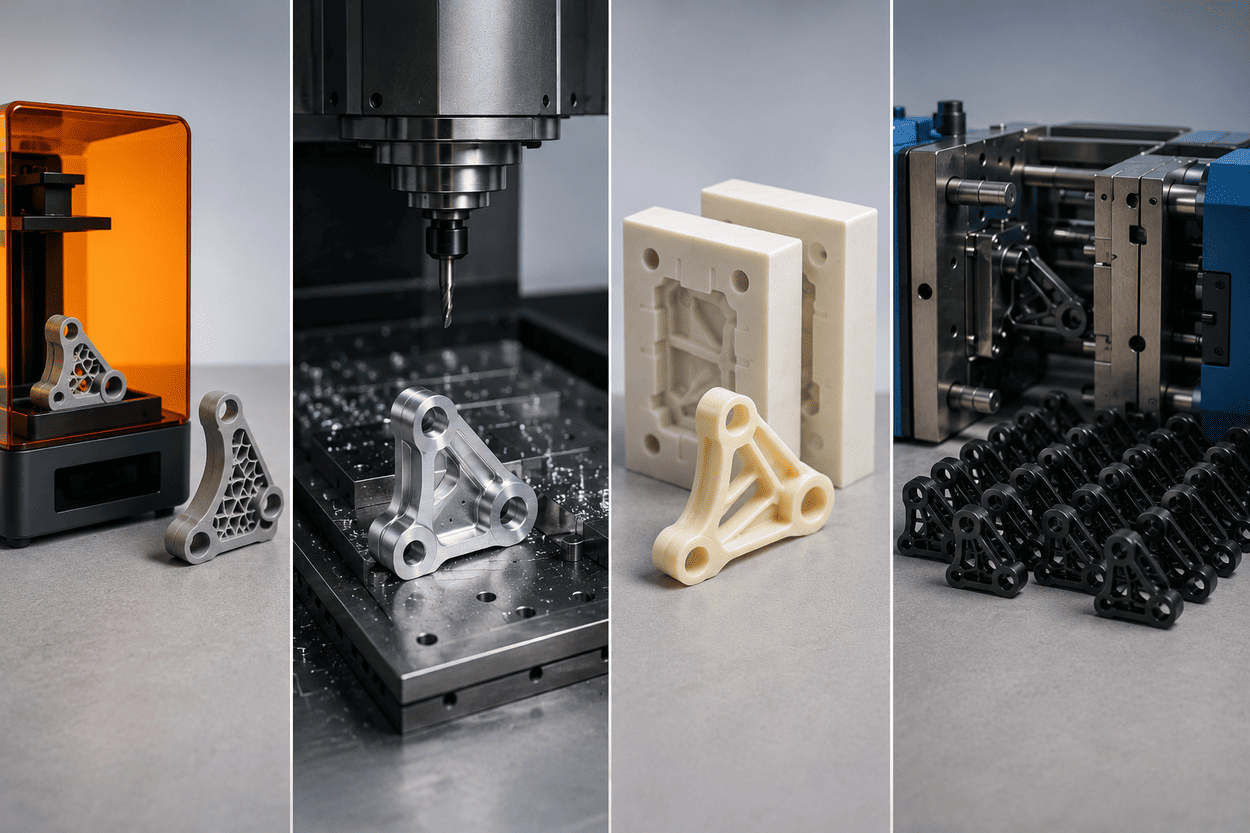
One-Off Parts and Prototypes: 3D Printing
Typical Quantity: 1 to 10 Parts
When you need only one part or a handful of prototypes, 3D printing is often the most practical manufacturing method.
The biggest advantage of 3D printing is that it requires no tooling. Traditional manufacturing processes often involve setup work, fixtures, molds, or programming costs that can significantly increase the price of a low-volume order. With 3D printing, production can begin directly from a digital CAD file.
3D printing is particularly suitable for concept models, design verification, functional prototypes, custom products, and one-off replacement parts.
Another major benefit is design freedom. Complex internal channels, lattice structures, and intricate geometries can often be produced without additional manufacturing complexity. Creating these features using conventional methods may require multiple setups or may not be possible at all.
Lead times are also typically shorter because there is no need to manufacture molds or special tooling before production begins.
For quantities ranging from one to roughly ten parts, 3D printing generally offers the fastest and most economical path from design to finished product.
Small Production Runs: Comparing 3D Printing and CNC Machining
Typical Quantity: 10 to 100 Parts
As quantities increase into the range of approximately 10 to 100 parts, the decision becomes less straightforward. Both 3D printing and CNC machining can be viable options, depending on the project's requirements.
3D printing remains attractive because there are still no tooling costs. It allows manufacturers to produce parts on demand and supports rapid design modifications. If multiple design iterations are expected, 3D printing often remains the preferred solution.
However, CNC machining begins to offer advantages in certain situations.
Machined parts are produced directly from solid engineering materials such as aluminum, stainless steel, brass, POM, ABS, or polycarbonate. This can provide superior mechanical properties, tighter tolerances, and better surface finishes compared with some additive manufacturing processes.
CNC machining is often preferred when:
• Precise dimensional accuracy is critical.
• High-strength engineering materials are required.
• Excellent surface finish is needed.
• The part geometry is relatively simple.
The tradeoff is that CNC machining involves setup and programming costs. While these costs can be spread across a batch of parts, they may still be significant for very small orders.
In practice, the choice often depends on the part design. Complex geometries may favor 3D printing, while simpler designs with demanding performance requirements may be better suited to CNC machining.
For many projects within this production range, manufacturers may even combine both processes by using 3D printing for prototyping and CNC machining once the design has been finalized.
Medium-Volume Production: Vacuum Casting
Typical Quantity: 20 to 200 Parts
When production quantities move beyond typical prototype volumes but remain far below mass production levels, vacuum casting often becomes an attractive solution.
Vacuum casting uses silicone molds created from a master model, which is commonly produced through SLA 3D printing. Liquid polyurethane resin is then poured into the mold under vacuum conditions to create production parts. It bridges the gap between prototyping and injection molding.
Compared with producing dozens or hundreds of parts through 3D printing, vacuum casting can significantly reduce the cost per part. At the same time, the tooling investment remains much lower than injection molding.
Vacuum casting is particularly suitable for product validation batches, pilot production, market testing, pre-production runs, and low-volume commercial products.
The process can also achieve excellent surface quality and allows manufacturers to simulate the appearance and performance of various production plastics.
One limitation is mold life. A silicone mold can typically produce only a limited number of parts before replacement is necessary. Because of this, vacuum casting is most economical for medium-volume production rather than long-term mass manufacturing.
For quantities ranging from roughly 20 to 200 parts, vacuum casting often provides an effective balance between cost, quality, and lead time.
High-Volume Manufacturing: Injection Molding
Typical Quantity: 1000+ Parts
When production quantities reach hundreds or thousands of units, injection molding becomes increasingly attractive.
Unlike the other methods discussed so far, injection molding requires a metal mold that can be expensive to manufacture. Depending on part complexity, mold costs can range from several thousand dollars to significantly more.
At first glance, this investment may seem difficult to justify. However, the economics change dramatically as production volume increases.
Once the mold is completed, parts can be produced rapidly and repeatedly with highly consistent quality. The per-part cost decreases substantially because the tooling expense is distributed across a large number of units.
Injection molding offers several advantages, including extremely low unit cost at high volumes, fast production cycles, consistent part quality, wide material selection, and excellent repeatability.
For consumer products, electronics housings, automotive components, and many industrial applications, injection molding remains the preferred manufacturing method for large-scale production.
The challenge is determining when the transition should occur. The exact break-even point varies based on part size, complexity, material choice, and tooling costs. In some cases, injection molding becomes economical at several hundred units. In others, the transition may not occur until production reaches several thousand parts.
Careful cost analysis is essential before committing to tooling investment.
Quantity Isn't the Only Decision Factor
Although production quantity is a major factor in manufacturing decisions, it should never be considered in isolation.
Material requirements often influence process selection. A project requiring aerospace-grade aluminum or stainless steel may naturally favor CNC machining, regardless of quantity. Similarly, certain plastic materials may only be available through specific manufacturing methods.
Part geometry also matters. Complex internal structures that are easy to print may be difficult or impossible to machine. Likewise, designs intended for injection molding must follow specific design rules to ensure proper moldability.
Tolerance requirements can further affect the decision. Some applications demand extremely tight dimensional control that may limit the available manufacturing options.
Lead time is another important consideration. A company preparing for a product launch may prioritize speed over unit cost. In such cases, 3D printing or vacuum casting may help bring products to market faster than waiting for injection mold production.
Finally, design stability should not be overlooked. If a design is still evolving, investing in expensive tooling may introduce unnecessary risk. Flexible manufacturing methods that allow easy design changes can provide significant advantages during product development.
Production quantity plays a central role in determining the most suitable manufacturing process. For one-off prototypes, 3D printing often delivers the best combination of speed and cost efficiency. As quantities increase, CNC machining becomes a strong option for precision parts, while vacuum casting provides an economical solution for medium-volume production. For large-scale manufacturing, injection molding typically offers the lowest per-part cost.
 0
0


COMMENTS
- Be the first to share your thoughts!