 English
  日本語
日本語  Deutsch


Selective Laser Melting (SLM) can produce complex tubular components with hollow cavities, curved surfaces, branches, and thin walls. These structures are widely used in applications such as turbine piping, intake manifolds, and coolant manifolds. However, their geometry also makes them more challenging to print than conventional solid parts. Without appropriate support structures, tubular components may experience collapse, warping, cracking, dimensional deviation, and other forming defects.
For this reason, support structures are not simply an additional feature added to an SLM build. They perform several important mechanical and thermal functions. The key engineering challenge is therefore not to eliminate supports, but to determine where support is functionally required and how much is actually necessary.
SLM 3D Printing Supports Strategy for Tubular Components:
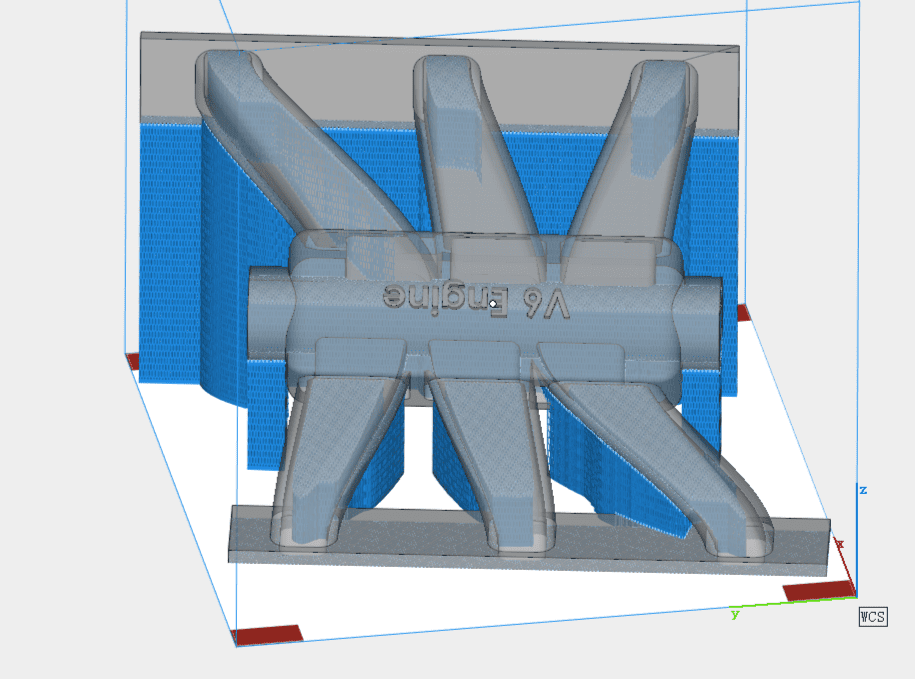
Image Copyright © 3DSPRO. All rights reserved.
SLM Forming Challenges of Tubular Components
Tubular components have several structural characteristics that increase the difficulty of SLM processing. Their walls may be relatively thin, while their geometry often includes curved surfaces, branches, transitions, overhanging regions, and enclosed internal cavities. Compared with solid components, these structures have lower overall stiffness and fewer natural paths for heat dissipation.
During layer-by-layer SLM processing, these characteristics can make the component more sensitive to thermal stress and mechanical instability. In unsupported areas, the molten material may not have sufficient structural stability during solidification. This can result in collapse, dross, layer misalignment, warping, or dimensional deviation.
These risks explain why tubular components generally require more carefully planned support structures than conventional solid geometries.
Why Supports Are Required for SLM Tubular Components
Support structures perform three primary functions in SLM tubular components: mechanical support, heat dissipation, and structural restraint.
1. Mechanical Support for Overhanging Structures
Many tubular geometries contain regions that extend away from the build platform or from previously solidified material. Examples include curved tube walls, manifold branches, transition surfaces, and suspended flange sections.
During printing, the molten pool remains in a high-temperature state before it fully solidifies. Without sufficient support, unsupported regions can become unstable, causing collapse, excessive dross, or layer displacement. In severe cases, internal openings may become blocked, or the entire component may fail.
Support structures therefore provide a mechanical foundation for areas that cannot reliably maintain their shape during the build.
2. Heat Dissipation and Thermal Stress Control
Mechanical support is only part of the function. SLM involves rapid heating and cooling, which creates significant temperature gradients within the component. Thin-walled tubular structures are particularly sensitive because their low wall thickness and uneven geometry can make heat accumulation more difficult to control.
A support structure can provide an additional heat-conduction path, helping transfer heat away from the melt region and distribute the thermal load more evenly. This can reduce thermal stress and help limit warping, bulging, and cracking in thin-walled areas.
For enclosed or curved tubular structures, this thermal function can be especially important because some areas have limited access to external heat-dissipation paths.
3. Structural Restraint and Dimensional Stability
Residual stress generated during layer-by-layer solidification can cause thin tubular walls to deform as the material contracts. Typical problems include ovalized tube openings, depressed surfaces, and distorted branches.
Support structures can provide additional rigidity around vulnerable regions, limiting deformation during solidification. This helps maintain critical dimensions such as circularity, flatness, concentricity, and assembly interfaces.
Therefore, support structures should be considered functional process structures rather than simply temporary material added for overhangs.
Determining the Reasonable Amount of Support
There is no universal support quantity that can be applied to every tubular component. A reasonable support strategy should provide enough mechanical and thermal stability to meet the required part quality while avoiding unnecessary support material and post-processing work.
Several criteria can be used to determine whether the support level is appropriate.
1. Forming Stability
The component should be printed without collapse, excessive dross, or layer cracking. Overall deformation should remain within the specified dimensional and geometric tolerances, particularly around critical interfaces.
2. Thermal Stability
Support should help prevent significant local heat accumulation and thermal stress concentration. After printing, thin-walled areas should not show unacceptable warping, bulging, or cracking.
3. Functional Necessity
Every support region should have a clear purpose, such as providing mechanical restraint or improving heat conduction. Large areas of solid or redundant support should be avoided when they do not contribute to forming stability.
4. Post-Processing Requirements
Supports must also be removable. Excessive contact area or inaccessible support can make removal difficult, particularly inside enclosed cavities or around thin walls. A suitable support strategy should minimize residual material and prevent damage caused by aggressive support removal.
5. Production Cost
Support quantity also affects material consumption, printing time, and post-processing labor. The appropriate support level is therefore the point where forming reliability and production efficiency are balanced rather than simply the lowest possible support volume.
The Consequences of Insufficient or Excessive Support
Both extremes can create problems.
Insufficient support may fail to provide adequate mechanical restraint or thermal control, leading to collapse, deformation, cracking, and ultimately part rejection.
Excessive support, on the other hand, may add unnecessary material, increase the printing workload, extend production time, and make support removal more difficult.
The goal of support design is therefore not simply to use less support. It is to use only the support that performs a necessary function.
What Defines an Appropriate Support Strategy?
For SLM tubular components, an appropriate support strategy should achieve four objectives simultaneously: Forming stability, thermal control, dimensional accuracy, and post-processing efficiency.
This means support should be sufficient to prevent critical defects, functionally matched to the requirements of different regions, and minimized wherever it provides no meaningful benefit. The final objective is a controlled balance between part quality, support consumption, production time, and post-processing effort.
In practice, determining the appropriate support level is not based on a fixed support quantity or density. It depends on the geometry, wall thickness, overhanging conditions, thermal behavior, and dimensional requirements of each region of the component.
It provides the foundation for support optimization. The next step is to determine how support structures can be selectively designed, lightweighted, and positioned to meet these requirements with less redundancy.
 0
0