 English
  日本語
日本語  Deutsch


When comparing 3D printing technologies, resolution and accuracy are two of the most important terms to understand. They are often used interchangeably, but they describe different aspects of a 3D printed part.
A printer can produce very fine details without producing a dimensionally accurate part. Likewise, a part can match the specified dimensions closely while having a relatively rough surface or limited ability to reproduce tiny features.
Understanding the difference between 3D printing resolution and accuracy helps you choose the right manufacturing process, set realistic design expectations, and avoid problems during production.
AI Generated Image
3D Printing Resolution and Accuracy Explained
3D printing resolution refers to the level of detail that a 3D printing process can reproduce. It describes how finely the printer can create features, layers, pixels, or deposited material.
Resolution can involve several different parameters depending on the printing technology.
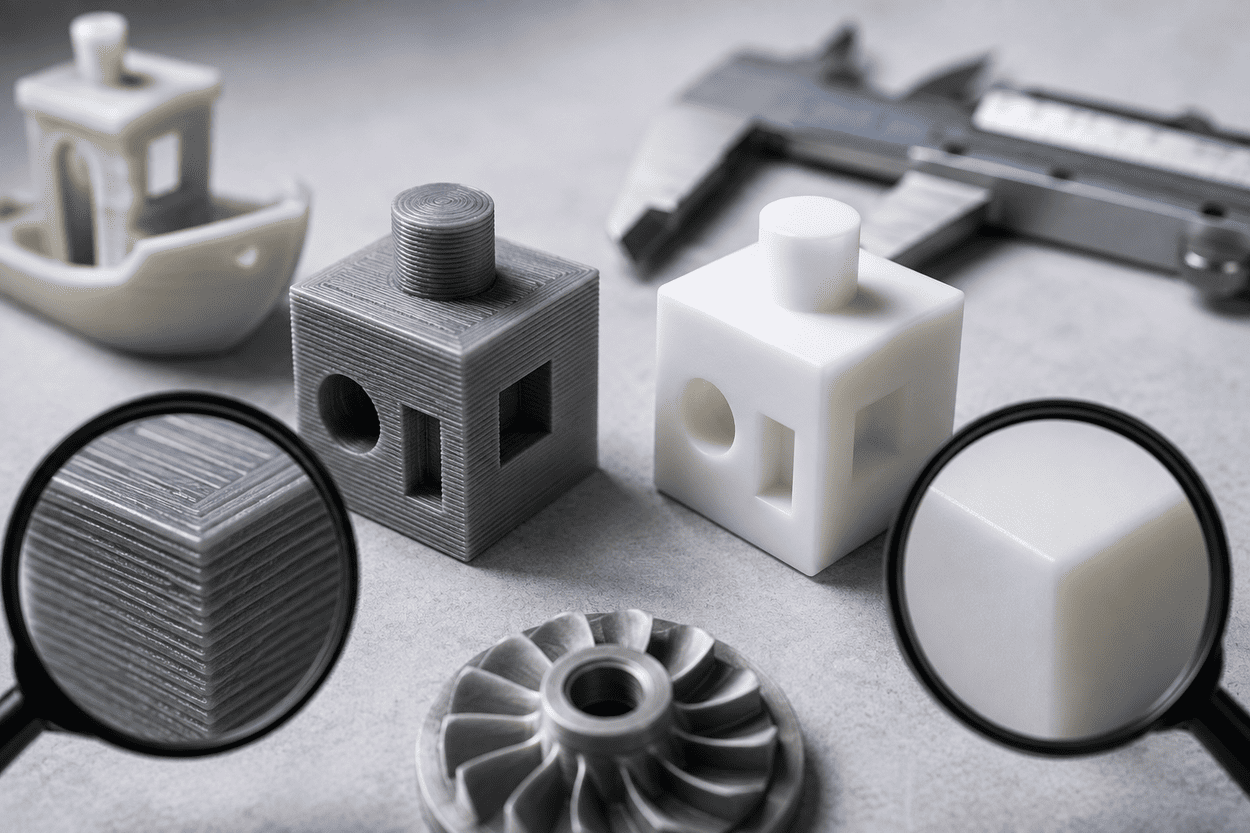
Layer height is one of the most commonly discussed resolution parameters. It defines the thickness of each printed layer in the Z direction. A smaller layer height generally produces finer vertical detail and a smoother surface, especially on curved or angled surfaces.
For example, an SLA or DLP printer may use relatively thin layers to reproduce small surface details. FDM printing typically uses thicker layers, which can make very small vertical features more difficult to reproduce.
Resolution also depends on the technology's feature size. For resin-based 3D printing, XY resolution is influenced by the projected pixel size or laser spot size. For FDM, resolution is affected by nozzle diameter, extrusion behavior, and the printer's ability to accurately control material deposition.
However, higher theoretical resolution does not automatically mean a part will have better overall quality. Material properties, machine calibration, part orientation, and post-processing can all affect the final result.
What Is 3D Printing Accuracy?
3D printing accuracy refers to how closely the dimensions of a printed part match the dimensions specified in the original CAD model.
For example, if a hole is designed with a diameter of 10.00 mm and the printed hole measures 9.90 mm, the dimensional deviation is 0.10 mm.
Accuracy is therefore mainly concerned with dimensional conformity, rather than the ability to reproduce tiny details.
A part can have high resolution but poor accuracy. A high-resolution printer may reproduce a very small feature clearly, while thermal shrinkage, material deformation, or process variation causes the overall dimensions to deviate from the CAD model.
Accuracy is commonly evaluated by comparing measured dimensions against the nominal CAD dimensions. Depending on the application, different features may have different acceptable tolerances.
It is also important to distinguish accuracy from repeatability. Accuracy describes how close a result is to the target dimension, while repeatability describes how consistently the process produces the same result.
For functional components, accuracy is often more important than simply achieving the smallest possible layer height.
3D Printing Resolution vs. Accuracy
The simplest way to understand the difference is to think of resolution as detail capability and accuracy as dimensional precision.
Resolution answers questions such as:
• How small a feature can the process reproduce?
• How fine can the layers or pixels be?
• How smooth and detailed can the printed surface appear?
Accuracy answers questions such as:
• How closely will the printed dimensions match the CAD model?
• Will a 20 mm component actually measure close to 20 mm?
• Will holes, slots, and mating surfaces meet the required dimensional tolerance?
These two properties are related, but improving one does not necessarily improve the other.
For example, reducing layer height may improve the appearance of a curved surface, but it cannot automatically compensate for material shrinkage or warping. Similarly, a well-calibrated process may deliver excellent dimensional accuracy while still having visible layer lines.
For engineering applications, it is therefore better to evaluate resolution and accuracy separately rather than selecting a process based only on its advertised resolution.
Which 3D Printing Processes Offer Better Resolution and Accuracy?
Different 3D printing processes have different strengths. The following table provides a general comparison for common production technologies. Actual results vary depending on the machine, material, part geometry, orientation, and post-processing.
|
3D Printing Process |
Typical Resolution Characteristics |
Dimensional Accuracy |
Suitable Applications |
|
SLA |
Very fine layers and small features |
High |
Detailed prototypes, housings, models, visual parts |
|
DLP |
High XY detail with fine layers |
High |
Small detailed parts, prototypes, dental and industrial components |
|
SLS |
Good feature detail without support structures |
Good |
Functional prototypes, complex nylon parts, low-volume production |
|
MJF |
Fine details and consistent layer formation |
Good |
Functional nylon parts, assemblies, production batches |
|
FDM |
Lower detail due to nozzle and layer size |
Moderate |
Large parts, functional prototypes, cost-sensitive components |
|
SLM |
Fine metal features with good dimensional control |
Good |
Metal functional parts, complex engineering components |
|
Metal Binder Jetting |
Good fine-feature capability |
Moderate to good |
Metal production components, batch manufacturing |
What Affects the Resolution and Accuracy of a 3D Printed Part?
1. Printing Technology
Different technologies have different mechanisms for creating features. Laser-based, projected-light, powder-bed, and extrusion processes therefore have different limits for feature size, surface quality, and dimensional control.
2. Machine Calibration
Printer calibration has a direct impact on dimensional accuracy. Poor calibration can lead to inconsistent extrusion, incorrect scaling, positioning errors, or uneven layer formation.
3. Material Properties
Materials can shrink, warp, deform, or change dimensions during printing and cooling. Thermoplastics and metal materials can be particularly sensitive to thermal behavior. Resin systems may also experience shrinkage during curing.
4. Part Orientation
The orientation of a part can affect both detail resolution and dimensional accuracy. Features printed vertically, horizontally, or at an angle may experience different levels of stair-stepping, support interaction, and deformation.
5. Layer Height and Feature Size
Smaller layer heights can improve Z-direction detail and surface smoothness. However, layer height is only one part of the equation. The size of the nozzle, laser spot, projected pixel, or individual powder particles can also limit the smallest practical feature.
6. Part Geometry
Thin walls, deep holes, narrow slots, sharp corners, and large flat surfaces may be more difficult to reproduce accurately than simple geometries. Large parts can also be more susceptible to warping or dimensional variation.
7. Post-processing
Processes such as sanding, blasting, machining, curing, heat treatment, or coating can change final dimensions and surface characteristics. For tight-tolerance parts, post-processing may be required to achieve the final specification.
3D printing resolution and accuracy are not the same thing. Resolution describes how much detail a process can reproduce, while accuracy describes how closely the finished part matches the intended dimensions.
When selecting a 3D printing process, consider both factors alongside material, part size, geometry, tolerance requirements, surface finish, and production volume. A process with extremely high resolution is not necessarily the best choice for a functional component that requires tight dimensional tolerances.
For the most reliable results, define the critical dimensions and tolerances first, then select the printing technology and material that can consistently meet those requirements.
 4
4


COMMENTS
- Be the first to share your thoughts!