 English
  日本語
日本語  Deutsch


Anodizing is one of the most widely used finishing processes for aluminum parts. It can improve corrosion resistance and surface durability while also creating colored finishes through dyeing or electrolytic coloring. However, the final color is not determined by the dye alone. The aluminum alloy itself has a major influence on how the anodized surface looks and how consistently it can be colored.
The difference becomes especially noticeable when comparing 6061 aluminum with AlSi10Mg. Both can be anodized, but 6061 is generally more suitable when a project requires a wider selection of bright and consistent colors. AlSi10Mg, particularly in metal 3D printed parts, can produce darker or less uniform anodized surfaces because of its high silicon content and distinctive microstructure.
Aluminum Alloy Composition Matters in Anodizing
Anodizing is an electrochemical process that converts the aluminum surface into an oxide layer. In sulfuric acid anodizing, the coating contains a porous outer structure that can absorb dyes, allowing manufacturers to produce different colors. The composition and microstructure of the aluminum underneath the coating affect how this oxide layer forms.
6061 is a wrought aluminum alloy in the 6xxx series, with magnesium and silicon as its principal alloying elements. Its silicon content is typically around 0.40–0.80%.
AlSi10Mg is fundamentally different. As its name indicates, it contains approximately 10% silicon, together with magnesium, and is widely used in metal additive manufacturing. The much higher silicon content changes the anodizing behavior of the alloy.
Silicon does not behave in the same way as aluminum during anodizing. Silicon-rich phases can remain within or interact differently with the growing anodic film, affecting film formation, optical appearance, and color uniformity. Research on Al-Si alloys has shown that the silicon phase and its distribution can significantly affect the growth and uniformity of the anodic oxide layer.
This is why selecting an aluminum alloy for anodizing is not simply a matter of choosing a compatible dye. The alloy itself establishes important limits on the final appearance.
Anodized 3D Printed Aluminum 6061 in Red:
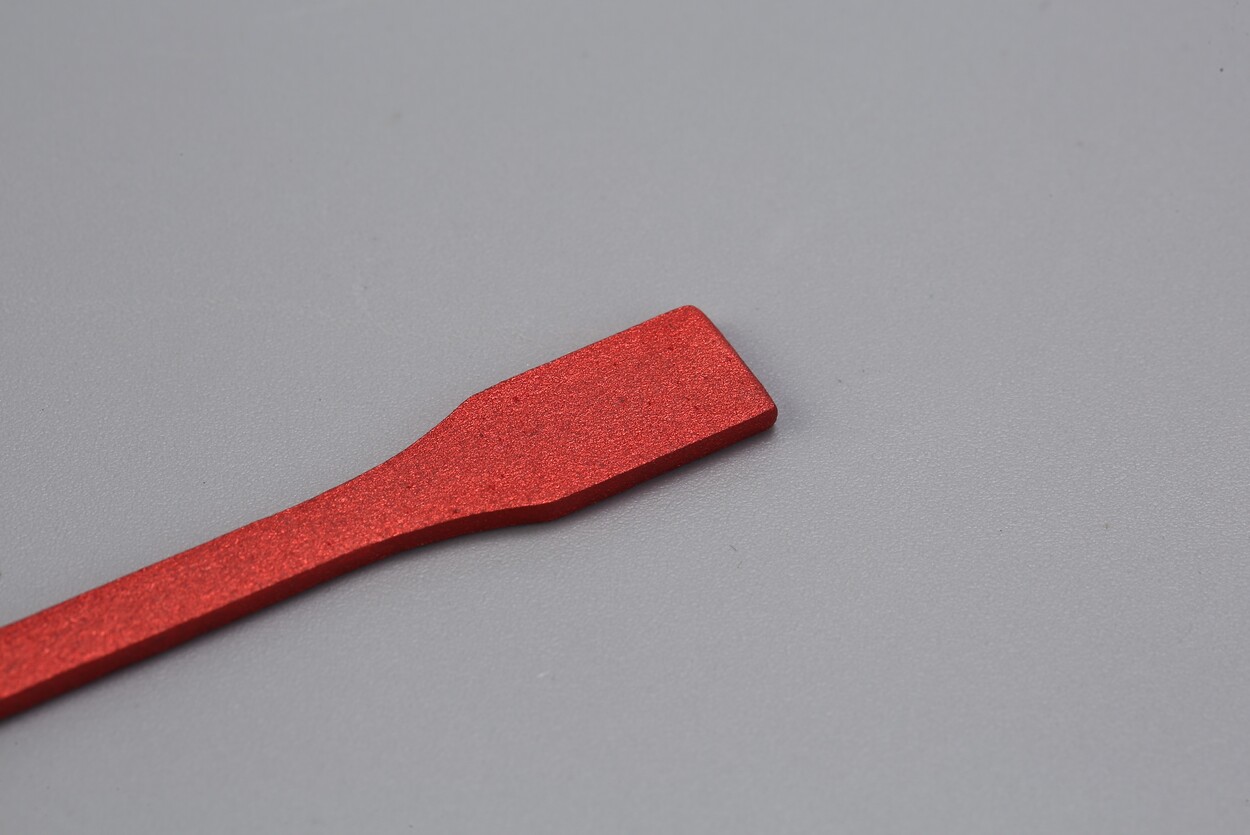
Image Copyright © 3DSPRO. All rights reserved.
What Makes 6061 Suitable for More Anodizing Colors
6061 is considered an alloy with good anodizing characteristics. The Aluminum Anodizers Council identifies the 6xxx series as having an excellent response to anodizing and specifically notes that 6061 is widely used by machine shops, including for hard anodizing.
For color anodizing, the important advantage is that the surface can generally produce a relatively consistent anodized oxide layer suitable for subsequent coloring. During conventional dyeing, color is introduced into the pores of the anodic coating. Because the underlying alloy has less silicon than AlSi10Mg, there is less silicon-rich material interfering with the appearance of the anodized surface.
It makes 6061 a practical choice when a part needs colors such as red, blue, gold, green, or black. The actual result still depends on factors such as surface preparation, anodizing parameters, coating thickness, dye chemistry, and sealing. Therefore, 6061 should not be treated as a guarantee of one exact color across every production batch.
Surface preparation is also important. Machining marks, scratches, roughness, and differences in surface texture can remain visible after anodizing because anodizing does not simply cover the original surface like paint. The final appearance therefore depends on both the alloy and how the part is prepared before finishing.
Why AlSi10Mg Is More Difficult to Color Anodize
The main challenge with AlSi10Mg is its high silicon content.
The Aluminum Anodizers Council notes that high-silicon aluminum alloys generally do not anodize as well because silicon is not readily soluble in aluminum. Areas containing higher concentrations of silicon can remain unanodized and contribute to a gray or black appearance after processing.
For AlSi10Mg, the situation can be even more complex because the alloy is commonly produced through metal additive manufacturing. The rapid solidification associated with additive manufacturing creates a fine silicon-rich microstructure. Research has shown that this silicon distribution can obstruct anodic oxide growth and strongly influence the resulting porous structure.
Heat treatment can change this behavior. Studies on additively manufactured AlSi10Mg have found that breaking up the silicon network through heat treatment can improve oxide-layer thickness and uniformity.
It explains why AlSi10Mg is often associated with black or dark anodized finishes rather than bright decorative colors. The issue is not that a dye cannot technically be applied. Instead, the alloy's silicon-rich structure can influence the base appearance and the consistency with which the anodized layer accepts or displays color.
Therefore, saying that AlSi10Mg can only be anodized black is too absolute. Black or dark finishes are generally more practical, but the exact result depends on the alloy condition, additive manufacturing parameters, surface preparation, anodizing process, and coloring method.
6061 vs. AlSi10Mg for Anodizing Aluminum
|
Factor |
Aluminum 6061 |
AlSi10Mg |
|
Alloy type |
Wrought aluminum alloy |
Aluminum-silicon-magnesium alloy |
|
Typical silicon content |
About 0.40–0.80% |
About 10% |
|
Anodizing response |
Generally good |
More challenging |
|
Silicon-related effect |
Relatively limited |
Stronger influence on oxide formation |
|
Surface appearance |
More suitable for consistent finishes |
Can appear gray, dark, or less uniform |
|
Bright color anodizing |
Generally suitable |
More difficult |
|
Color consistency |
Generally easier to control |
More difficult to control |
|
Common practical color range |
Black, red, blue, gold, green, and others |
Black and darker shades are more practical |
|
Typical manufacturing process |
CNC machining, extrusion, etc. |
Metal 3D printing, casting-related applications |
|
Recommended when color is critical |
Often a practical choice |
Requires careful process evaluation |
Choosing Between 6061 and AlSi10Mg for Anodized Parts
When anodizing is an important part of the product's appearance, material selection should happen before manufacturing rather than after the part has already been produced.
For CNC-machined aluminum parts that require multiple anodized colors, 6061 is often a practical material because it combines good machinability with a generally favorable anodizing response. It is especially appropriate when the design calls for recognizable colors such as red, blue, gold, or black.
AlSi10Mg makes more sense when the advantages of metal 3D printing are important, such as producing complex geometries that would be difficult or expensive to machine. In these cases, anodizing can still be considered, but expectations for color should be adjusted. Black or dark finishes may be more suitable than highly saturated decorative colors.
It is also important to consider the complete finishing process. The surface condition of a 3D printed AlSi10Mg part, heat treatment, blasting or polishing, anodizing parameters, and coloring method can all affect the final result. Research has demonstrated that even changes in the silicon microstructure can alter the anodizing behavior of AlSi10Mg.
Ultimately, anodizing aluminum is not a one-size-fits-all finishing process. If a project requires a broad range of consistent colors, 6061 is generally easier to work with. If AlSi10Mg is selected for its 3D printing advantages, the finishing strategy should be planned around the material's silicon-rich structure. Choosing the alloy and the desired surface finish together can help avoid unexpected color limitations later in production.
 0
0


COMMENTS
- Be the first to share your thoughts!