 English
  日本語
日本語  Deutsch


When multiple parts need to be produced in a single 3D printing build, the available build volume becomes an important production resource. Simply placing parts inside the printer is not enough. Their position, orientation, spacing, and distribution can directly affect how efficiently the build volume is used.
This process of arranging multiple parts within the available printing space is known as nesting. Nesting is particularly important for batch production, where dozens or even hundreds of parts may need to be produced together. A well-planned nesting strategy can increase the number of parts produced in one build, improve production efficiency, and reduce the average cost per part.
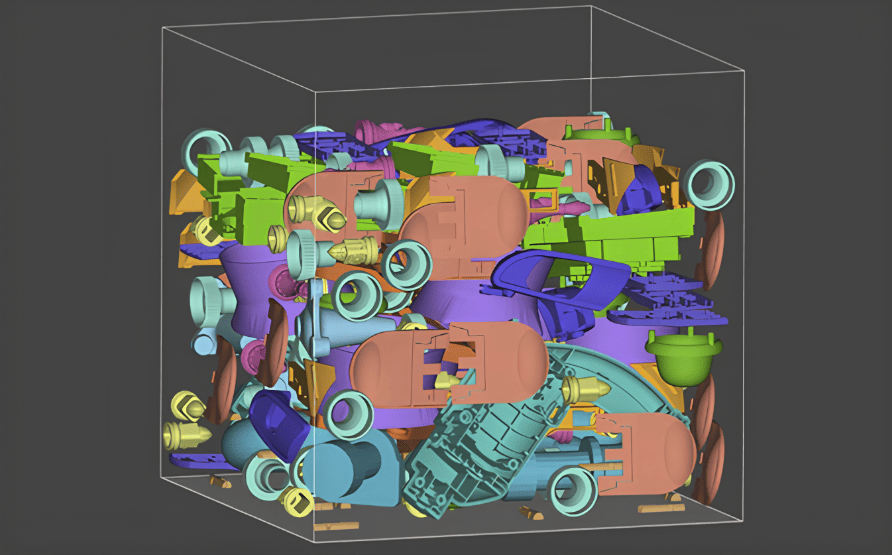
Image Source: Materialise
Nesting in 3D Printing: Definition and Basic Concept
Nesting in 3D printing refers to the process of arranging multiple parts within a printer's build volume before manufacturing. The objective is to make effective use of the available space while maintaining the required distance between parts and meeting process requirements.
Nesting is closely related to part orientation, but the two concepts are different. Part orientation determines how an individual part is positioned relative to the build platform. Nesting determines how multiple parts are positioned relative to one another within the same build.
For example, a group of identical components may be rotated and arranged in different directions to fit more parts into the available space. Alternatively, parts with different shapes and sizes may be distributed around the build volume to reduce empty areas.
Nesting can be performed manually, automatically using software, or through a combination of both. Automatic nesting tools can quickly generate an initial arrangement, while engineers may make further adjustments based on production requirements.
The Role of Nesting in 3D Printing
The main role of nesting is to improve build-volume utilization. A 3D printer has a fixed build area and build height, so unused space represents unused production capacity.
A more efficient nesting arrangement can allow more parts to be manufactured in the same build. This is especially valuable for technologies such as SLS and MJF, which are commonly used to produce multiple parts in one build.
Nesting can also improve production efficiency by reducing the number of separate builds required. Instead of printing a small number of components repeatedly, manufacturers can combine multiple orders or multiple parts into one build when the process allows it.
However, efficient nesting is not simply about fitting the maximum number of parts into the printer. A very dense arrangement may create difficulties during powder removal, post-processing, inspection, or part separation. Therefore, the best nesting strategy needs to balance space utilization, manufacturability, build time, and downstream processing.
The 3D Printing Nesting Process
The nesting process generally begins after the parts have been prepared for printing.
Part Preparation
The required 3D files are imported into the slicing or build-preparation software. The software establishes the dimensions and geometry of each part before placement.
Part Orientation
Each part is oriented according to its geometry and manufacturing requirements. Orientation can influence surface quality, support requirements, thermal behavior, and overall height.
Part Arrangement
Once orientations are established, parts are positioned within the build volume. The objective is to use available space efficiently while avoiding overlap and maintaining appropriate clearances.
Spacing and Collision Checks
A sufficient gap must be maintained between neighboring parts. The required spacing depends on the printing technology and material. For powder-bed processes, spacing may also be needed to facilitate powder removal and part handling.
Final Build Layout
After the arrangement is reviewed, the final nesting layout is prepared for manufacturing. Engineers may compare several configurations to determine which one provides the best balance between production capacity and processing requirements.
Nesting Across Different 3D Printing Technologies
|
3D Printing Technology |
Nesting Importance |
Main Consideration |
|
SLS |
High |
Efficient use of powder-bed volume |
|
MJF |
High |
Dense batch production and cooling considerations |
|
SLM |
High |
Build-volume utilization and thermal behavior |
|
SLA |
Moderate |
Build-platform utilization and post-processing |
|
FDM |
Moderate to Low |
Available build area and total print time |
Nesting and 3D Printing Cost
Nesting can have a direct influence on the cost efficiency of batch 3D printing. When more parts can be produced in one build, the production resources associated with that build can potentially be distributed across a larger number of parts.
For example, if a machine can produce 20 components in one build instead of 10, the average machine-related cost per part may decrease. This can make nesting particularly valuable for larger production quantities.
However, the relationship between nesting and cost is not always linear. Adding more parts can increase build height, extend production time, and create additional post-processing work. In some processes, a densely packed build may also increase the time required for cooling, powder removal, cleaning, or inspection.
Therefore, maximum packing density does not necessarily mean minimum cost. A slightly less dense layout may sometimes provide better overall economics if it reduces processing time or simplifies post-processing.
For service bureaus and production manufacturers, nesting is therefore evaluated as part of the broader production workflow rather than as an isolated space-saving exercise.
Common Problems in 3D Printing Nesting
Excessively tight spacing is one of the most common issues. Parts that are positioned too close together may be difficult to separate or process after printing. In powder-bed technologies, insufficient space can also make powder removal more difficult.
Poor orientation can reduce the effectiveness of an otherwise good nesting arrangement. A part may occupy unnecessary space because of its orientation, preventing other parts from fitting efficiently around it.
Another problem is focusing only on packing density. A layout that contains the maximum possible number of parts may appear efficient, but it may also increase build height or complicate post-processing. The resulting production time and labor can offset the apparent space savings.
Ignoring part differences can also create inefficient builds. Parts with different sizes, heights, or processing requirements may need to be positioned strategically rather than packed together without consideration.
Finally, automatic nesting should not always be treated as the final solution. Software can generate efficient arrangements quickly, but engineers still need to review the layout based on material behavior, manufacturing constraints, and post-processing requirements.
Effective nesting is therefore a balance between fitting more parts into the available build volume and maintaining a practical, reliable production process. When used correctly, it can help manufacturers make better use of machine capacity while improving the efficiency and cost-effectiveness of 3D printing production.
 0
0


COMMENTS
- Be the first to share your thoughts!