 English
  日本語
日本語  Deutsch


For years, the conversation around 3D printed shoes has largely centered on one part of the product: the midsole. 3D printing made it possible to create lattice structures and other geometries that would be difficult to produce using conventional methods. Adidas was one of the brands that helped bring this concept into the mainstream with its Futurecraft 4D platform.
Now, Adidas is pushing the idea further.
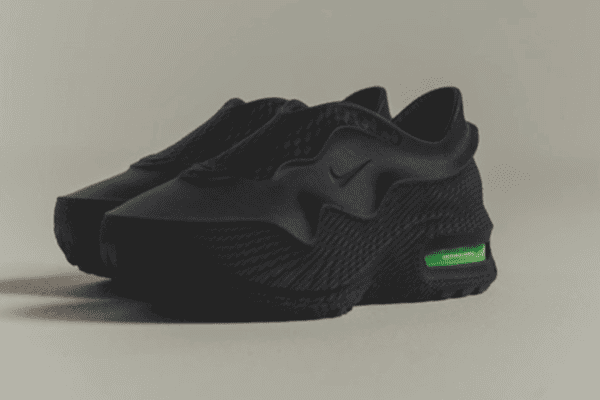
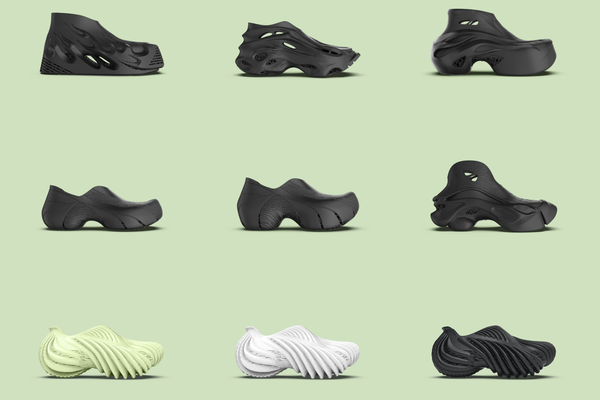
On August 27, 2026, Adidas unveiled Futurecool, a new 3D printed sneaker built around a seamless, one-piece structure. The company describes it as the next era of 3D printed footwear, combining additive manufacturing with specialized materials to deliver 360-degree breathability, adaptive comfort, and a distinctive silhouette. Futurecool will receive a limited release of 400 numbered pairs before its wider global launch on April 1, 2027.
The significance of Futurecool goes beyond a new sneaker. It shows how 3D printing is gradually moving from a way to manufacture individual components toward a broader approach to making consumer products.
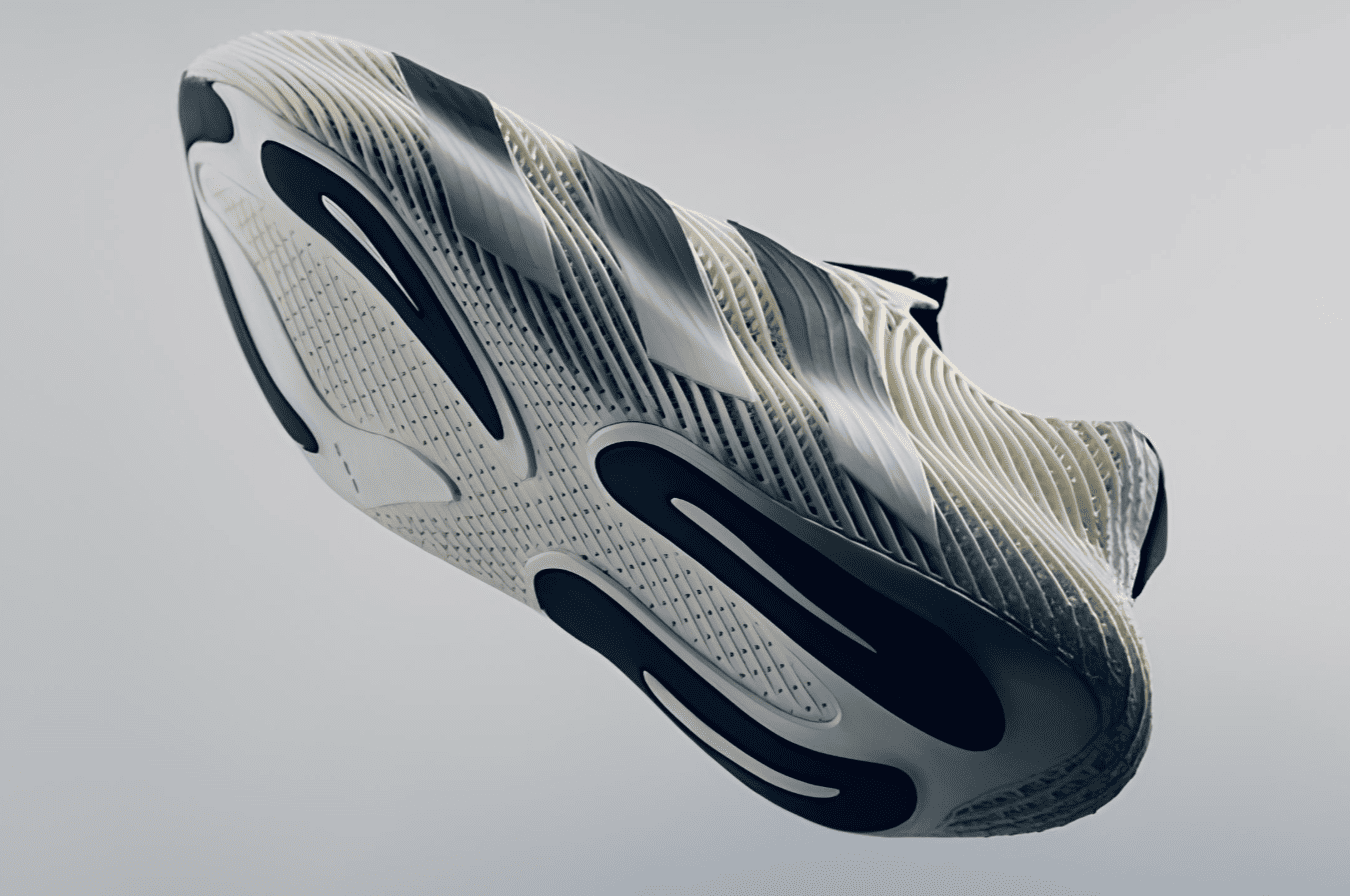
Image Source: Adidas
What Makes Adidas Futurecool Different
The most notable feature of Futurecool is its construction.
According to Adidas, the shoe is 3D printed as a single, seamless structure, combining resin with specialized materials. Rather than treating 3D printing as a method for producing one isolated part, the manufacturing process plays a much larger role in defining the finished footwear.
The approach enables Adidas to explore a different relationship between geometry, comfort, and ventilation. The shoe features a 360-degree ventilation system, while its seamless construction is intended to provide a second-skin feel that adapts naturally to the foot. Its sculpted proportions and flowing curves also give the shoe a look that would be difficult to replicate through traditional footwear construction.
There is also an important positioning difference. Futurecool is not presented as a conventional performance running shoe. Adidas describes it as a lifestyle silhouette, using the company's performance expertise to focus on comfort, breathability, and a progressive appearance.
That matters because it places 3D printing in a different consumer context. Additive manufacturing is no longer being promoted only as a way to solve a highly technical sports-performance problem. It is becoming part of the product's visual identity and everyday user experience.
From 3D Printed Midsoles to 3D Printed Footwear
Futurecool makes more sense when viewed as part of a longer development in Adidas' 3D printing strategy.
The company's Futurecraft 4D, introduced in 2017, used Digital Light Synthesis to produce a 3D printed midsole based on extensive running data. The technology was positioned as a way to create complex cushioning structures without relying on conventional molding for the component.
That approach established an important model: use additive manufacturing where it offers a clear advantage, while conventional manufacturing continues to produce the rest of the shoe.
Adidas later moved toward printing a larger portion of the footwear. Its CLIMACOOL platform and the 3D printed CLIMACOOL LACED introduced more extensive additive manufacturing into the shoe structure, with Adidas highlighting 360-degree airflow and a lattice-based form. The CLIMACOOL LACED became widely available in 2026 after initially launching in limited quantities in 2024.
Futurecool continues this progression.
The important change is not simply that more material is printed. It is that the printed structure becomes a much larger part of the final product itself. The progress reflects a broader shift in additive manufacturing. Instead of asking where 3D printing can replace one manufacturing step, product developers can increasingly ask which parts of a product could be designed around additive manufacturing from the beginning.
3D Printed Shoes Advantages
The appeal of 3D printed shoes comes from several capabilities that are difficult to achieve efficiently with traditional processes.
Complex geometry is one of the clearest advantages. 3D printing can produce interconnected structures, open areas, curved surfaces, and variable geometries without requiring a separate mold for every shape, which gives footwear developers more freedom to experiment with structures that combine multiple functions.
Functional geometry is another advantage. In a 3D printed shoe, geometry is not necessarily just an aesthetic decision. Changes in wall thickness, openings, lattice patterns, and local structures can influence flexibility, support, airflow, and cushioning.
Seamless construction can also reduce some of the boundaries created by conventional assembly. Traditional footwear typically involves multiple pieces that are cut, stitched, bonded, or otherwise joined together. A more integrated printed structure can approach the product as one continuous form. Adidas specifically highlights this seamless construction in Futurecool.
Moreover, 3D printing offers digital flexibility. Once the product geometry exists digitally, changes can be made without creating an entirely new physical tooling set. That does not automatically make every 3D printed shoe customized or inexpensive, but it can make product iteration and structural variation more flexible.
What Futurecool Says About the Next Trend in Consumer Goods
The more interesting story behind Futurecool is what it suggests about the future of 3D printing in consumer goods.
The first trend is a shift from components to products.
For a long time, 3D printing was commonly used for prototypes, fixtures, or selected components. Futurecool points toward a different model in which a larger share of the finished consumer product can come directly from 3D printing.
The second trend is the growing importance of product geometry. As manufacturing constraints change, designers can use structure itself to deliver functions such as ventilation, flexibility, lightweighting, and support, which can lead to products where the geometry does more of the work traditionally handled by multiple materials or assembled components.
The third trend is the increasing connection between digital product development and physical manufacturing. A digitally defined product can potentially be modified, tested, and produced with fewer tooling constraints. In the long term, it could support greater product variation, smaller production runs, and more responsive manufacturing.
Shoes are only one example. The same logic could influence eyewear, wearables, sports accessories, and other consumer products in which complex geometry and personalization are valuable. In that sense, Futurecool is not just about making a different sneaker. It illustrates how additive manufacturing can become part of the product strategy rather than simply a production technique.
Why 3D Printed Consumer Products Have Not Taken Over Yet
Despite the progress, 3D printing is not about to replace conventional consumer manufacturing across the board.
The biggest challenge is still production efficiency. Traditional processes such as injection molding remain extremely competitive for high-volume production because once tooling is established, large numbers of identical parts can be produced quickly.
Cost is another limitation. Industrial 3D printing can reduce tooling requirements and enable complex geometries, but material costs, machine time, labor, and post-processing can still make additive manufacturing expensive for certain products and volumes.
There are also demanding requirements for repeatability and quality control. Consumer products need consistent dimensions, mechanical performance, surface quality, durability, and appearance. Producing one successful prototype is very different from producing thousands of products to the same standard.
And finally, consumers care about more than manufacturing technology. A 3D printed product still needs to be comfortable, durable, attractive, reliable, and affordable.
That is why the significance of Adidas Futurecool should not be interpreted as proof that conventional footwear manufacturing is disappearing. A more realistic conclusion is that additive manufacturing is expanding into areas where its specific strengths create enough value to justify its use.
Futurecool takes 3D printed shoes beyond the midsole, but the bigger shift is taking 3D printing beyond the individual component. As consumer brands become more comfortable building products around additive manufacturing, the technology may play a larger role not only in how products are prototyped, but also in how they are manufactured, differentiated, and brought to market.
 0
0


COMMENTS
- Be the first to share your thoughts!