 English
  日本語
日本語  Deutsch


Lightweight parts can reduce material consumption, lower manufacturing costs, and improve the performance of moving components. However, reducing weight is not simply a matter of making every section thinner or removing as much material as possible. Poorly planned material reduction can lower stiffness, create stress concentrations, and cause deformation or premature failure.
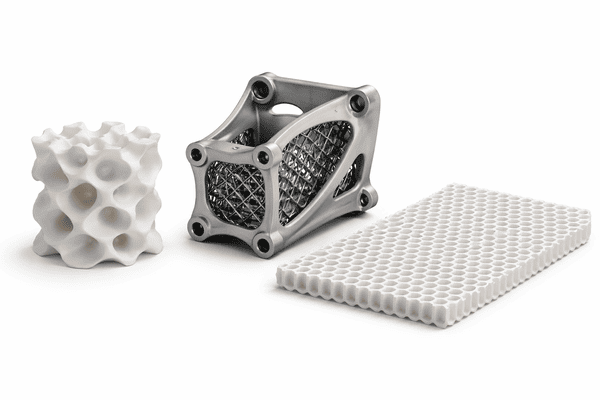
A good lightweight design keeps material where it contributes to structural performance and removes it where it provides little benefit. For 3D printed parts, lightweight design becomes even more valuable because 3D printing can produce hollow structures, lattices, ribs, and other geometries that are difficult to manufacture with conventional processes.
Image Copyright © 3DSPRO Limited. All rights reserved.
Lightweight Design Is a Structural Optimization Problem
The objective of lightweight design is not to make a part as light as possible. Instead, it is to achieve the required mechanical performance with the least unnecessary material.
A successful lightweight part must satisfy its application requirements, which may include strength, stiffness, dimensional stability, fatigue resistance, and resistance to impact or vibration. These requirements do not always change at the same rate as part weight. Removing a small amount of material from an unimportant area may have almost no effect on performance, while removing the same amount from a critical section can significantly weaken the part.
This is why lightweighting should be treated as a structural optimization problem. Designers need to understand how the part will be loaded before deciding where material can be removed.
Simply reducing wall thickness across the entire part is rarely the most efficient strategy. A better approach is to redistribute material so that more of it is concentrated in areas that contribute directly to carrying loads.
Start With Load Paths, Not Material Removal
Before removing material, identify the load paths through the part. A load path describes how forces enter the component, travel through its structure, and transfer to another component or support.
Mounting holes, joints, bearing surfaces, brackets, and interfaces often experience concentrated loads. These areas may require additional material even when the surrounding structure can be much lighter.
Material can generally be removed more aggressively from regions that experience relatively low stress. However, designers should avoid cutting through primary load paths simply because those areas appear visually bulky.
For example, a bracket can often be made lighter by removing material from the center of a low-stress region while keeping the mounting points and the main structural connections intact. The result can be significantly lighter without sacrificing its ability to carry the intended load.
Improve Strength-to-Weight Ratio Through Geometry
One of the most effective ways to reduce weight without creating a fragile part is to improve its geometry rather than simply reducing its dimensions.
Ribs and webs can increase structural stiffness by positioning material farther from the neutral axis of a section. Hollow structures can remove low-value material from the interior while retaining material around the outer surfaces that contributes to bending resistance. Box-like and curved sections can also provide efficient stiffness with relatively little material.
Lattice structures offer another option for applications where large internal volumes do not need to remain solid. By replacing solid material with a repeating cellular structure, designers can reduce mass while maintaining useful levels of stiffness and strength.
Local reinforcement is equally important. Instead of increasing the thickness of the entire component, designers can reinforce only areas around holes, fasteners, joints, or other high-load features.
The key principle is simple: place material where it performs structural work. A well-designed lightweight structure can achieve a better strength-to-weight ratio than a heavier part with uniform thickness.
Control Stiffness, Not Just Ultimate Strength
A lightweight part does not necessarily need to be stronger in every region, but it does need to remain stiff enough for its application.
Strength describes a material or structure's ability to resist failure under load, while stiffness describes its resistance to deformation. A component can therefore carry a load without breaking but still perform poorly because it bends too much.
Excessive deformation can cause misalignment, loss of dimensional accuracy, vibration, interference with adjacent components, or poor fit. For precision brackets, fixtures, housings, and moving components, stiffness can be more important than ultimate strength.
Weight reduction should therefore be evaluated against allowable deflection as well as failure limits. Increasing section depth, adding ribs, or changing a flat surface into a more efficient geometric form can often improve stiffness without adding large amounts of material.
This is another reason why geometry is usually more effective than uniform thickening. The goal is not simply to preserve enough material, but to use that material efficiently.
Eliminate Common Structural Weak Points
Lightweight structures often fail at local features rather than in their largest surfaces. Removing material can make these weak points more significant, so critical details require careful attention.
Sharp internal corners can concentrate stress, especially around loaded joints. Adding fillets can create smoother transitions and reduce local stress concentration. Sudden changes in wall thickness can produce similar problems and should generally be replaced with gradual transitions where practical.
Thin connecting sections, undersized bosses, and holes located too close to an edge can also reduce the effective load-bearing area. These features may become the first locations to deform or crack even when the rest of the part remains structurally sound.
For lattice designs, the individual struts must also be large enough to withstand the expected loading and to be reliably manufactured. Making lattice members excessively thin may reduce weight further, but it can also make the structure sensitive to manufacturing variation, defects, and local damage.
A better lightweight design does not eliminate all reinforcement. It uses reinforcement selectively at the locations where failure is most likely to begin.
Design Lightweight Structures for 3D Printing
3D printing provides significant freedom for lightweight structural design, but the printed geometry still needs to match the capabilities of the selected process.
Minimum feature size is one consideration. Extremely thin walls, ribs, or lattice members may be difficult to print consistently and may not provide the intended mechanical performance. Designers should therefore work within appropriate feature-size limits for the material and printing technology.
Build orientation is also important, particularly for processes in which mechanical properties vary with direction. The orientation of critical features relative to the build direction can influence strength, stiffness, surface quality, and the effectiveness of supports.
Internal structures introduce additional considerations. Hollow and lattice geometries may require access for powder removal in powder-bed processes or drainage and cleaning paths in vat photopolymerization processes. Support structures can also become necessary when lightweight geometry contains unfavorable overhangs.
For this reason, the best lightweight design is not simply the structure with the lowest calculated mass. It is a structure that combines mechanical efficiency, manufacturability, and reliable performance.
A practical workflow is to identify the load paths, determine the strength and stiffness requirements, remove material from low-value regions, add efficient structural geometry, reinforce critical features, and then evaluate the design using simulation and physical testing where necessary.
Lightweighting works best when material is removed strategically rather than indiscriminately. By combining load-path analysis, efficient geometry, stiffness control, local reinforcement, and 3D printing considerations, designers can reduce mass without turning a functional component into a fragile one.
 0
0