 English
  日本語
日本語  Deutsch


Copper is an attractive material for metal 3D printing because it combines excellent electrical conductivity, high thermal conductivity, and good corrosion resistance. However, pure copper and copper alloys are not interchangeable. The addition of elements such as chromium and zirconium can significantly improve strength and high-temperature performance, but usually at the cost of some electrical or thermal conductivity.
The right choice therefore depends less on which material is “better” and more on which property your part needs most. For applications dominated by heat transfer or electrical conduction, pure copper is often the better choice. When mechanical strength, dimensional stability, wear resistance, or performance at elevated temperatures becomes more important, a copper alloy may be more suitable.
Pure Copper vs. Copper Alloy: What Is the Difference?
The fundamental difference is composition.
Pure copper contains very little alloying material and is primarily selected for its intrinsic physical properties. Copper has exceptionally high electrical and thermal conductivity, which makes it valuable for electrical and thermal management components. In metal additive manufacturing, pure copper can be produced by processes such as laser powder bed fusion (L-PBF), although printing it is technically demanding because copper strongly reflects common near-infrared laser wavelengths and rapidly conducts heat away from the melt pool.
Copper alloys, in contrast, add controlled amounts of other elements to modify copper's properties. CuCrZr, for example, uses chromium and zirconium to create a precipitation-hardening alloy with a stronger mechanical property profile while retaining useful electrical and thermal conductivity. Other copper-based alloy families, including GRCop alloys, are also developed for demanding high-temperature applications.
This does not mean every copper alloy has the same performance. Alloy composition, processing conditions, heat treatment, and final microstructure all affect the properties of the printed part.
Another important point is that both pure copper and copper alloys can be challenging to print. Copper-rich powders have low absorptivity at commonly used infrared laser wavelengths, while their high thermal conductivity makes stable melting more difficult. Consequently, material selection and machine capabilities need to be considered together.
When to Choose 3D Printed Pure Copper
Choose pure copper when electrical or thermal performance is the primary requirement and extremely high mechanical strength is not essential.
Electrical Applications
Pure copper is an obvious choice for components that need efficient electrical conduction. Its high electrical conductivity makes it suitable for applications such as electrical conductors, contacts, busbar-like components, and other current-carrying parts.
This becomes especially interesting when the geometry is too complex for conventional manufacturing. Additive manufacturing can create customized internal structures, integrated channels, and shapes that would otherwise require multiple manufacturing steps.
Thermal Management Components
Pure copper is also well suited to heat-transfer applications because of its high thermal conductivity. Examples include heat exchangers, cooling components, thermal management structures, and components with internal cooling channels.
The geometric freedom of additive manufacturing is particularly valuable here. Research on pure copper L-PBF has demonstrated the production of near-full-density parts while maintaining high electrical conductivity, showing that the material can retain much of the performance expected from bulk copper when processed correctly.
Applications Where Conductivity Matters More Than Strength
A pure copper part may also be preferable when the mechanical loads are relatively moderate. Increasing strength through alloying can introduce a conductivity penalty, so using an alloy when the application does not actually need its additional strength may provide little benefit.
In simple terms, choose pure copper when the part's job is primarily to move electricity or heat.
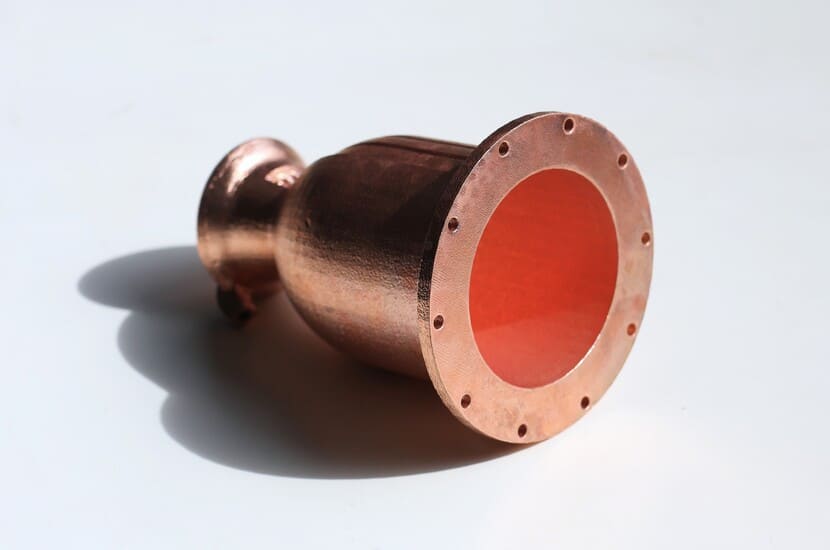
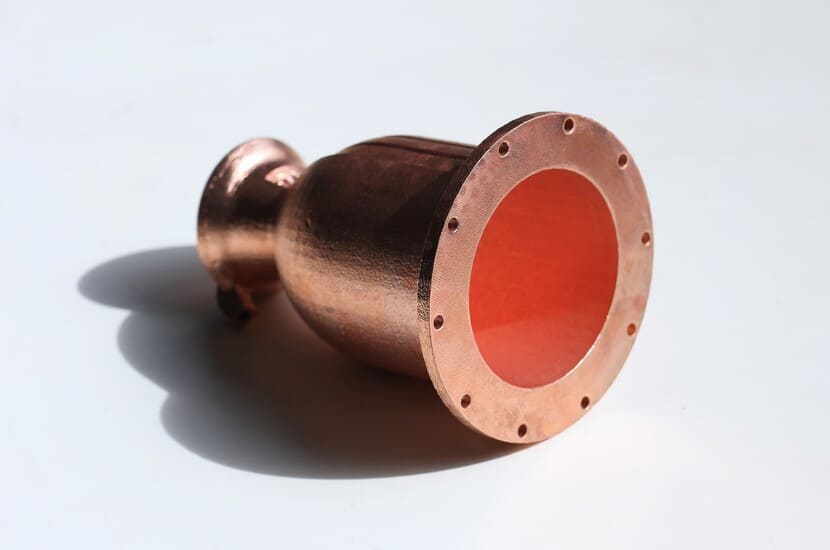
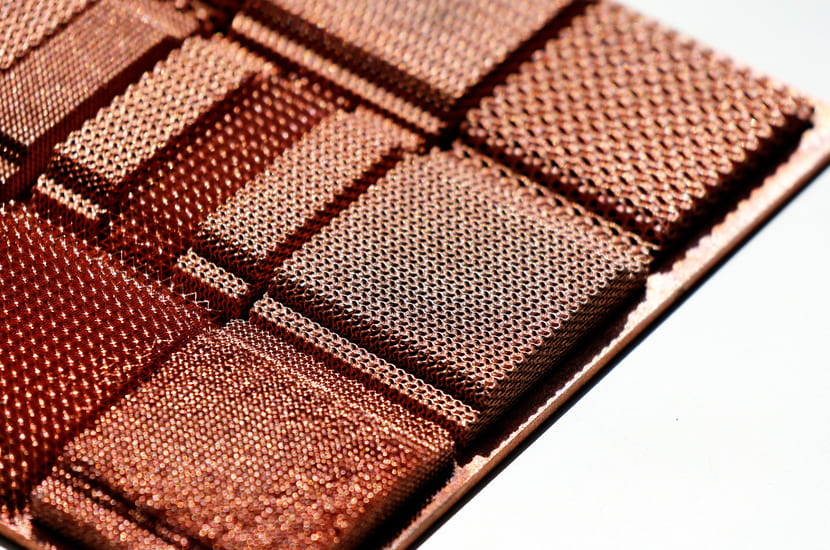
Image Copyright © 3DSPRO. All rights reserved.
When to Choose 3D Printed Copper Alloy
A copper alloy becomes more attractive when pure copper cannot provide enough mechanical performance.
When Higher Strength Is Required
Pure copper is relatively soft compared with precipitation-hardened copper alloys. For structural or mechanically loaded components, an alloy such as CuCrZr can provide a better balance between conductivity and strength.
CuCrZr is particularly notable because chromium and zirconium enable precipitation strengthening. Research on additively manufactured CuCrZr has demonstrated that the alloy can combine useful electrical and thermal properties with substantially improved mechanical performance.
When the Part Operates at Elevated Temperature
High-temperature performance is another important reason to consider copper alloys. Certain copper alloy systems are specifically developed to maintain mechanical stability and useful thermal properties under demanding thermal conditions.
This is why copper alloys have attracted attention for applications in aerospace, energy, and fusion-related systems, where components may need to handle both severe heat loads and mechanical stress.
When Wear Resistance or Durability Matters
For components exposed to mechanical contact, repeated loading, or wear, the greater hardness and strength of a copper alloy can be more valuable than maximum conductivity.
For example, a heat-transfer component that also experiences significant mechanical loading may benefit from CuCrZr rather than pure copper. The alloy can provide a more balanced property combination instead of maximizing only thermal or electrical conductivity.
However, do not assume that a copper alloy is automatically easier to 3D print. Copper alloys can still present serious additive manufacturing challenges, including laser absorption, melt-pool instability, defects, and the need for optimized process parameters and heat treatment.
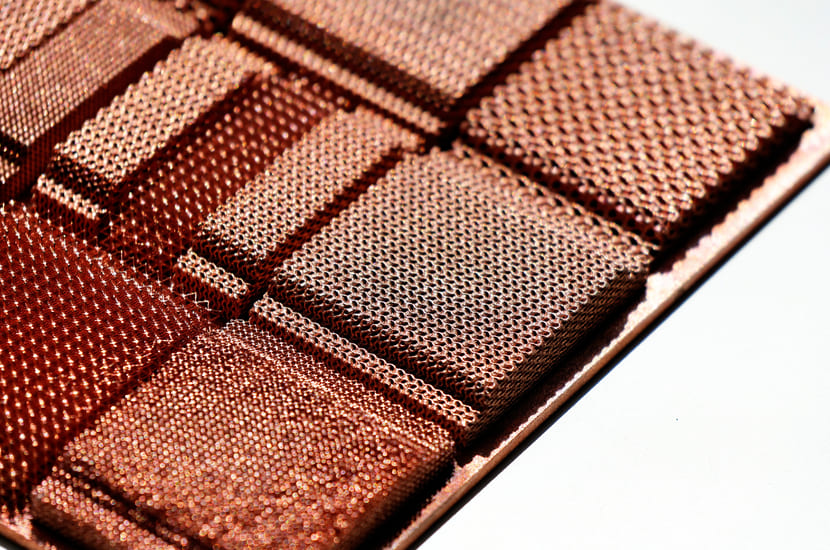
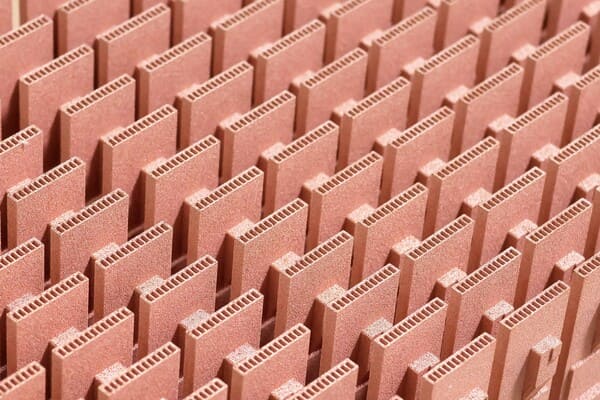
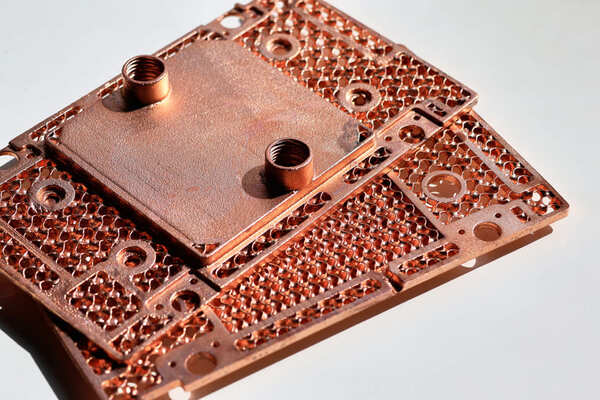
Image Copyright © 3DSPRO. All rights reserved.
Pure Copper vs. CuCrZr: Key Factors to Compare at 3DSPRO
|
Properties |
Pure Copper |
Copper Alloy CuCrZr |
|
Hardness |
100 HV |
160 HV |
|
Density |
8.94 g/cm³ |
8.89 g/cm³ |
|
Relative Density |
≥99.0% |
≥99.0% |
|
Tensile Strength |
220 MPa |
500 MPa |
|
Elongation at Break |
25% |
18% |
|
Yield Strength (Rp0.2) |
160 MPa |
420 MPa |
|
Elastic Modulus |
110 GPa |
120 GPa |
|
Electrical Conductivity |
≥96% IACS |
80% IACS |
|
Thermal Conductivity |
365 W/(m.K) |
320 W/(m.K) |
Which Copper Material Should You Choose?
The best material can usually be selected by starting with the main function of the part rather than the material name.
✅ Choose pure copper when your priorities are:
• Maximum electrical conductivity
• Maximum thermal conductivity
• Efficient heat transfer
• Electromagnetic applications
• Complex cooling or conductive geometries where conductivity is critical
✅ Choose a copper alloy when your priorities are:
• Higher mechanical strength
• Greater hardness and durability
• Better performance under mechanical loading
• Improved high-temperature strength
• A balance between conductivity and structural performance
For many applications, the decision can be viewed as a simple trade-off: pure copper maximizes conductivity, while copper alloys shift the balance toward strength and durability.
CuCrZr is one of the most relevant choices when that balance is needed. It offers high electrical and thermal properties together with improved mechanical performance, making it particularly useful for demanding thermal-management and high-heat-flux applications.
Ultimately, material selection should also consider the 3D printing process, part geometry, required tolerances, heat treatment, and service environment. A material that looks ideal on a datasheet may not be the best option if the chosen additive manufacturing process cannot reliably produce the required density or geometry.
The simplest rule is therefore: choose pure copper when conductivity comes first; choose copper alloy when strength and durability must be added to that conductivity.
 0
0


COMMENTS
- Be the first to share your thoughts!