 English
  日本語
日本語  Deutsch


What is 3D Printing Infill?
Infill is the internal structure printed inside the outer walls of a 3D printed part. Instead of making a part completely solid, most slicing software allows users to create an internal pattern with a specified infill density.
Infill density describes the approximate percentage of the internal volume occupied by printed material. A part with 20% infill contains much more internal space than one with 80% infill, while 100% infill produces a fully filled internal structure.
Infill is especially important in FDM 3D printing, where reducing unnecessary internal material can significantly decrease material consumption and print time. Common infill patterns include grid, honeycomb, triangular, and gyroid structures. Each pattern distributes material differently and can therefore produce different mechanical behavior.
Infill also works together with the part's walls or perimeters. For many functional parts, increasing wall thickness or the number of perimeters can have a greater effect on strength than simply increasing infill density. As a result, infill should be treated as one part of the overall structural strategy rather than an isolated setting.
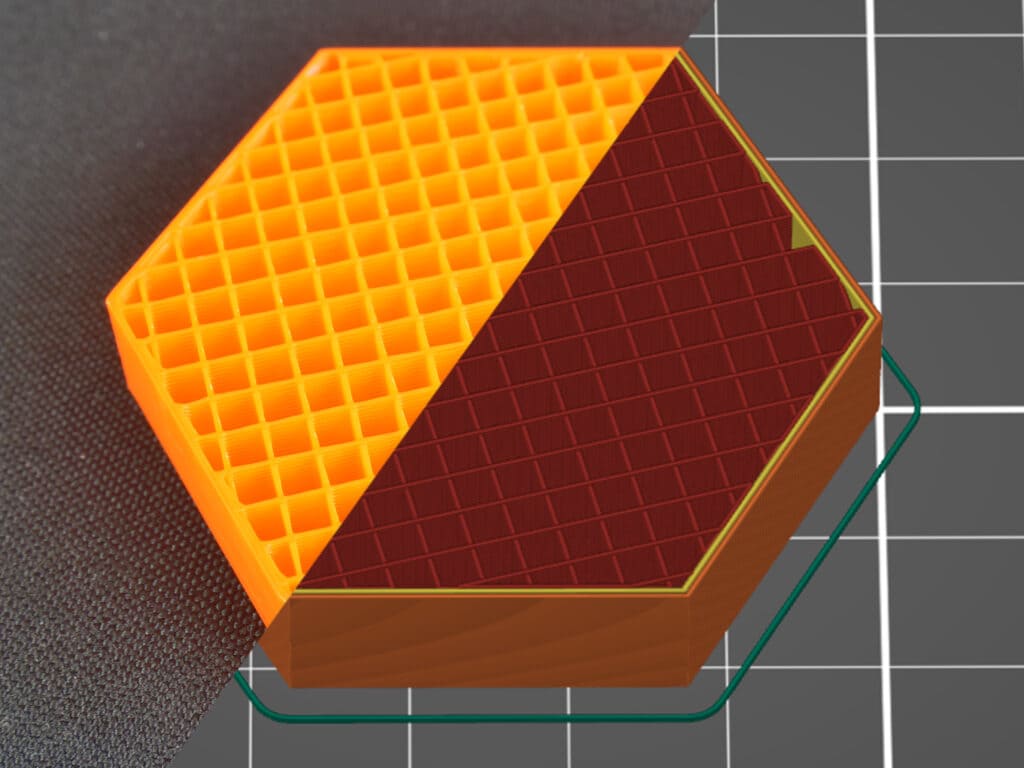
Image Source: PRUSA 3D
Infill Affects 3D Printed Part Performance
The most obvious effect of infill is on strength. As infill density increases, there is generally more material available to carry loads and support the outer walls, which improves the part's ability to withstand compression and other mechanical loads. However, the relationship is not always linear. Doubling infill does not necessarily double the strength because the outer shell, layer bonding, geometry, and print orientation also play major roles.
Infill also affects stiffness. A low-density internal structure may allow a part to deform more easily under load, while a denser structure can provide greater resistance to bending and compression. It can be especially important for larger parts or components that must maintain their shape during use.
Another major factor is weight. Lower infill density creates more internal voids and can significantly reduce part mass, which makes low-density infill useful when lightweight construction is more important than maximum strength. In applications where weight reduction matters, the goal is often to use enough infill to maintain the required performance without filling the entire part.
Infill also influences impact resistance, although the result depends strongly on pattern and material. Some internal structures can distribute impact loads more effectively than others. A pattern with a continuous three-dimensional structure may behave differently from a simple linear pattern when a part experiences sudden or multidirectional loading.
Finally, infill directly affects material consumption and print time. Higher densities generally require more material and longer printing times. Lower densities can reduce manufacturing cost and increase printing efficiency, provided that the resulting part still meets its performance requirements.
Infill Density vs. Infill Pattern
Infill density and infill pattern are closely related, but they control different aspects of a part's internal structure.
Infill Density
Infill density determines how much material is used, while the infill pattern determines how that material is arranged. Two parts with the same infill percentage can therefore behave differently if they use different patterns.
A low infill density can be sufficient for parts where appearance, low weight, or quick production is the main priority. Moderate infill is often a practical compromise for functional prototypes and general-purpose components. Higher infill densities are more appropriate when greater stiffness or load-bearing capability is required.
Infill Pattern
There is no universally strongest infill pattern. The best choice depends on the direction and type of loading, the material, and the performance requirements of the part.
|
Infill Pattern |
Structure |
Strength & Stability |
Material Use |
Print Speed |
Best For |
|
Rectilinear |
Parallel lines alternating by layer |
Good overall performance |
Low |
Fast |
General-purpose parts |
|
Grid |
Crossed lines forming a grid |
Good strength and layer support |
Moderate |
Fast |
Functional parts and general printing |
|
Triangles |
Three-directional triangular structure |
High structural stability |
Moderate |
Moderate |
Parts exposed to significant loads |
|
Cubic |
3D cube-like internal structure |
Good strength in multiple directions |
Moderate |
Moderate |
Multidirectional support and lightweight structures |
|
Honeycomb |
Hexagonal cellular structure |
High mechanical resistance |
Relatively high |
Relatively slow |
Strength-focused parts |
|
Concentric |
Lines follow the part perimeter |
Flexible and directionally compliant |
Moderate |
Relatively slow |
Flexible parts and transparent models |
|
Gyroid |
Continuous 3D curved structure |
Excellent multidirectional support |
Low–Moderate |
Relatively fast |
Strength-to-weight balance and complex loads |
|
Adaptive Cubic |
Dense near walls, sparse in the center |
Good support with efficient material distribution |
Low |
Fast |
Large parts with large internal volumes |
How to Choose the Right Infill for Different Applications
Choosing infill should start with the part's performance requirements, not a fixed percentage copied from another project.
Lightweight Parts
A relatively low infill density can reduce mass and material consumption. This approach works well when the component is not exposed to significant mechanical loads. However, the walls still need enough thickness to prevent excessive deformation or damage.
Strong and Rigid Parts
Higher infill may be appropriate, particularly when the part must withstand compression or repeated loading. Even in these cases, simply maximizing infill is rarely the most efficient solution. Increasing wall thickness, improving print orientation, or changing the geometry may provide a greater improvement.
Functional Prototypes
Moderate infill is often a practical starting point. Functional prototypes need enough structural integrity for testing while avoiding unnecessary material consumption and long print times. The infill can then be adjusted after evaluating how the prototype performs.
Large Parts
Using very high infill throughout the entire component can add substantial weight and printing time. A better approach may be to combine adequate walls with a carefully selected internal structure. In some designs, localized reinforcement can also provide the required strength without making the entire part dense.
The goal is not to choose the highest possible infill density. Instead, the goal is to select the lowest infill level that can reliably meet the part's intended performance requirements.
Infill Is Not the Only Factor That Determines Part Performance
Although infill is important, it is only one factor affecting the mechanical performance of a 3D printed part.
Wall thickness can have a major influence on strength because the outer shell directly carries many loads. Increasing the number of perimeters can sometimes improve performance more efficiently than increasing infill.
Print orientation is equally important, especially for FDM parts. Since strength is affected by interlayer adhesion, the orientation of a part can determine how effectively it handles loads in different directions.
Layer height and printing temperature can also affect layer bonding and therefore mechanical performance. The behavior of the chosen 3D printing material is another critical consideration. PLA, ABS, nylon, PETG, and other materials have different strength, stiffness, toughness, and thermal characteristics.
Finally, part geometry often matters more than infill settings alone. A well-designed structure can achieve high stiffness and strength with relatively little material, while a poorly designed part may remain weak even with high infill.
For this reason, infill should be optimized together with wall thickness, material, print orientation, geometry, and printing parameters. The best 3D printed part is not necessarily the one with the highest infill density, but the one that achieves the required performance with an efficient combination of these factors.
 0
0


COMMENTS
- Be the first to share your thoughts!