 English
  日本語
日本語  Deutsch


Clips and hooks are simple yet highly functional features widely used in 3D printed parts. From cable organizers and protective covers to industrial fixtures and consumer products, these fastening features allow components to connect without screws, adhesives, or additional hardware.
However, designing clips and hooks for 3D printing requires careful consideration of geometry, material properties, printing technology, and mechanical stress. Unlike injection-molded parts, 3D printed components have unique limitations, including layer adhesion, dimensional accuracy, and anisotropic strength.
3D Printed Clip
A 3D printed clip is a mechanical feature designed to hold, secure, or position another component through elastic deformation or mechanical engagement. Clips are commonly used when a part needs to be attached, removed, or adjusted repeatedly.
Common applications of 3D printed clips include cable management clips, electronic device housings, mounting brackets, tool holders, automotive interior components, medical device assemblies, and consumer product enclosures.
One of the most common clip designs is the cantilever clip, where a flexible arm bends temporarily during assembly and returns to its original position after engaging with another part. This design is popular because it is easy to manufacture and provides reliable fastening performance.
Other Clip Types:
• Ring clips: Circular or semi-circular structures that grip cylindrical objects such as tubes or cables.
• U-shaped clips: Flexible designs that hold parts through compression or spring force.
• Snap clips: Features that deform during insertion and lock into place afterward.
When designing a clip for 3D printing, the main goal is to achieve the right balance between flexibility and strength. A clip that is too thin may break during assembly, while a clip that is too thick may become too rigid and require excessive force.
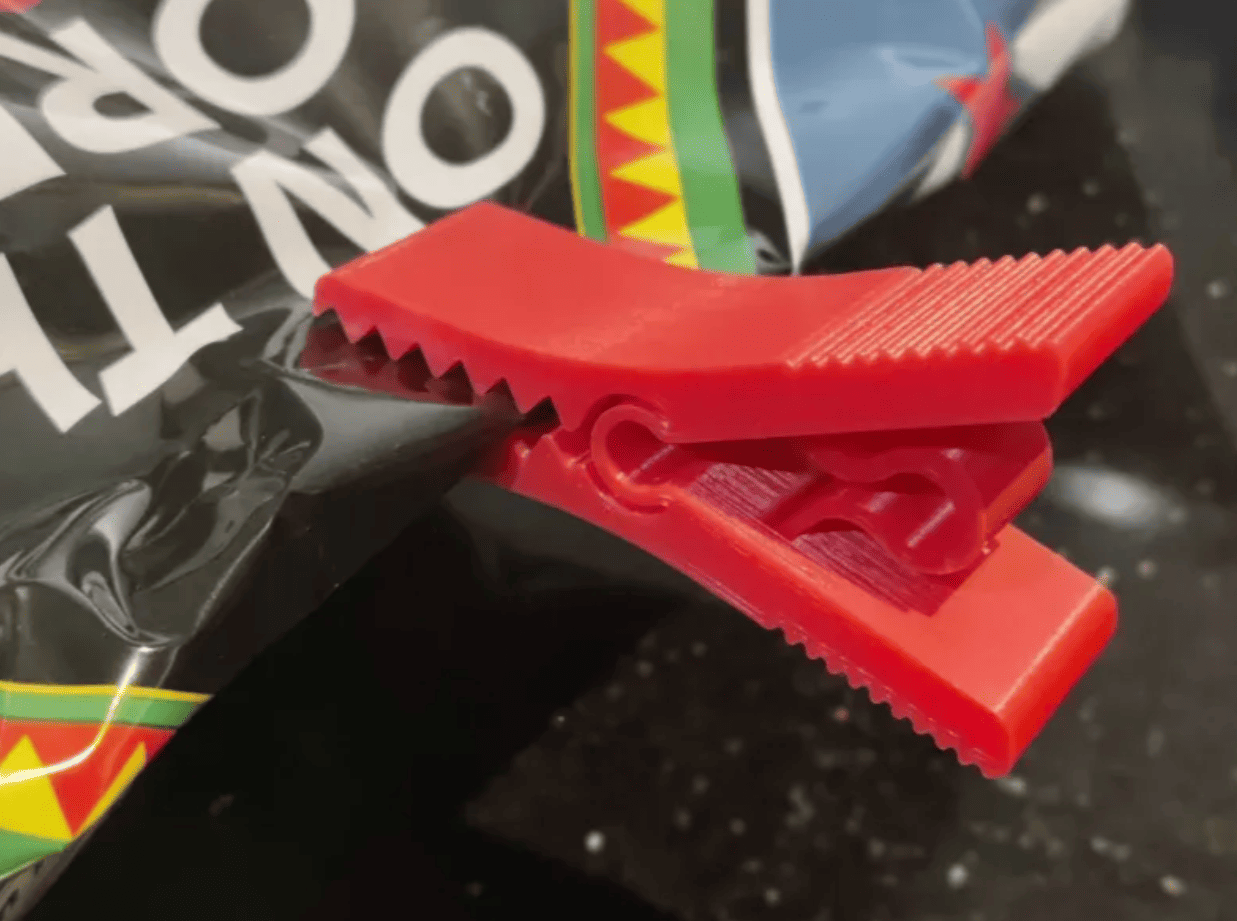
Image Source: Botannik
3D Printed Hook
A 3D printed hook is a curved or angled feature designed to engage with another component, typically by hanging, locking, or supporting a load. Unlike clips that often rely on elastic deformation, hooks usually rely on their shape and mechanical engagement.
Common applications of 3D printed hooks include wall-mounted holders, equipment brackets, hanging fixtures, packaging components, wearable accessories, and assembly positioning features
Hooks can be designed in different forms depending on their function:
• Simple hooks: Used for hanging or supporting lightweight objects.
• Locking hooks: Include additional geometry to prevent accidental release.
• Guide hooks: Help align components during assembly.
• Retaining hooks: Secure parts by preventing movement in a specific direction.
For 3D printed hooks, strength is often the most important consideration. The curved section and connection point typically experience the highest stress, especially when supporting weight. Adding smooth transitions and avoiding sharp corners can significantly improve durability.
The orientation of the hook during printing is also important. Since 3D printed parts generally have lower strength between layers compared with within layers, the hook should be oriented so that the primary load is applied along the strongest direction.
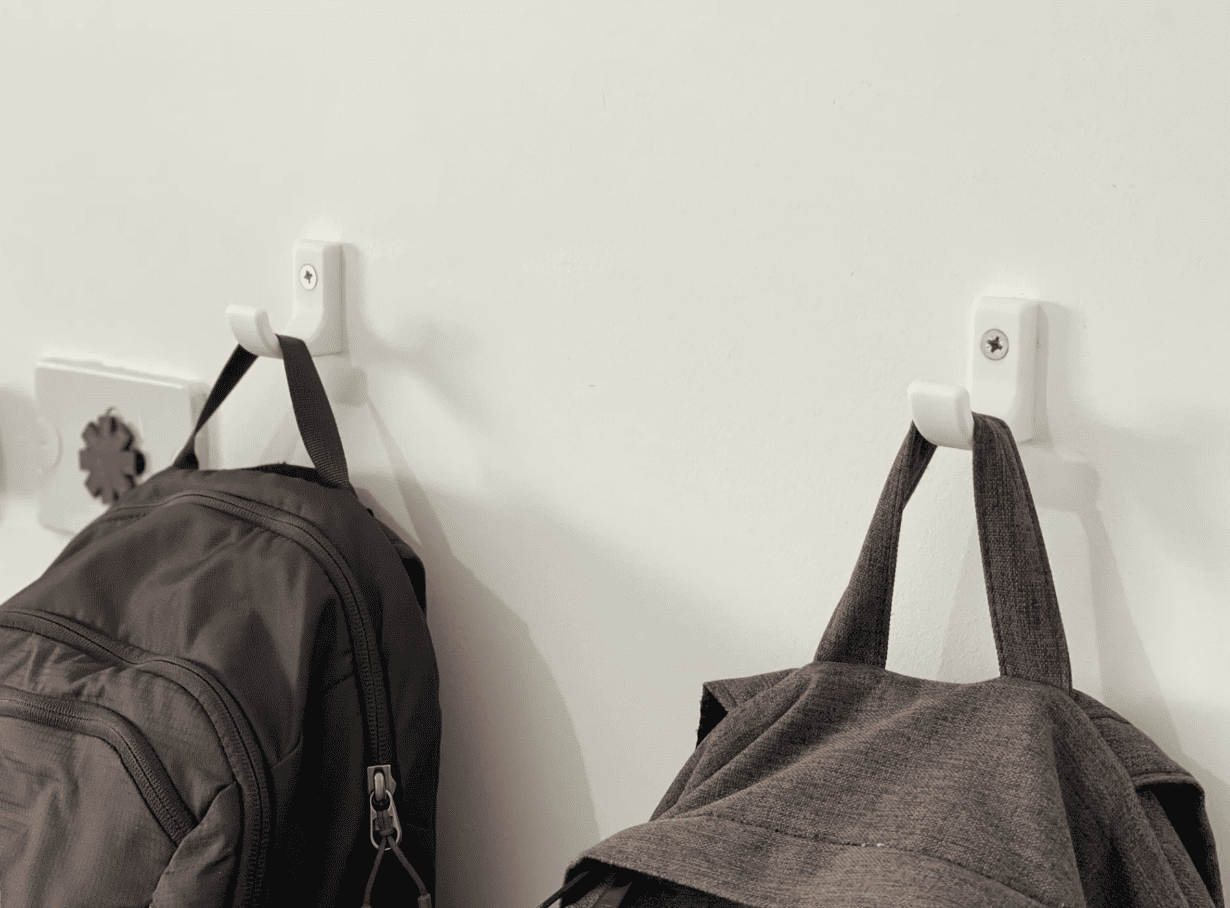
Image Source: yuvalaj
Key Design Considerations for 3D Printed Clips and Hooks
1. Avoid Sharp Corners and Stress Concentration
Sharp corners create areas where stress can accumulate, increasing the risk of cracking or failure. This is especially important for flexible clips that repeatedly bend during use.
Adding rounded corners and fillets at high-stress areas helps distribute forces more evenly. For example, the connection between a cantilever clip arm and the main body should include a smooth transition rather than a sharp 90-degree corner.
2. Consider Wall Thickness and Feature Size
The thickness of clips and hooks directly affects their mechanical performance.
• Thinner sections provide more flexibility but lower strength.
• Thicker sections improve strength but require more force to deform.
The ideal thickness depends on material properties, part size, expected load, and number of assembly cycles.
Small clips used for lightweight applications may require only a thin flexible arm, while industrial retaining hooks may need thicker structures for higher loads.
3. Design Proper Clearance Between Mating Parts
Clearance is essential when designing clips and hooks that connect with other components. Unlike molded parts, 3D printed parts require additional tolerance due to printing accuracy, material shrinkage, surface roughness, and post-processing methods.
Insufficient clearance can make assembly difficult or cause excessive friction. Too much clearance, however, may result in loose connections.
The required clearance depends on the printing process. Technologies such as SLA, SLS, and MJF generally provide better dimensional accuracy than basic FDM printing, allowing tighter tolerances.
4. Consider Printing Orientation
Print orientation has a significant impact on clip and hook performance.
For bending features such as snap clips, avoid designs where the bending force separates printed layers. Instead, orient the part so that the stress follows the strongest direction of the printed structure.
For hooks carrying loads, the load direction should ideally align with the strongest layer orientation to reduce the risk of delamination.
Material Selection for Durable Clips and Hooks
Nylon (PA11 and PA12)
Nylon is one of the most commonly used materials for functional 3D printed clips and hooks. Advantages include high toughness, good impact resistance, excellent fatigue performance, and the ability to withstand repeated bending. SLS and MJF printed nylon parts are especially suitable for clips because they provide consistent mechanical properties without requiring support structures.
TPU and Flexible Materials
Flexible materials such as TPU are suitable for applications requiring elasticity or soft gripping. Typical uses include flexible cable clips, protective holders, and shock-absorbing hooks. However, TPU parts may not provide enough stiffness for structural hooks or heavy-duty fastening applications.
Tough Resin
Tough SLA resins can be used for detailed clips and hooks requiring smooth surfaces and high accuracy.
They are suitable for small mechanical components, prototype assemblies, and consumer product testing. However, standard resins may become brittle under repeated stress, so material selection should match the expected usage conditions.
Reinforced Engineering Materials
For demanding applications, reinforced materials such as glass-filled nylon or carbon fiber-filled polymers can provide higher stiffness and strength. These materials are suitable for industrial fixtures, functional prototypes, and high-load components.
Common Failure Problems and How to Avoid Them
Clip Breaks During Assembly
One of the most common failures is a clip snapping during installation.
Possible causes include:
• Excessively thin geometry
• Sharp corners
• Brittle material selection
• Incorrect print orientation
Solutions:
• Increase the flexible section thickness.
• Add fillets at stress points.
• Select tougher materials such as nylon.
• Adjust printing direction.
Hook Cracks Under Load
Hooks often fail at the connection between the hook and the main body.
Possible causes include:
• Insufficient reinforcement
• Heavy loading
• Poor layer orientation
Solutions:
• Strengthen the base connection.
• Increase the cross-sectional area.
• Optimize print orientation.
Clip Loses Elasticity Over Time
Repeated bending can cause permanent deformation or fatigue failure.
Solutions include:
• Choosing materials with better fatigue resistance.
• Reducing excessive deformation.
• Designing the clip to operate within its elastic range.
Poor Fit Between Components
A clip or hook may fail to engage correctly because of inaccurate dimensions or insufficient tolerance.
To avoid this:
• Include proper clearance in the design.
• Test prototypes before final production.
• Consider the limitations of the selected 3D printing process.
3D printed clips and hooks provide efficient solutions for fastening, positioning, and assembly applications. However, achieving reliable performance requires careful attention to geometry, material selection, printing orientation, and tolerance control. By understanding how different designs respond to mechanical stress and selecting the right 3D printing material, engineers can create durable clips and hooks suitable for both prototypes and end-use products.
 0
0