 English
  日本語
日本語  Deutsch


Living hinges are a useful design feature that allows two connected parts to bend repeatedly without requiring additional components such as pins, screws, or metal hardware. Commonly found in product packaging, electronic covers, and consumer products, living hinges can simplify assembly and reduce part count.
When applying living hinges to 3D printing, designers need to consider more than just creating a thin flexible section. Factors such as hinge geometry, material properties, print technology, and expected usage cycles all affect whether the hinge will perform reliably. A poorly designed living hinge may crack, become permanently deformed, or fail after only a few bending cycles.
By following proper design principles, 3D printed living hinges can become functional features for prototypes and low-volume production parts.
AI Generated Image
What Are Living Hinges and How Do They Work in 3D Printing?
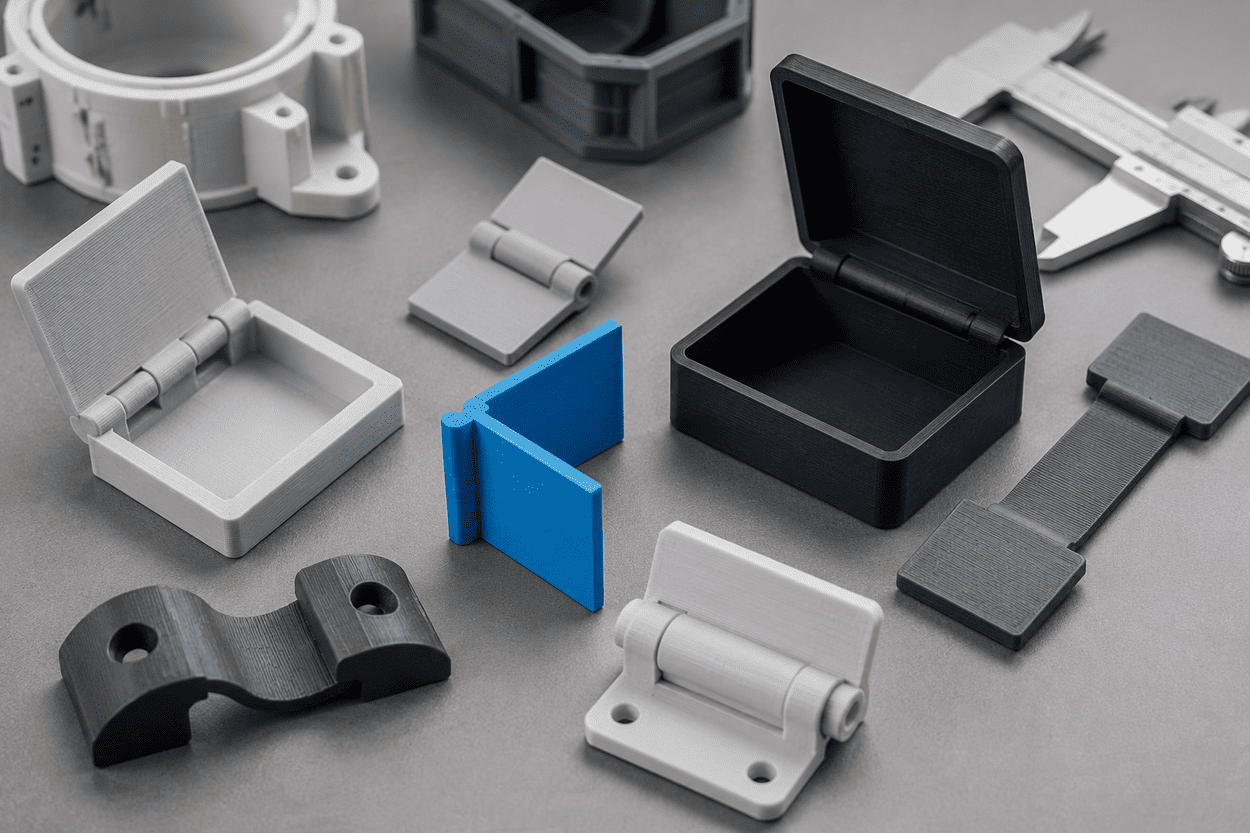
A living hinge is a thin, flexible section that connects two rigid sections of a part, allowing them to rotate relative to each other. Instead of using separate mechanical components, the hinge relies on the flexibility of the material itself.
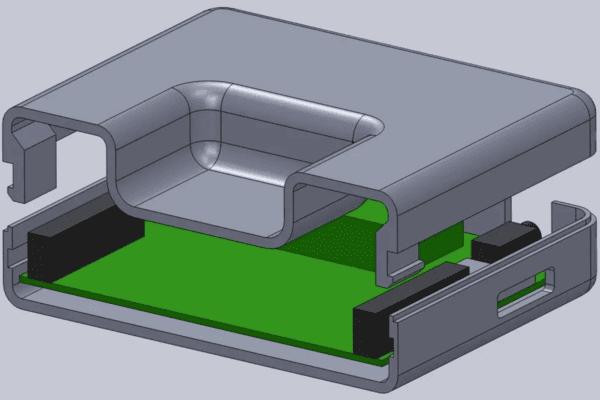
For example, a small electronics enclosure with an integrated cover can use a living hinge to open and close repeatedly. The hinge section bends while the surrounding structure remains rigid, creating a simple one-piece assembly.
Traditional manufacturing processes, especially injection molding, commonly use living hinges because certain plastics can withstand repeated flexing. In 3D printing, however, achieving similar performance requires careful design and material selection.
Why Living Hinges Are Challenging for 3D Printing
Unlike injection-molded parts, 3D printed components are created layer by layer. The manufacturing process introduces several factors that influence hinge performance.
• Layer adhesion: The direction of printed layers can affect how well the hinge withstands bending forces.
• Material flexibility: Some plastics can handle repeated movement, while others may crack under stress.
• Wall thickness: A hinge that is too thin may fail during printing or use, while one that is too thick may not bend properly.
• Surface quality: Rough surfaces or sharp transitions can create stress concentration points.
For functional living hinges, materials with good fatigue resistance and flexibility are usually preferred. Nylon materials such as PA11 and PA12 are commonly considered for durable flexible mechanisms because they offer a balance of strength, impact resistance, and flexibility. Flexible materials such as TPU can also work for applications requiring significant deformation.
Rigid materials, including many standard resins, are generally less suitable because they may become brittle when repeatedly bent.
Design the Right Hinge Geometry for 3D Printing
The geometry of a living hinge plays a major role in determining its flexibility and lifespan. A successful design should allow controlled bending while minimizing stress concentration.
Optimize Hinge Thickness
Hinge thickness is one of the most important design factors. The hinge section should usually be thinner than the surrounding part so that bending occurs in a specific area.
If the hinge is too thin:
• The part may break during printing.
• The hinge may tear after repeated use.
• Small manufacturing variations can significantly affect performance.
If the hinge is too thick:
• The hinge may require excessive force to bend.
• The surrounding structure may experience unnecessary stress.
• The part may not achieve the required range of motion.
The ideal thickness depends on the material, printing technology, hinge size, and expected number of cycles. Prototype testing is often necessary to determine the best design.
For most 3D printed living hinges:
• Typical hinge thickness: 0.3–1.0 mm for flexible materials such as TPU, PP-like materials, or flexible nylon.
• Common functional range: 0.5–0.8 mm for many nylon-based 3D printed living hinges used in prototypes.
• Thicker hinges (around 1–2 mm): May be suitable for larger parts or applications requiring higher stiffness, but they will require more bending force.
Use Smooth Transitions and Rounded Corners
Sharp corners near the hinge connection can create stress concentration areas. When the hinge bends repeatedly, these areas experience higher loads and are more likely to crack.
Adding rounded transitions or fillets between the hinge and the rigid sections helps distribute stress more evenly. A smooth transition allows the material to flex gradually instead of forcing all movement into one small area.
Consider Hinge Width and Length
The width and length of the hinge also influence flexibility.
A wider hinge can distribute bending forces over a larger area, improving durability. However, an excessively wide hinge may require more force to bend.
Recommended Guidelines for Hinge Width:
• Small parts: A hinge width of around 5–10 mm is often sufficient for small covers, boxes, or compact mechanisms.
• Medium-sized parts: 10–30 mm is common for larger enclosures or functional components.
• Large hinges: Wider designs may be needed, but adding reinforcement around the hinge area is recommended to prevent excessive deformation.
A longer hinge generally provides more flexibility because the bending stress is spread over a greater distance. Short hinges may feel stiff and experience higher stress during movement.
Recommended Guidelines for Hinge Length:
• Short hinges (<5 mm): Tend to be stiff and create higher stress concentration.
• Medium hinges (5–20 mm): Suitable for many small functional parts.
• Longer hinges (>20 mm): Provide greater flexibility and are useful for larger covers or parts requiring a wider opening angle.
Designers should balance these dimensions based on the required opening angle and application requirements.
Choose an Appropriate Hinge Structure
Different hinge geometries can provide different performance characteristics:
• Simple thin-strip hinges: The most common design, suitable for basic opening and closing functions.
• Tapered hinges: Gradually changing thickness can reduce stress concentration and improve durability.
• Multiple flexible sections: Several smaller hinges can distribute movement and reduce strain on one area.
• Curved hinge designs: Curved transitions can improve flexibility and reduce sharp stress points.
For 3D printed parts, simpler geometries are often easier to manufacture and optimize. Complex hinge structures should be tested carefully before production.
Test and Improve Living Hinge Performance Before Production
Even with a well-designed living hinge, testing is important before moving into production. Small changes in geometry or material can significantly affect performance.
Evaluate Bending Cycles
The expected lifespan of a living hinge depends on how frequently it will be used.
For example:
• A packaging prototype may only require several opening cycles.
• A reusable product enclosure may require thousands of cycles.
Testing should simulate actual usage conditions, including the opening angle and applied force. This helps identify whether the hinge design meets the required durability.
Check Common Failure Problems
During testing, designers should look for several common issues:
• Cracking near hinge edges: This often indicates stress concentration caused by sharp transitions or insufficient material flexibility.
• Permanent deformation: If the hinge does not return to its original position, the material may not be suitable, or the hinge may be too thin.
• High bending force: A hinge that is difficult to open may need a longer hinge section, reduced thickness, or a more flexible material.
• Layer separation: For technologies such as FDM, incorrect print orientation may weaken the hinge and cause failure along layer boundaries.
Improve the Design Through Iteration
Living hinges often require several design iterations before achieving the right balance between flexibility and strength.
Possible improvements include:
• Adjusting hinge thickness gradually.
• Increasing transition radii.
• Changing print orientation.
• Selecting a more flexible material.
Redesigning surrounding structures to reduce stress on the hinge.
For production applications, engineers should consider the entire manufacturing process, including printing technology, post-processing, and quality requirements.
3D printing makes it easier to test multiple design variations quickly, allowing engineers to refine hinge performance before committing to larger production runs.
 0
0