English
 日本語
 Deutsch


Heat exchangers move heat from one fluid to another without mixing them. They play a key role in aircraft, vehicles, power systems, industrial machines, and electronics cooling. As these systems get smaller and need to handle more heat, engineers have to balance heat transfer, pressure drop, weight, and space. Traditional manufacturing works well for many designs, but making complex internal channels or combined structures can be hard or expensive.
Metal 3D printing is another way to make these parts. It builds components layer by layer from metal powder, which lets engineers create internal channels and shapes that are hard to machine, cast, or put together. While it is not always the best choice, it gives engineers more design options.
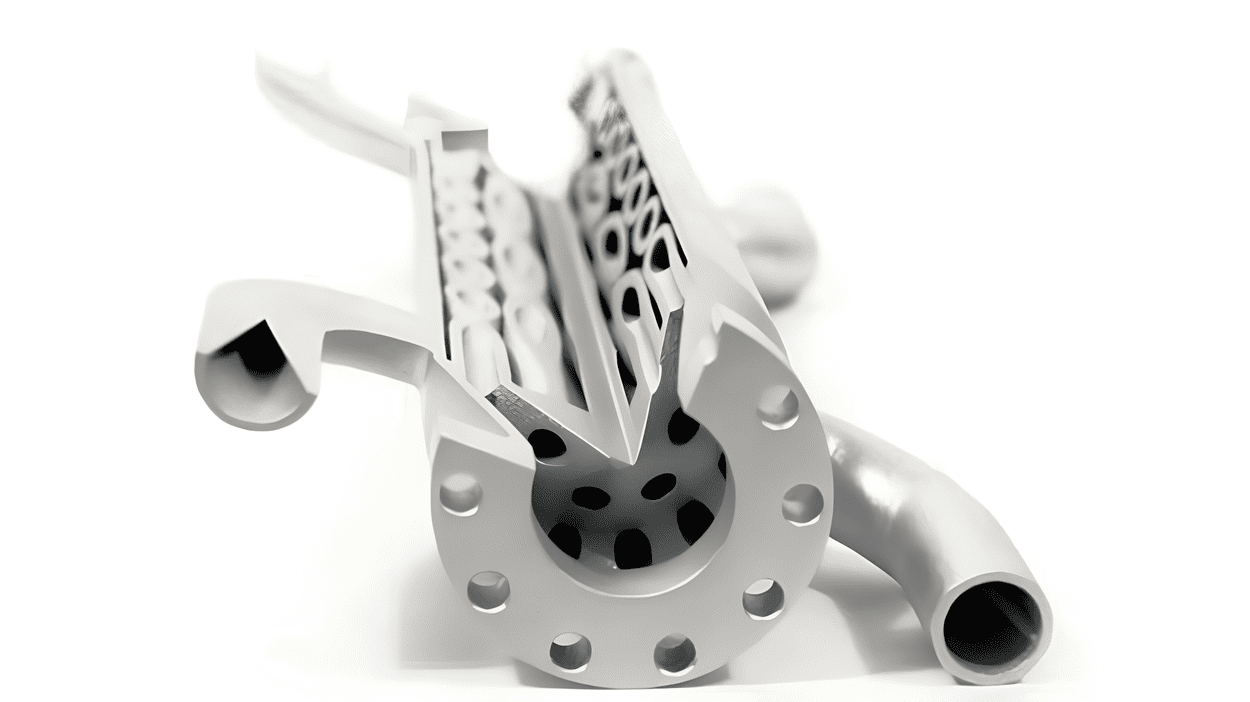
Image Source: Stratasys
Metal 3D Printed Heat Exchangers
A metal 3D printed heat exchanger is a thermal management part that moves heat between two fluids through a solid wall, keeping their paths separate. The fluids can be liquids, gases, or both, depending on the use.
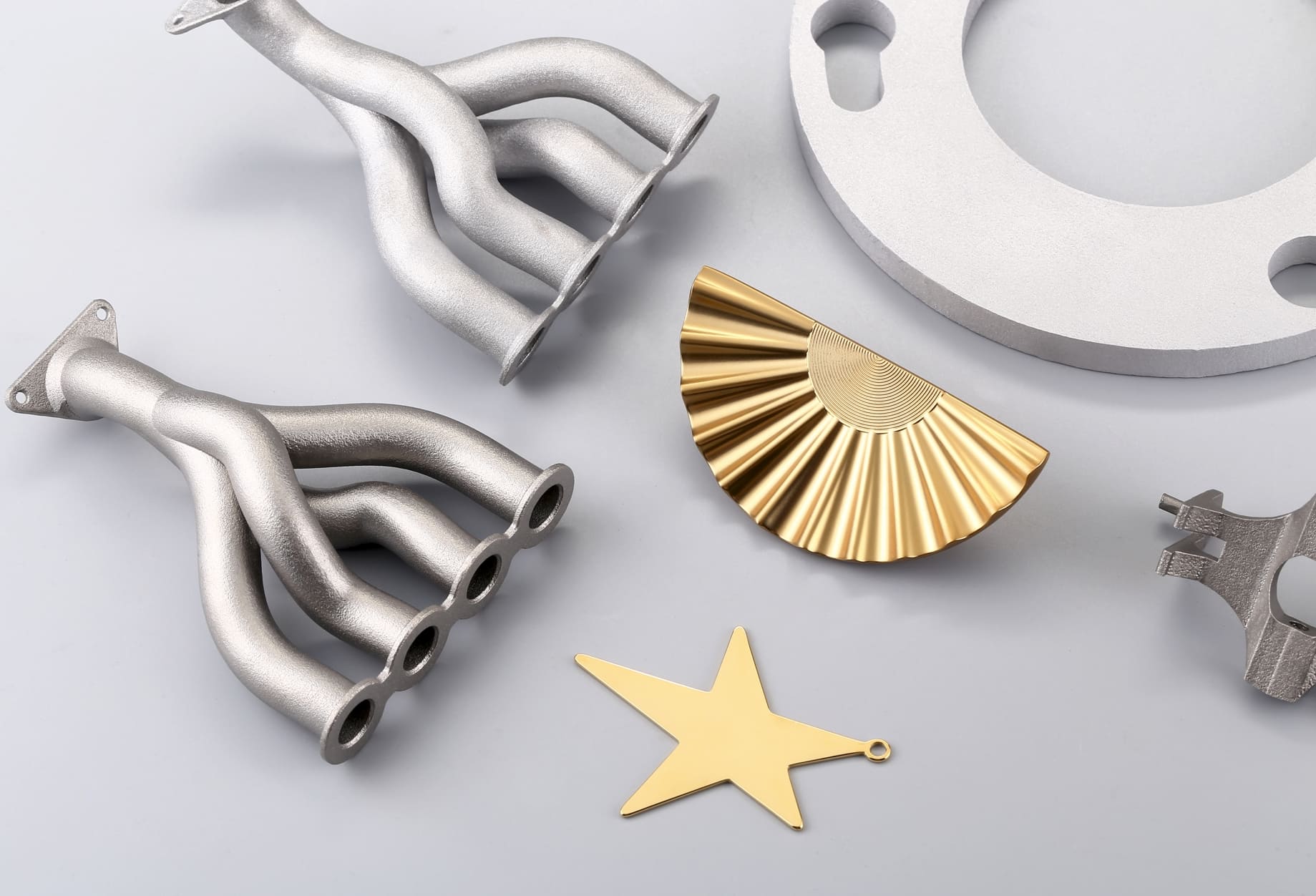
Selective Laser Melting (SLM), or laser powder bed fusion, is one way to make these parts. A laser melts certain spots in a thin layer of metal powder based on a digital design. The platform lowers, a new powder layer is added, and the steps repeat. After printing, the part may need support removal, heat treatment, machining, and inspection.
Designs can include compact passages, curved channels, thin fins, lattice cores, and TPMS (triply periodic minimal surface) structures like Gyroid shapes. These features help increase the heat-transfer area in a small space. Aluminum alloys, copper alloys, and stainless steels are chosen based on thermal conductivity, weight, corrosion resistance, temperature limits, and strength needs.
Key Advantages of 3D Printed Heat Exchangers
1. Greater Design Freedom and Complex Internal Geometries
A huge benefit of 3D printed heat exchangers is the ability to have very complex internal features within a single component. Conventional machining tools simply can't get into the enclosed passages that you'd want. With brazed or welded assemblies, you’re going to end up with a number of separate parts that you have to join together. Metal 3D printing can produce all sorts of complex internal features such as curved flow paths, branching channels, compact manifolds and lattices, which are very difficult to do via conventional methods.
This freedom enables the use of topology optimization and CFD (computational fluid dynamics) to shape the heat exchanger around its thermal and flow requirements. It can be designed for a particular application rather than being constrained by conventional manufacturing methods.
2. Improved Heat Transfer Potential
Heat transfer is a function of contact surface area, flow distribution, material properties and temperature difference. 3D printing enables the introduction of microchannels, thin walls, fins and complex internal surfaces which all increase the effective heat transfer area in a small volume.
Engineered structures such as TPMS lattices can create a network of flow paths and a very high surface area to volume ratio. With the right design and testing they can be used to improve heat transfer performance or to enable a smaller heat exchanger to meet a given duty. Work on topology optimized additively manufactured heat exchangers has demonstrated that an optimized channel design can outperform a simple straight channel design under certain test conditions.
However more surface area doesn’t necessarily translate into better overall performance. Narrow or tortuous channels can result in a higher-pressure drop, restricted flow and difficult to clean. Thermal performance and pumping power have to be considered together.
3. Lightweight and Compact Structures
Additive manufacturing can put the material where it's most useful in terms of strength or heat transfer and take it away from areas where it's not so important. Topology optimisation and lattice structures can reduce the weight of a component without simply relying on thinner walls.
You can also reduce package size by integrating a number of flow paths into a single compact core. That's obviously a major advantage in aerospace, in EVS and in high power electronics where you're very much constrained by both package size and weight. The final benefit of course is going to be very much dependent on the full assembly and the actual operating conditions.
4. Part Consolidation and Fewer Joining Interfaces
Traditional heat exchangers can be made up of a number of plates, tubes, fins, manifolds and connectors all joined together by brazing, welding or some other form of mechanical fastening. Metal 3D printing can be used to combine some of those elements into a single integrated structure.
Fewer discrete components will of course simplify the assembly process and reduce the number of joints that need to be inspected. Fewer joining interfaces may also lead to fewer potential leak paths. That said it doesn't get rid of leak testing at all. The printed parts will still require appropriate inspection and pressure or flow testing for their intended service conditions.
5. Customization and Faster Design Iteration
Metal 3D printing uses a digital model rather than tooling of any kind so design changes can frequently be made without the need to produce new tooling or fixtures. It enables application-specific geometries, functional prototypes and low volume production.
Engineers can modify the channel layout, inlet and outlet positions, mounting features and indeed the overall envelope of a particular system. This is useful when a standard heat exchanger simply won't fit in the available space or won't meet the required performance. Real lead time of course will still be dictated by the complexity of the design, the availability of materials, the printing capacity and the amount of post processing required.
Applications of 3D Printed Heat Exchangers
✅ Aerospace: Aircraft and space systems prioritize low weight, compact packaging, and reliable thermal control. Additively manufactured heat exchangers can be designed around restricted installation spaces and complex cooling requirements.
✅ Automotive and Electric Vehicles: Heat exchangers manage temperatures in batteries, power electronics, motors, and engines. Compact, integrated designs can help address tight packaging constraints and changing thermal loads.
✅ Energy and Power Generation: Power systems may need heat exchangers that operate at elevated temperatures or pressures or fit into compact energy conversion equipment. Metal additive manufacturing enables complex flow paths and application-specific cores, subject to material qualification and pressure validation.
✅ Electronics and Data Centers: High-performance processors and power electronics generate concentrated heat. Compact liquid-cooling heat exchangers with engineered internal channels may support thermal management where space and heat flux are challenging.
Metal 3D Printing Service at 3DSPRO
Producing a functional metal heat exchanger requires more than printing a complex shape. The design must account for channel dimensions, wall thickness, build orientation, support strategy, powder removal, thermal distortion, and access for machining or inspection. Internal passages should allow unfused powder to be removed, while critical interfaces may need machining to achieve the required fit.
3DSPRO provides metal 3D printing through Selective Laser Melting (SLM), with material options including aluminum alloys, stainless steel, copper and copper alloys, titanium alloys, and Inconel 718/625. Material selection depends on thermal conductivity, corrosion resistance, strength, weight, operating temperature, and compatibility with the working fluid. Not every material is suitable for every heat exchanger environment.
For a custom project, prepare a 3D CAD file and specify the working fluids, operating temperature and pressure, target heat duty, flow rate, allowable pressure drop, and connection dimensions. These details help assess printability and identify potential design or post-processing requirements. Submit your 3D model to S Quote to request a quotation and discuss a suitable manufacturing approach for your metal heat exchanger.
 0


COMMENTS
- Be the first to share your thoughts!