 English
  日本語
日本語  Deutsch


3D printing enables manufacturers and designers to create complex geometries, customized components, and functional prototypes with greater flexibility. However, a fully functional part often requires more than just the printed material itself. Adding the right accessories can significantly improve strength, durability, assembly efficiency, and user experience.
From threaded inserts and bearings to magnets, seals, and surface treatments, 3D printing accessories help transform printed components into reliable products ready for real-world applications.
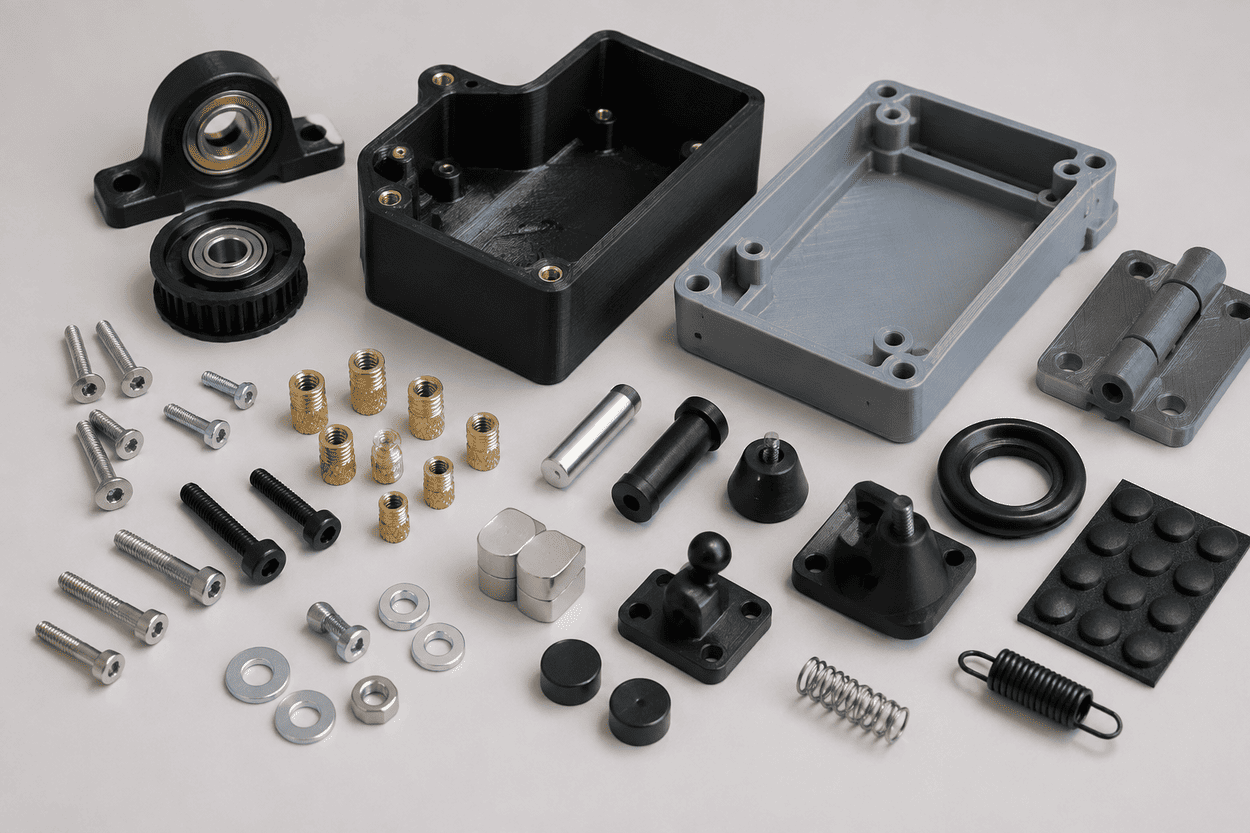
AI Generated Image
What Are 3D Printing Accessories?
3D printing accessories are additional components used together with 3D printed parts to enhance their functionality, performance, or usability. While many parts can be printed as a single component, certain mechanical functions, such as repeated fastening, smooth movement, or sealing, are often better achieved by integrating external accessories.
For example, a plastic enclosure may be printed with mounting holes, but adding threaded inserts allows screws to be installed and removed repeatedly without damaging the printed material. Similarly, a rotating mechanism may benefit from metal bearings instead of relying only on printed surfaces.
Types of 3D Printing Accessories:
• Threaded inserts and fasteners
• Screws, nuts, and washers
• Bearings and shafts
• Magnets
• Hinges and pins
• Rubber feet and seals
• Surface finishing components
These add-ons are widely used in functional prototypes, industrial fixtures, robotic components, electronic housings, and customized consumer products.
The key advantage of using accessories is that they allow designers to combine the strengths of different materials. 3D printed materials provide design freedom and customization, while metal or rubber components can provide superior mechanical performance in specific areas.
Mechanical Fasteners for Stronger Assemblies
Mechanical fasteners are among the most common accessories used with 3D printed parts. They improve assembly reliability and allow components to be connected securely without relying only on printed features.
Threaded Inserts
Threaded inserts are widely used in functional 3D printed parts that require repeated assembly and disassembly. Heat-set inserts, for example, are installed into thermoplastic parts by applying heat, allowing the insert to bond with the surrounding material.
Compared with directly printed threads, threaded inserts provide higher wear resistance, better load-bearing capability, longer service life, and more reliable screw connections. They are especially useful for electronic enclosures, manufacturing fixtures, product housings, and engineering prototypes.
When designing parts for threaded inserts, engineers should consider insert dimensions, installation direction, wall thickness, and surrounding material strength.
Screws, Bolts, Nuts, and Washers
Standard metal hardware is often combined with 3D printed components to create stronger assemblies. Screws and bolts can handle higher mechanical loads than many printed fastening features. Washers are also useful because they distribute pressure over a larger area, reducing stress concentration and preventing damage to softer plastic materials.
For successful assembly, designers should consider hole diameter tolerance, clearance between mating parts, fastener size and expected load, and material properties of the printed part.
Using standard hardware instead of printing every connection feature can make functional parts easier to maintain and repair.
Motion and Connection Accessories
Many functional products require movement, rotation, or detachable connections. In these cases, accessories can significantly improve performance compared with printed mechanisms alone.
Bearings
Bearings are commonly added to 3D printed parts that require smooth rotational movement. While printed holes and shafts may work for simple applications, they can experience friction and wear over time. Adding bearings helps reduce friction, improve movement accuracy, increase durability, and support higher rotation speeds. Common applications include mechanical prototypes, rollers, robotics components, and rotating fixtures.
Designers should ensure that bearing seats are properly sized, as excessive clearance may cause movement issues while insufficient clearance can make installation difficult.
Magnets
Magnets are another useful accessory for functional 3D printed parts. They allow components to connect without screws, clips, or permanent bonding. Typical applications include magnetic covers, detachable panels, product packaging, and alignment systems. When integrating magnets, designers should create precise pockets that match the magnet size and consider whether adhesive or mechanical retention is needed.
Hinges and Pins
Although living hinges can sometimes be printed directly, external hinges or metal pins may provide better durability for frequently used moving parts. Applications include storage boxes, tool holders, protective covers, and equipment enclosures. Using separate hinge hardware can reduce stress on printed materials and extend product lifespan.
Functional Add-Ons for Better Performance
Beyond assembly and movement, accessories can improve the practical performance of 3D printed parts in different environments.
Rubber Feet and Pads
Rubber feet and pads are useful additions for parts that need stability, vibration reduction, or surface protection. They are commonly used for equipment stands, electronic devices, desktop accessories, and industrial fixtures. Adding rubber components can prevent slipping and reduce impact between the printed part and surrounding surfaces.
Seals and Gaskets
For enclosures and components exposed to moisture, dust, or fluids, seals and gaskets can improve protection. While some flexible materials can be 3D printed, separate sealing components may provide better compression performance and reliability. Common applications include waterproof housings, outdoor equipment, and fluid-related components.
Designers should consider sealing surfaces, compression space, and assembly pressure when preparing parts for gaskets.
Springs and Flexible Components
Metal springs and other flexible elements can be combined with printed parts to provide controlled movement or force. Examples include return mechanisms, shock absorption systems, and clamping devices.
Using dedicated flexible accessories instead of printing complex spring structures can improve consistency and durability.
Surface Finishing Accessories for Improved Appearance and Usability
Functional parts often require additional finishing components to achieve the desired appearance, texture, or user experience.
Labels and Markings
Adding labels, nameplates, or printed markings can improve product identification and usability. Common options include laser marking, screen printing, decals, and custom labels. These solutions are useful for industrial equipment, product branding, and user instructions.
Protective Coatings
Surface coatings can improve the performance of 3D printed parts by enhancing chemical resistance, wear resistance, surface appearance, and environmental protection.
For example, coatings can provide a smoother finish for prototypes or add protective layers for parts used in demanding environments.
Grips and Soft-Touch Components
For handheld products, adding rubberized grips or soft-touch surfaces can improve ergonomics and comfort. Applications include tools, consumer products, medical devices, and equipment handles.
Combining rigid printed structures with softer materials creates more user-friendly products.
Designing 3D Printed Parts Around Accessories
To achieve the best results, accessories should be considered during the early design stage rather than added after production.
Designers should plan for:
Proper Mounting Features
Parts may require insert holes, bearing seats, magnet pockets, fastener locations, and alignment features. These features should match the dimensions and installation requirements of the selected accessories.
Assembly Sequence
The order of assembly affects part design. For example, if magnets or inserts need to be installed before closing an enclosure, the design must provide access during manufacturing.
Tolerance Considerations
3D printed parts have manufacturing tolerances that may differ from standard hardware dimensions. Designers should allow appropriate clearance for screws, bearings, pins, and moving components.
Material Compatibility
The printed material should also be considered. For example, flexible materials may require different fastening methods compared with rigid plastics, while metal 3D printed parts may use different assembly strategies.
3D printing accessories play an important role in improving the functionality and reliability of printed parts. While 3D printing provides exceptional design freedom, combining printed components with inserts, fasteners, mechanical hardware, and finishing solutions often creates stronger and more practical products.
 0
0


COMMENTS
- Be the first to share your thoughts!