 English
 日本語
日本語 Deutsch


What Is Ceramic Resin?
Ceramic resin is a composite 3D printing material made by mixing fine ceramic particles with a photopolymer resin. It is mainly designed for vat photopolymerization technologies such as SLA (Stereolithography) and DLP (Digital Light Processing), which can achieve the high precision required for ceramic parts.
During printing, the resin acts as a temporary binder that holds ceramic particles together. The printed part at this stage is known as a “green part” because it still contains polymer material. To achieve final ceramic properties, the part must go through additional post-processing steps, including debinding and sintering.
The general manufacturing process includes:
1. 3D printing: A ceramic-filled resin is cured layer by layer using UV light.
2. Cleaning and drying: Excess resin is removed, and the part is prepared for thermal processing.
3. Debinding: The polymer binder is gradually removed through controlled heating.
4. Sintering: The remaining ceramic particles are fused at high temperatures to increase density and mechanical performance.
Ceramic resin can be formulated with different ceramic materials depending on the required properties. Common ceramic compositions include alumina (Al₂O₃), zirconia (ZrO₂), and silica-based ceramics. Each type offers different advantages, such as improved hardness, wear resistance, or thermal performance.
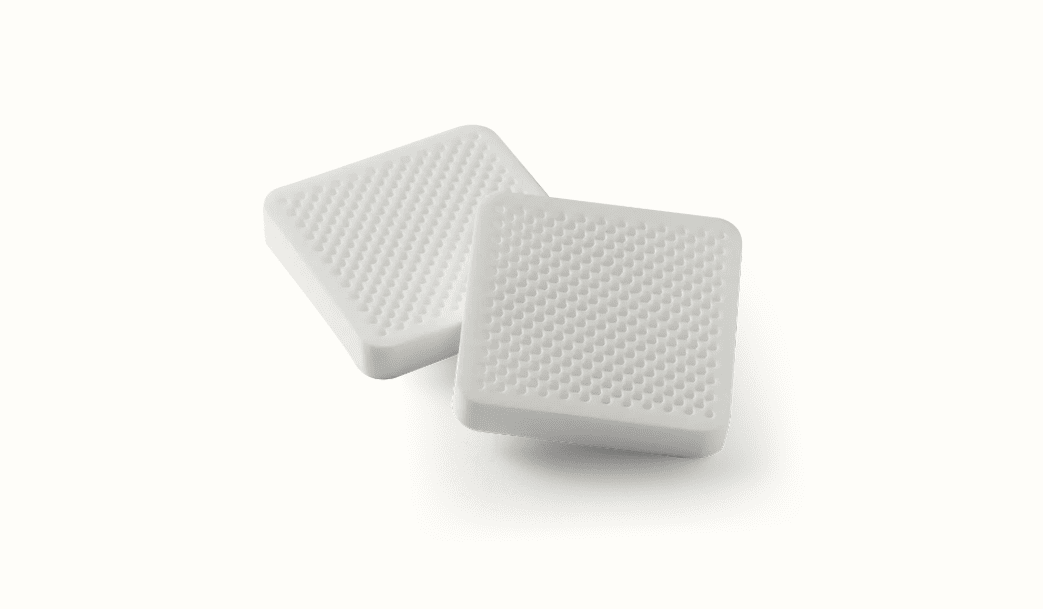
Image Source: Formlabs
Key Properties of 3D Printed Ceramic Resin
High Temperature Resistance
One of the biggest advantages of ceramic resin is its ability to withstand high temperatures after sintering. Compared with polymer-based 3D printing materials, ceramic parts maintain their performance in much hotter environments. Ceramic resin is suitable for applications involving thermal exposure, heat-resistant fixtures, laboratory components, and specialized industrial parts.
Excellent Hardness and Wear Resistance
Ceramics are known for their high hardness, and ceramic resin parts inherit these characteristics after the sintering process. They offer strong resistance against scratches, abrasion, and surface wear. For components exposed to friction or repeated contact, ceramic resin can provide longer service life compared with standard resin materials.
Chemical Resistance
Ceramic materials generally provide excellent resistance to many chemicals, solvents, and corrosive environments. This makes ceramic resin useful for applications where conventional polymer materials may degrade over time.
Electrical Insulation
Many ceramic materials have excellent electrical insulation properties. Ceramic resin parts can be used for electrical components, insulating fixtures, and applications requiring stable performance in high-voltage environments.
High Detail Resolution
Because ceramic resin is processed through SLA or DLP technologies, it can achieve highly detailed features and smooth surface finishes. This makes it possible to manufacture complex ceramic structures that are difficult to produce through traditional methods.
How Is Ceramic Resin 3D Printed?
Ceramic resin is mainly processed through vat photopolymerization technologies, especially SLA and DLP printing. During printing, a light source selectively cures the resin layer by layer. The ceramic particles remain evenly distributed throughout the printed structure, creating the initial green part. After printing, several important post-processing steps are required.
Cleaning and Drying
The printed part must be carefully cleaned to remove uncured resin. Proper drying is also important because remaining moisture or resin residue may affect later thermal processing.
Debinding
Debinding removes the polymer binder from the printed part. This process requires controlled heating because removing the binder too quickly may create internal stress, cracks, or deformation.
Sintering
Sintering is the final step that transforms the printed green part into a dense ceramic component. During this process, the ceramic particles bond together under high temperatures. However, sintering also causes dimensional shrinkage. Engineers need to consider shrinkage compensation during the design stage to achieve accurate final dimensions.
Pros and Cons of Ceramic Resin 3D Printing
Pros of Ceramic Resin 3D Printing
1. Complex Ceramic Geometries
Ceramic resin 3D printing enables the production of intricate designs, including internal channels, thin walls, and customized structures that are challenging with traditional ceramic manufacturing.
2. Reduced Tooling Requirements
Unlike conventional ceramic production methods that often require molds, 3D printing allows direct manufacturing from digital models. This reduces preparation time and makes customization easier.
3. Suitable for Small-Batch Production
Ceramic resin is ideal for prototypes, research projects, and low-volume production where traditional tooling costs may not be practical.
4. High-Performance Material Characteristics
After sintering, ceramic resin parts can provide excellent thermal stability, hardness, chemical resistance, and electrical insulation.
Cons of Ceramic Resin 3D Printing
1. Additional Post-Processing Is Required
Unlike standard resin printing, ceramic resin requires debinding and sintering before reaching its final properties. These additional steps increase manufacturing complexity.
2. Shrinkage During Sintering
The dimensional change during sintering can affect accuracy. Proper process control and design compensation are necessary.
3. Brittle Mechanical Behavior
Although ceramics are hard and wear-resistant, they are generally brittle. Ceramic resin parts are not suitable for applications requiring high impact resistance or flexibility.
4. Higher Manufacturing Cost
Ceramic resin materials, specialized equipment, and thermal processing requirements typically make ceramic printing more expensive than standard resin printing.
Applications of Ceramic Resin 3D Printing
Electronics and Electrical Components
Ceramic resin is commonly used for electrical insulation parts, ceramic housings, and high-temperature electronic fixtures due to its excellent dielectric properties and thermal stability.
Aerospace and Industrial Applications
Industries requiring lightweight, heat-resistant, and chemically stable components can benefit from ceramic resin 3D printing. Examples include specialized tooling, thermal management components, and experimental aerospace parts.
Medical and Dental Applications
Ceramic materials are widely used in medical fields because of their biocompatibility and chemical stability. Ceramic resin 3D printing supports the development of customized medical components, dental applications, and research prototypes.
Art and Decorative Products
The high resolution of SLA and DLP printing allows artists and designers to create detailed ceramic sculptures, customized products, and complex decorative objects.
Research and Development
Ceramic resin is valuable for laboratories and universities exploring new ceramic structures, material combinations, and advanced manufacturing methods.
Ceramic Resin vs Standard Resin
|
Feature |
Ceramic Resin |
Standard Resin |
|
Material Composition |
Photopolymer resin mixed with ceramic particles |
Pure photopolymer resin |
|
Final Material Properties |
Ceramic-like hardness, heat resistance, and chemical stability after sintering |
Polymer-based properties |
|
Printing Technology |
Mainly SLA and DLP |
SLA, DLP, and other resin printing technologies |
|
Post-Processing |
Requires cleaning, debinding, and sintering |
Requires cleaning and UV curing |
|
Temperature Resistance |
High after sintering |
Limited compared with ceramics |
|
Mechanical Behavior |
Hard and wear-resistant but brittle |
More flexible depending on resin type |
|
Surface Finish |
Smooth ceramic surface after processing |
Smooth polymer surface |
|
Best Applications |
Industrial ceramic parts, insulation components, research prototypes |
Visual prototypes, models, casting patterns |
Ceramic resin provides a unique solution for manufacturers who need the design freedom of 3D printing combined with the performance of ceramic materials. While it requires more processing steps than standard resin, its ability to produce complex, high-performance ceramic parts makes it valuable for specialized applications. For projects requiring heat resistance, chemical stability, electrical insulation, or advanced ceramic geometries, ceramic resin 3D printing can be an effective manufacturing option.
 0
0


COMMENTS
- Be the first to share your thoughts!