English
 日本語
 Deutsch


CNC machining is the process of removing material from a workpiece to produce a part of the required dimensions and geometry. The machine controls the movement; the tool does the cutting. The tool's shape, material and condition all have an effect on cutting efficiency and the accuracy of the features being produced.
Understanding cutting tools is more than just knowing what they're called. It's about understanding how the tool works with the workpiece, how the tool's characteristics facilitate the cutting action and why the tool design is so important to the quality of the machining. The article looks at the basics first before going on to look at the various tool types in turn.
What Are CNC Machining Cutting Tools?
CNC machining cutting tools are precision components used to remove unwanted material from a workpiece through controlled cutting action. They have one or more defined cutting edges that penetrate the material and separate it in the form of chips. Depending on the operation, a tool may rotate, follow a programmed path, or work against a rotating component.
A cutting tool is not the same as the CNC machine or tool holder. The machine provides controlled motion and power. The holder or spindle interface secures the tool and transfers force and torque. The cutting tool engages with the workpiece and removes material.
Tools are designed for different materials and machining conditions. A tool suitable for aluminum may not perform equally well on stainless steel or hardened steel because these materials differ in hardness, strength, thermal behavior, and chip formation. Selection depends on workpiece material, part geometry, required tolerance and surface finish, and production conditions.
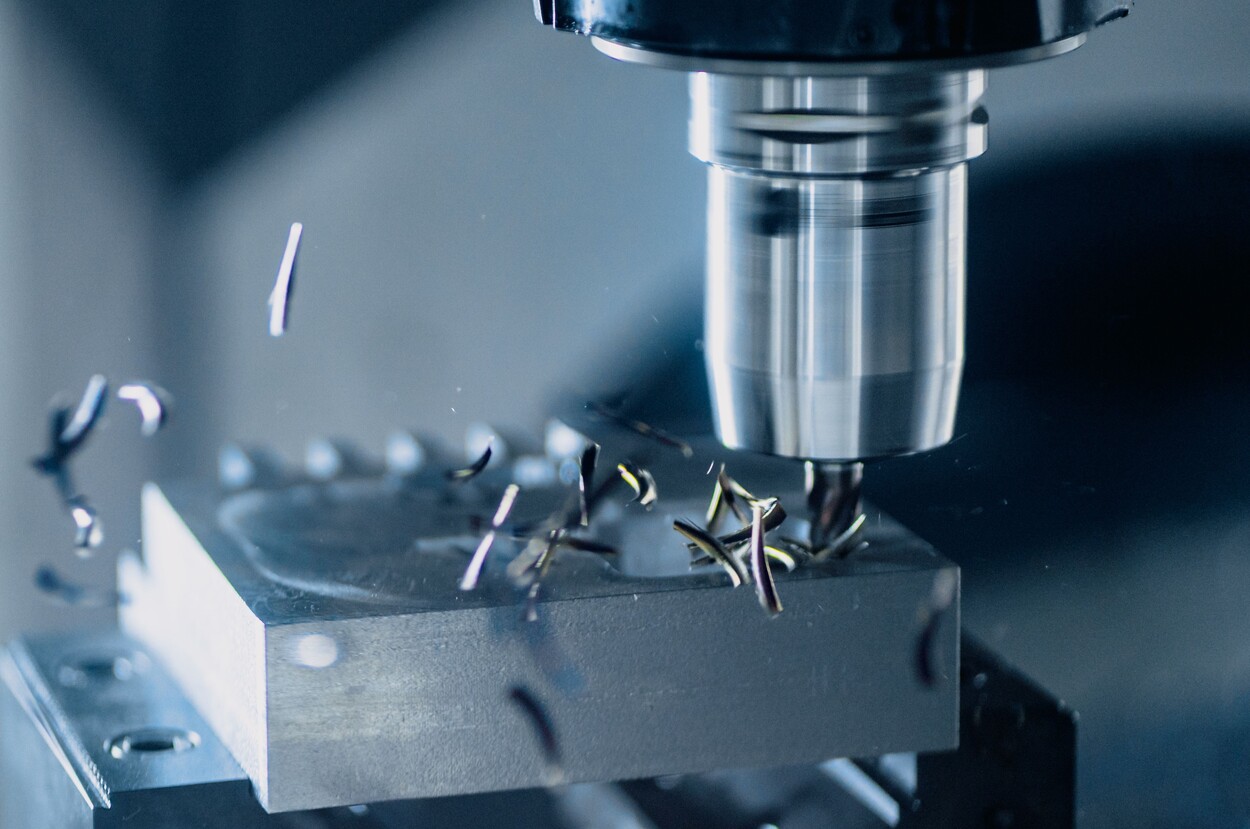
Image Source: Daniel Smyth
How Do Cutting Tools Work in CNC Machining?
Material removal relies on relative motion between the cutting edge and the workpiece. As the edge enters the material, it compresses and shears a small volume of material. This material undergoes plastic deformation and separates as a chip, exposing a newly machined surface.
The movement depends on the process. In milling, the cutter typically rotates while the workpiece or machine axes move along the programmed path. In turning, the workpiece rotates while a cutting tool advances along or across its surface. In drilling, a rotating tool generally feeds into the workpiece to produce a hole. Although the motion arrangements differ, all three processes rely on controlled relative movement between tool and workpiece.
Three basic parameters define the cutting action:
✅ Cutting speed is the speed of the cutting edge relative to the workpiece surface, commonly expressed in meters per minute.
✅ Feed rate describes how quickly the tool advances relative to the workpiece. It may be specified per tooth, per revolution, or per minute.
✅ Depth of cut describes how deeply the cutting edge engages the workpiece in a pass.
These parameters work together. Increasing speed or feed does not automatically improve productivity; the right combination depends on tool and workpiece materials, machine rigidity, tool geometry, and finish requirements. Poorly matched conditions can increase cutting forces, heat, vibration, and tool wear.
The chip must also move away from the cutting zone. Chip flow affects heat transfer, tool loading, and the risk of chips being trapped or recut. Tool geometry, coolant delivery, and machining strategy help manage chip evacuation.
Main Components of CNC Cutting Tools
Tool construction varies, but several features appear on many cutting tools.
• Cutting edge: The edge that engages the workpiece and separates material. Its sharpness, strength, and condition influence cutting performance.
• Rake face: The surface over which the chip flows. Its orientation affects chip flow and cutting forces.
• Flank: The surface behind the cutting edge that faces the newly machined workpiece surface. Clearance helps prevent excessive rubbing.
• Flutes: Grooves on many rotating tools. They provide space for chips to leave the cutting zone and contribute to the tool's geometry. Not every tool has flutes.
• Shank or mounting portion: The part secured in a holder or machine interface. It locates the tool and transmits motion and cutting loads.
• Tool body and cutting portion: The body supports the working features; the cutting portion contains the edges and geometry used for material removal. Some tools are made in one piece, while others use replaceable inserts mounted in a body.
The nose radius is another important feature on tools with a defined tip. It can influence edge strength, cutting forces, surface finish, and the shape of a machined corner.
Key Characteristics of CNC Cutting Tools
A cutting tool's performance is shaped by its material, geometry, coating, and construction.
Tool material determines properties such as hardness, toughness, wear resistance, and ability to retain hardness at high temperatures. High-speed steel (HSS) is relatively tough. Cemented carbide combines hardness and wear resistance with useful toughness, making it widely used in CNC machining. Ceramics suit selected high-temperature, high-speed applications but are more sensitive to impact. Cubic boron nitride (CBN) is used for certain hard machining applications, while polycrystalline diamond (PCD) is valued for many non-ferrous materials and abrasive composites. No single material is best for every workpiece or cutting condition.
Tool geometry includes rake angle, clearance angle, helix angle, cutting-edge angle, and edge radius. Rake geometry affects chip flow and cutting force. Clearance helps keep the flank from rubbing against the finished surface. Helix geometry influences chip flow and cutting smoothness in applicable rotating tools. Geometry must be balanced: a sharper edge may reduce cutting forces but be less robust, while a stronger edge can better withstand demanding cuts.
Tool coatings can improve wear resistance, reduce friction, or help a tool withstand heat, depending on the coating and application. Common families include titanium nitride (TiN), titanium aluminum nitride (TiAlN), and diamond-like carbon (DLC). A coating does not make every tool suitable for every material; compatibility with the workpiece and cutting conditions remains essential.
Tool construction matters as well. Solid tools have an integrated cutting body, while indexable designs use replaceable inserts. The choice depends on the operation, precision, accessibility, production volume, and tooling cost.
Why Cutting Tools Matter in CNC Machining
Cutting tools directly influence the accuracy, surface quality, efficiency, and consistency of CNC-machined parts. A suitable tool with appropriate geometry can maintain stable cutting conditions and produce features within the required tolerances. A poorly matched tool may generate excessive heat, vibration, burrs, or an unsatisfactory surface finish.
Tool condition is equally important. As an edge wears or becomes damaged, cutting forces can rise, and the machined surface or dimensions may become inconsistent. Monitoring tool condition and replacing tools at the right time helps reduce defects, unexpected tool failure, and unplanned downtime.
For manufacturers, tool selection is a process decision rather than a simple purchasing choice. The goal is to balance machining performance, part requirements, tool life, and total production cost. At 3DSPRO, CNC machining projects are evaluated according to material, geometry, dimensional requirements, and finishing needs so the machining approach can be matched to the part.
Understanding cutting tool structure and working principles provides a foundation for better machining decisions. The next step is to explore the specific tools used in CNC milling, turning, drilling, and other operations, and understand where each one is most effective.
 0


COMMENTS
- Be the first to share your thoughts!