 English
  日本語
日本語  Deutsch


Traditional mold manufacturing often requires expensive tooling, long lead times, and significant upfront investment. For companies developing new products or producing small batches, these challenges can slow down innovation and increase production costs. 3D printed molds provide an alternative solution to create molds faster and more economically.
With the ability to produce complex geometries, customized designs, and low-cost tooling, 3D printed molds are becoming increasingly popular in industries such as consumer products, automotive, aerospace, medical devices, and manufacturing. However, choosing the right 3D printing process and material is critical because mold performance depends on factors such as temperature resistance, mechanical strength, surface quality, and production requirements.
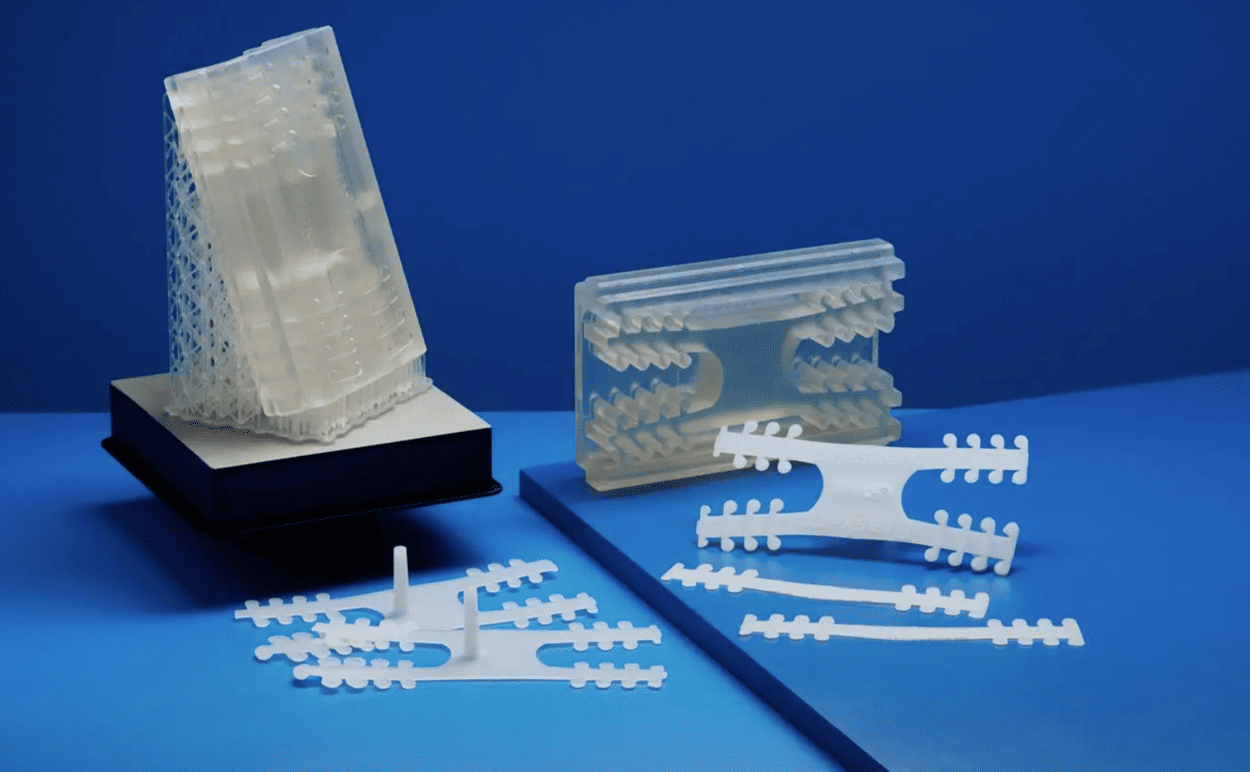
Image Source: Formlabs
What Are 3D Printed Molds?
3D printed molds are molds manufactured using additive manufacturing technologies instead of traditional machining methods. A digital CAD model is converted into a physical mold through layer-by-layer 3D printing.
Unlike conventional molds made from machined metal or injection molded tooling, 3D printed molds are typically used for rapid prototyping, low-volume production, design validation, and specialized manufacturing applications. They allow engineers to quickly modify mold designs, test different iterations, and reduce development cycles.
A 3D printed mold can be used for several molding processes, including:
• Injection molding: 3D printed molds can produce small quantities of plastic parts before investing in expensive steel or aluminum tooling.
• Vacuum casting: 3D printed master patterns are commonly used to create silicone molds for polyurethane casting.
• Compression molding: Printed molds can help produce composite parts, rubber components, and prototype products.
• Thermoforming: Heat-resistant printed molds can be used to shape plastic sheets into customized forms.
Compared with traditional mold manufacturing, 3D printed molds offer several advantages:
Faster Production
Traditional mold production may take weeks because it requires CNC machining, tooling adjustments, and surface finishing. 3D printing can create a functional mold within hours or days, allowing manufacturers to accelerate product development.
Lower Tooling Costs
For low-volume production, creating a metal mold may not be financially practical. 3D printed molds significantly reduce tooling costs because they require less material, fewer machining operations, and minimal setup.
Greater Design Flexibility
3D printing enables the production of complex mold geometries, including internal channels, customized textures, and optimized structures that are difficult or expensive to manufacture using conventional methods.
However, 3D printed molds also have limitations. Compared with metal molds, they generally have lower durability and temperature resistance. Therefore, they are usually selected for prototyping, short production runs, or applications with moderate molding requirements.
3D Printing Processes for Molds
SLA 3D Printing
Stereolithography (SLA) uses liquid resin cured by a laser to build parts layer by layer. SLA is one of the most common technologies for creating 3D printed molds because it provides excellent dimensional accuracy and smooth surface quality. SLA printed molds are especially suitable for vacuum casting patterns, prototype injection molds, detailed product prototypes, and small silicone molding applications. The smooth surface of SLA parts helps reduce post-processing requirements and improves the final surface quality of molded components.
SLS 3D Printing
Selective Laser Sintering (SLS) uses a laser to fuse powdered polymer materials, such as nylon, into solid parts. SLS molds provide better mechanical strength and durability compared with many resin-based molds. SLS is suitable for functional prototype molds, low-volume production tools, and complex mold geometries without support structures. Because SLS does not require support structures during printing, it can produce molds with complicated internal features more efficiently.
SLM 3D Printing
Selective Laser Melting (SLM) is a metal 3D printing technology that uses a high-power laser to fully melt and fuse metal powder layer by layer. Compared with polymer-based 3D printing processes, SLM produces molds with significantly higher strength, thermal resistance, and wear resistance. SLM 3D printed molds are suitable for applications where polymer molds cannot withstand operating conditions, especially in high-temperature manufacturing environments.
One major advantage of SLM is its ability to produce complex internal cooling channels. Traditional machining methods often struggle to create curved or optimized cooling structures, while SLM can manufacture conformal cooling channels directly inside the mold. These channels improve heat dissipation, shorten cycle times, and enhance part quality during injection molding.
Materials for 3D Printed Molds
Standard SLA or DLP resin is commonly used for prototype molds and master patterns. It provides excellent detail reproduction and smooth surfaces. Advantages include high dimensional accuracy, fine feature reproduction, and easy post-processing. However, standard resin has limited impact resistance and temperature resistance, making it unsuitable for demanding molding applications.
Tough resin is designed to provide improved impact resistance and durability compared with standard resin. It is suitable for molds that require repeated handling or moderate mechanical stress. Typical applications include prototype injection molding, functional testing, and low-volume manufacturing.
High-temperature resin is developed for applications involving elevated temperatures. It can withstand higher heat levels during molding processes compared with standard photopolymer resins. It is commonly used for heat-assisted forming, high-temperature prototypes, and short-run injection molding.
Nylon PA 12 produced through SLS provides excellent strength, toughness, and chemical resistance. It is a popular choice for functional molds requiring greater durability. Benefits include good mechanical performance, high impact resistance, and low moisture absorption. Nylon molds are often used for low-volume production and functional testing.
Tool Steel
Tool steel is widely used for industrial molds because of its high hardness, wear resistance, and ability to maintain mechanical properties at elevated temperatures. Advantages include excellent durability, high strength, and good resistance to deformation. Tool steel molds are suitable for injection molding, die casting, and other applications requiring long service life.
Stainless steel provides a balance between strength, corrosion resistance, and cost. It is often selected for molds used in demanding environments where exposure to moisture or chemicals is possible. Common applications include medical device molds, food-related tooling, and industrial components.
Aluminum alloys, such as AlSi10Mg and Aluminum 6061, are lightweight metals with excellent thermal conductivity. They allow molds to heat and cool faster, which can improve production efficiency. Benefits include reduced mold weight, faster thermal response, and easier handling. Aluminum alloy molds are often used for prototype injection molding and low-to-medium volume production.
Titanium alloys provide high strength-to-weight ratios and excellent corrosion resistance. Although less common for general mold applications due to higher material costs, titanium molds may be considered for specialized aerospace or high-performance applications.
Applications of 3D Printed Molds
3D printed molds are widely used across industries because they reduce tooling costs and shorten product development cycles.
Product Prototyping
One of the most common applications is creating prototype molds for product validation. Designers can test product appearance, assembly, and functionality before committing to expensive production tooling. For example, companies developing consumer products can use 3D printed injection molds to produce small batches for market testing.
Low-Volume Manufacturing
When production quantities are limited, traditional molds may not provide a good return on investment. 3D printed molds allow manufacturers to produce dozens or hundreds of parts without significant tooling expenses. It is useful for customized products, such as replacement parts, limited-edition products, and early production runs.
3D printed master models are widely used in vacuum casting to create silicone molds. These molds can produce multiple polyurethane parts with similar surface finishes and mechanical properties to final products. Applications include automotive prototypes, consumer electronics housings, and medical device prototypes.
How to Choose the Right Material for a 3D Printed Mold?
|
Mold Material |
3D Printing Process |
Key Advantages |
Suitable Applications |
|
Standard Resin |
SLA |
Excellent surface finish, high dimensional accuracy, low cost |
Visual prototypes, master patterns, low-stress molding |
|
Tough Resin |
SLA |
Better impact resistance and durability than standard resin |
Functional prototypes, small-batch molding, repeated testing |
|
High-Temperature Resin |
SLA |
Improved heat resistance for elevated-temperature applications |
Heat-forming tools, prototype injection molding |
|
Nylon PA12 |
SLS |
High strength, good toughness, chemical resistance |
Functional molds, low-volume production, durable prototypes |
|
Fiber-Reinforced Nylon |
SLS |
Increased stiffness and dimensional stability |
Structural molds requiring higher mechanical performance |
|
Aluminum Alloy (AlSi10Mg / 6061) |
SLM |
Lightweight, excellent thermal conductivity, good strength |
Prototype injection molds, molds requiring faster cooling |
|
Stainless Steel |
SLM |
High strength, corrosion resistance, long service life |
Industrial molds, demanding production environments |
|
Tool Steel |
SLM |
Excellent hardness, wear resistance, and temperature performance |
High-cycle injection molding and durable tooling |
 0
0


COMMENTS
- Be the first to share your thoughts!