 English
  日本語
日本語  Deutsch


POM, also known as Polyoxymethylene, acetal, or Delrin® (a popular brand name), is one of the most widely used engineering plastics in manufacturing. It offers an excellent combination of strength, stiffness, wear resistance, and low friction, making it ideal for precision mechanical components.
However, many engineers and product designers are surprised to discover that professional 3D printing services rarely offer POM. One of the most common questions customers ask is, "Can you 3D print POM?"
The short answer is yes, but it is far more difficult than printing most engineering plastics. In many cases, CNC machining produces better results at a comparable or even lower cost.
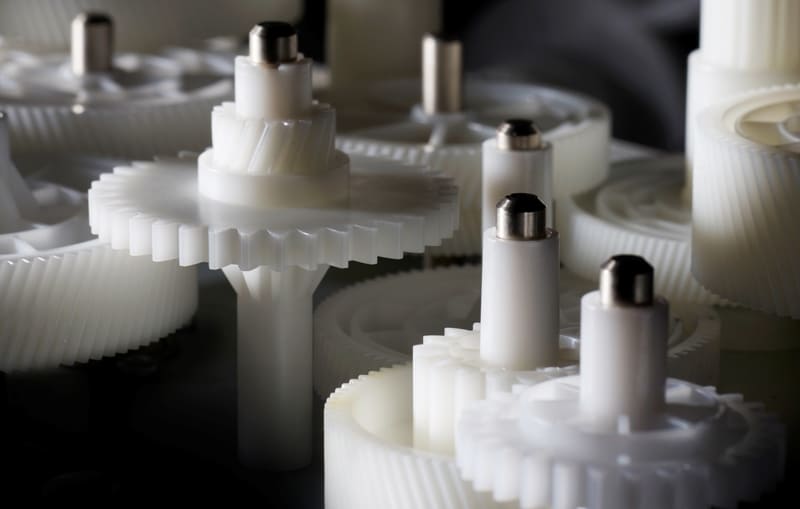
Image Source: Polyplastics
What Is POM Material?
Polyoxymethylene (POM) is a semi-crystalline thermoplastic known for its outstanding mechanical performance and dimensional stability. It is commonly used to replace metal in lightweight mechanical assemblies because it provides excellent rigidity while being much lighter than steel or aluminum.
POM is available in two primary forms, homopolymer POM and copolymer POM. Both types share similar mechanical properties, although copolymer POM generally offers slightly better chemical resistance and thermal stability.
Unlike many common plastics, POM has a naturally low coefficient of friction, which means components can slide against one another with minimal wear, often without requiring additional lubrication.
Because of these characteristics, POM has become a standard material in industries such as automotive, industrial automation, consumer electronics, medical devices, and food processing equipment.
Key Properties of 3D Printed POM
If POM could be printed as easily as PLA or PETG, it would be an outstanding engineering material. Its inherent properties remain highly attractive for functional parts.
High Strength and Stiffness
POM offers excellent tensile strength and rigidity, allowing it to withstand significant mechanical loads without excessive deformation.
Excellent Wear Resistance
Moving parts made from POM can operate for long periods with minimal surface wear. This makes it ideal for gears, bearings, bushings, and sliding components.
Low Friction
One of POM's greatest advantages is its self-lubricating surface. Components move smoothly with reduced friction, lowering maintenance requirements and improving service life.
Outstanding Dimensional Stability
POM maintains precise dimensions under varying humidity conditions because it absorbs very little moisture compared to materials such as nylon.
Good Chemical Resistance
POM performs well when exposed to oils, fuels, greases, solvents, and many industrial chemicals, making it suitable for demanding industrial environments.
Good Fatigue Resistance
Repeated loading and unloading cycles have little effect on properly designed POM parts, making them reliable for springs, clips, and mechanical mechanisms.
Why Is POM Difficult to 3D Print?
Although POM possesses excellent engineering properties, it is one of the most challenging thermoplastics to print successfully using FDM technology.
Severe Shrinkage
POM experiences significant shrinkage as it cools after extrusion. This shrinkage creates internal stresses that often lead to warping, corner lifting, or cracking during printing. The larger the part, the more pronounced these problems become.
Poor Bed Adhesion
POM's naturally low surface energy gives it excellent wear characteristics, but it also makes it difficult for the material to stick to the print bed. Even with specialized build plates or adhesives, maintaining reliable first-layer adhesion can be difficult.
Controlled Printing Environment Required
Successful POM printing typically requires a high-temperature nozzle, a heated print bed, an enclosed heated chamber, and careful control of cooling. These requirements exceed the capabilities of many desktop 3D printers.
Limited Material Availability
Compared with materials such as PLA, PETG, ABS, or nylon, relatively few filament manufacturers produce high-quality POM filament. As a result, fewer printing service providers offer POM as a standard material. Because of these challenges, many professional additive manufacturing companies recommend alternative materials unless POM's unique properties are necessary.
Common Applications of 3D Printed POM Parts
When successfully manufactured, POM parts excel in applications involving motion, wear, and mechanical precision.
Typical applications:
• Precision gears
• Bushings
• Bearings
• Rollers
• Conveyor components
• Mechanical linkages
• Sliding guides
• Electrical insulators
• Automotive interior mechanical parts
• Consumer products with moving mechanisms
However, many of these components require tight tolerances and excellent surface finishes. As a result, they are frequently manufactured using CNC machining rather than 3D printing.
For rapid prototyping, engineers often choose more printable materials that provide similar performance while reducing production risks.
Is CNC Machining a Better Choice for POM?
In most situations, the answer is yes.
POM is widely regarded as one of the best engineering plastics for CNC machining. It cuts cleanly, produces smooth surfaces, and maintains excellent dimensional accuracy throughout the machining process.
Compared with 3D printing, CNC machining offers several advantages for POM:
• Superior dimensional precision
• Better surface finish
• No concerns about warping or layer adhesion
• Consistent mechanical properties throughout the part
• Easier production of tight-tolerance components
For functional mechanical parts such as gears, bearings, precision fixtures, and automation components, CNC machining often provides both higher quality and greater reliability.
This is why many manufacturers recommend CNC machining whenever a design specifically calls for POM.
Alternatives to POM for 3D Printing
If your design requires additive manufacturing rather than machining, several engineering plastics can deliver comparable performance while being much easier to print.
Nylon (PA 12 or PA 11)
Nylon is often the closest substitute for POM in 3D printing. It offers excellent toughness, good wear resistance, and strong mechanical performance, making it suitable for gears, fixtures, and functional prototypes.
Glass- or Carbon-Fiber Reinforced Nylon
Fiber-reinforced nylon provides higher stiffness and improved dimensional stability compared with standard nylon, making it a strong choice for structural engineering parts.
Choose the Material Based on Performance, Not the Name
Rather than selecting POM simply because it is a well-known engineering plastic, consider the actual performance requirements of your application. In many cases, a more printable material can achieve similar functional results with lower cost, faster lead times, and fewer manufacturing risks.
At 3DSPRO, our engineering team evaluates each project based on part geometry, functional requirements, production quantity, tolerance, and budget. If POM is truly the best solution, CNC machining is often recommended. If 3D printing is more suitable, we can help identify the engineering plastic that delivers the right balance of performance, manufacturability, and cost.
 0
0


COMMENTS
- Be the first to share your thoughts!